WHY LUXURY BRANDS NEED SOCIAL MEDIA

Social media platforms are increasingly becoming a popular way to establish brand presence and two-way communication with clients. This asks for an effective social media management strategy. Social media management refers to the management of content which any business posts on their social media channels – whether images, short videos, blogs; along with communication management with the audience. For example, responding to customers’ comments.

Almost all brands have some kind of social media presence as it is a cost-effective marketing tactic and yields lots of benefits. While social media apps are considered “for everyone,” luxury brands give the exact opposite impression; they are exclusive. However, if you are a luxury brand, you should consider a social media management plan. Read on to learn more about how luxury brands can benefit from effective social media management.  

  1. Visual impact 

If you are a luxury brand, you already understand the impact of unique designs. Imagine high-quality images of your products on your social media channels that potential customers can see. 

According to research, our brains process visual content faster than text. As a luxury brand, you can benefit from posting stunning visuals of your product range on Instagram. Today, users have so much content to scroll through, and they usually do not spend more than a few seconds per post. In simpler words, if you want people to shop from you, you have to show them what they should be purchasing. Below are some tips on how you can create a visual impact:

  • Create a theme

Many social media accounts, especially Instagram, maintain a particular theme that makes their content coherent and aesthetically pleasing. You can do a theme per collection for a luxury brand- design your feed with prominent colors in the collection. 

  •  Switch up the visuals

If someone keeps posting the same kind of content, would you not get bored after a while? The same goes for your audience.  Do not just stick to pictures; shoot video content (short, engaging videos immediately catch the users’ attention), use infographics to lend an air of credibility to your brand, conduct story polls, and more. 

  • Pinterest boards 

Pinterest has always been famous for creating mood boards and collecting artistic photos. As a luxury brand, if you want to use visuals to attract new clientele, Pinterest will go a long way. A good example would be Chanel. If you search Chanel on Pinterest, lots of aesthetic content shows the brand’s core. As of 2013, Chanel was the most pinned brand on the app. 

2. Increase in potential and future customers

While mass-produced brands target a younger age demographic, luxury brands are particular about their target audience. According to a study conducted in 2019, the millennial generation (between the ages of 23-36) form the largest audience for luxury goods. This is one reason why, as a luxury brand, you may be hesitant to join the wave of social media. However, different platforms on social media can help you target millennials specifically. 

In addition, although a specific social media platform’s user base may be younger than your target audience, you could consider it as a platform. Think about it: what if gen Z users see your products and add them to their brands-I-want-to-shop-from when I get to an older list? Through social media, you would be creating future customers for your brand. While it may not be fruitful immediately, it can go a long way in increasing your customer base and, in turn, your profitability. 

3. Community management

An essential part of social media management is community management. It refers to the creation and maintenance of two-way communication with your customers as well as your employees. Or simply, community management is what makes your brand seem human. For your luxury brand, having a social media presence where you can engage in a conversation with your customers yield lots of benefits:

  • You can receive valuable feedback from users in real-time.
  • You can learn what kind of content users engage with more and use that type of content for your luxury brand.
  • Establish your brand presence online- be known for your products as well as your outstanding customer service.

4. Platform-specific content

There are many social media platforms; Instagram, Facebook, YouTube, Snapchat, Twitter & TikTok being the most popular ones. Each forum has a different user demographic, and one-size-fits-all content does not work across all platforms. For your brand, the first step you need to take is to decide which platform(s) is most relevant for you to showcase your luxury goods and reach out to your audience.

Having a social media management strategy helps a great deal in finding out what type of content will be most successful on each platform. A diversified content range will strengthen your brand awareness amongst a more extensive audience, e.g., video content does well on Facebook, and image content is most popular on Instagram. 

To Conclude

Social media management has become an essential part of marketing that holds lots of advantages for a business, in this context, a luxury brand. These advantages include increased user engagement, efficient customer service, new customers, and eventually, increased profitability. 

It is crucial to analyze your brand and the social media platforms you want to use to connect with users. Having multiple social media pages but average content does not do anything for your brand. Instead, carefully select the platforms which align with your brand personality. When done correctly, social media management will prove to be a useful tool for your luxury brand. We at Home of Performance offer Social Media Management services to brands where we manage your social media presence as well as provide guidance. We ensure an increase in your business efficiency. 


Got questions? Reach out to us.


New Google Lead Form Extension Convert Users Without Ad Clicks

Launching fresh out of its Beta Testing Phase is Google Ads newest feature and that too a really cool one indeed. Google Ads will now let its users fill up a lead form without leaving the SERP environment.

The Lead Form Extension feature, which was in the beta cycle since last year, debuts full-scale this month amid high expectations. Now users can fill up a form which pops up directly with a click on the heading of an ad in Google Search, Video, and Discovery Campaigns. This would mean better lead quality and higher conversion rates for advertisers promoting their products and services.

How does it work?

Conventionally, for lead capture, the user journey culminates on a landing page but now, when an advertiser opts in for a Lead Form Extension, the user can submit contact details by clicking on the Ad’s headline through a lead form that appears in the SERP itself. The lead form data can then be downloaded through a CSV file or synced to a CRM using a web-hook. After the form is completed, it is up to the user to visit the connected landing page or continue browsing Google Search.

What are its Benefits?

By providing an engagement interface within SERP, this new feature will help in generating more leads, increase lead quality and conversion rate along with improving ad engagement.

How to pull out the Data?

Advertisers can manually download the data collected over the past 30 days in a CSV file format directly from Google Ads. Alternatively, a web-hook can be used to push the collected data into the CRM.

Who is eligible to use it?

Google has specified the pre-requisites for advertisers who can use lead form extensions in their ads. They need to have –

  • a good history of policy compliance
  • a privacy policy to include in the lead form
  • a Google Ads account in an eligible vertical or sub-vertical. Sensitive verticals or sub-verticals are not eligible 

In addition, if lead form extensions are to be added to a Video or Discovery campaign, the Google Ads account should have a total spend of more than USD50,000 (or equivalent in non-USD currency). Read more on Google Ad Policies

What to be careful about?

When using this extension, it is highly important to analyse the user’s customer journey. This feature would work better for audiences that are far along in the funnel, in comparison to the ones at the awareness stage. The simple reason being higher clarity of thought and intent to purchase.


Got questions? Reach out to us.


The Takeover: Phrase Match absorbs Broad Match Modifier in the latest Google Update

Reducing clutter, getting rid of wasteful expenditure and reaching out to more refined audiences is every paid search manager’s modus operandi. Building on its goal to continually enhance relevant audience targeting through automation, smart bidding solutions and matching keywords to the meaning of a search, Google has surely reinforced their understanding of intent in order to make it easier for advertisers to reach target customers.

And, as 2021 is the unambiguously the year of new hope, where we make difficult things easy and complex things simpler, the search engine giant has followed suit through its latest update.

What is the new Google Update?

Last week Google announced that it will be phasing out its Broad Match Modifier (BMM) keyword match type permanently. This change will result in Phrase Match Type absorbing the search traffic generated by Broad Match Modifier, further fortifying its effectiveness.

How does that effect Paid Search?

Currently, advertisers reach out to their potential audience using the following keyword match types-

Broad Match – (max reach, min relevance)

Example: home of performance

Broad Match Modifier – (slightly lower reach, greater relevance)

Example: +home +of +performance

Phrase Match – (medium reach, medium relevance)

Example: “home of performance”

Exact Match – (min reach, max relevance)

Example: [home of performance]

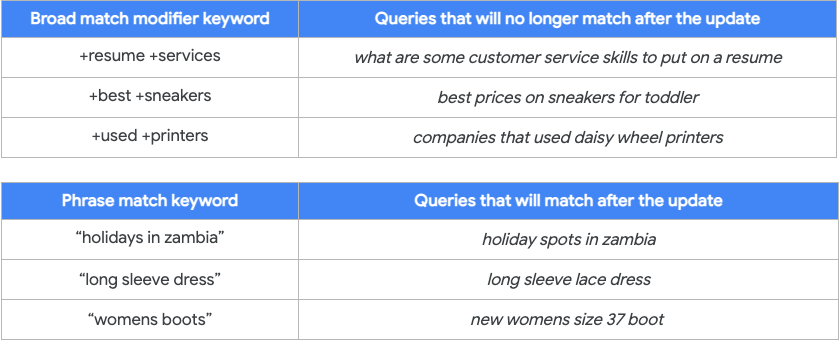
With this new update, Google is expanding the phrase match type to include additional broad match modifier traffic, effectively eliminating the broad match modifier category. The changes will take place in the next two weeks and from July 2021, creating broad match modifier match types will no longer be possible.

So, what’s in it for Paid Search Managers?

Well, for one, they will get the broad reach and refined relevancy in one single match type!! 

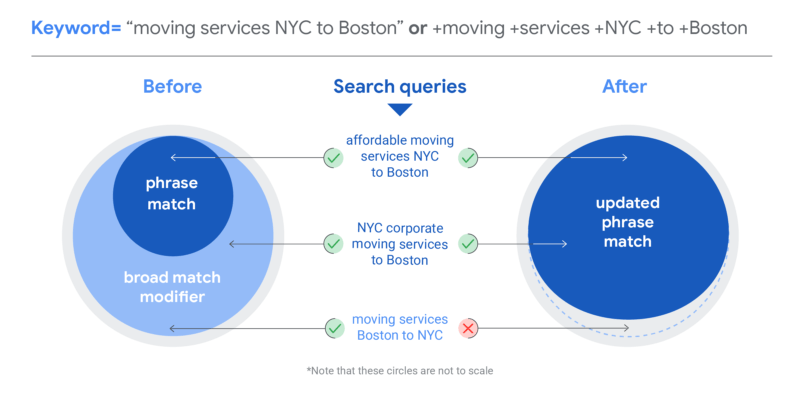
The update allows both phrase and broad match modifier keywords to have the same matching behavior, and trigger ads on searches that include the meaning of the target keyword, in addition to continuing to consider word order when relevant to the meaning.  So, not only will this change make it easier to reach relevant customers, it also will help in focusing on the searches you want and not fussing over unwanted search results that make you lose money. 

And, let’s admit, it will also save some good time spent in streamlining keywords to the often-similar BMM and Phrase match types.

How about an example?

The update uses the following example to showcase the change. Here’s how the keywords for “moving services NYC to Boston” (phrase match) or +moving +services +NYC +to +Boston (modified broad match) would be treated after the update is in effect:

Your Takeaways

  • Phrase Match searches will now include traffic sourced through a Broad Match Modifier Match type
  • The word order will continue to be in effect when it’s relevant to the meaning
  • The rollout will be globally complete by July 2021, after which advertisers will no longer be able to create new BMM match types. The existing ones will automatically adapt to the new behaviour
  • Since the update applies to both match types, there’s no need to migrate keywords and advertisers will get to keep their performance data
  • This change will have no impact on negative keyword match types and Quality Score


Got questions? Reach out to us.


SOCIAL MEDIA MANAGEMENT: IT’S SIGNIFICANCE IN TODAY’S WORLD

The power of social media; what is it? 

Remember when it was all about uploading quirky pictures and tagging memes? No more, friends. There is a whole sphere people know nothing about- the sphere where marketers design and promote businesses on social media platforms. 

Over the years, brands have taken notice of the growing popularity of social media and increasingly want to be part of the conversation across multiple social media platforms. So how can your brand go about establishing their social media presence where it matters the most?

Understanding popular social media platforms

Although there are plenty of platforms to choose from, some rule the world of social media because of the diverse options they offer to the users. Let’s take a look at these popular platforms.

Facebook: whoever says that Facebook is over, this is for you. With nearly 2.45b monthly active users, Facebook continues to dominate over other apps. However, the demographics of this platform have shifted recently. If you are a business looking to sell to boomers, Facebook is the right platform. In fact, nowadays users over the age of 65 years are increasingly growing!

Instagram: from pictures of your food to pictures of yourself, Instagram is as relevant today as any app could possibly be. Second position holder for the most downloaded app in the world, it comes toe to toe with Facebook for the popularity crown. 1 billion monthly users, Instagram’s largest user group consists of 18-24-year-olds. It is the best platform to reach out to millennials and offers brands multiple formats for content creation and promotion. 

YouTube: what do you do when you want to watch your favorite music video? Or, better yet, want to learn how to knit or fix a tyre or even make a salad? You guessed it: YouTube. The video-sharing platform has 1.9b users globally, more than 81% of the users are between 18 to 25 of age. 

Twitter: remember the times we tweeted to celebrities hoping for a response? Well, Twitter is much more than that. The platform hosts 330m monthly users with millennials forming the largest user group. Seen as more of a conversational app, it may not be in league with Instagram but Twitter has its own charms. It’s especially popular for brands with a strong personality or for customer relationship management.

Other apps: last but certainly not the least (just ask the teens of today), TikTok, Snapchat, and Pinterest make an entrance. 

How to choose the right platform?

Unless you have an unlimited marketing budget, every brand marketer must answer the biggest question: which one? 

You can’t be on every platform at once, you have to select the ones most relevant to your business. No need to feel overwhelmed, we are here for you! The formula is really simple. Do you know your business? Do you know your customers? That’s all you really need to know, to be honest. 

  • What is your brand’s personality? Yes, you read it correctly. Just like people, companies have personalities of their own. The personality of a brand is not only defined by the products or services it offers but also, by the brand image, values, and ethos. 
  • Simply: who buys from you? Who uses your products/services? Does your audience consist of Gen Zs? Millennials or boomers? Is your brand selling to consumers or to other businesses? Each social media channel has a specific demographic of users. Once you identify your customers, you can choose your platforms accordingly. 

How to develop an effective Social Media Strategy

If you’ve defined your objectives to be on social media, mapped out your target audience, and selected the social media platforms you want your brand to be on – you’re already half-way at creating your social media strategy. The next important thing is to create a content strategy and execution strategy. 

Unlike personal Instagram accounts, you can’t post memes on your business’ Instagram story at 2 in the morning unless you’re a nightclub! For your brand to have a successful social media presence, there needs to be a content strategy in place. To put it simply, it is a detailed plan of what to and what not to post. You don’t want your customers to go to your page to find some information and be greeted with selfies. Want to stay at the top of your social media game? Follow these three steps.

  • Create a social media content strategy with key content pillars and categories within each that are relevant to your brand, the region you sell in, and to your audience 
  • Next, design a social media calendar: just like we make a mental note of what to post today and tomorrow, you can take it one step further and make a content calendar. It’s how you’ll know what to upload and when. A visual reminder helps a lot! Why may you ask?

Having an up-to-date content calendar will help you stay on a schedule of your posts. It will quite literally save you from missing your posting date or having to post alternative (and possibly inappropriate) content at the last minute. 

Remember, always keep your calendar flexible to include last-minute updates like that award your team won!

  • Finally, Community (Not the TV show!) management: we’ve heard of social media management but what does this term really mean? It’s maintaining two-way communication with your audience. This way, your brand can get valuable feedback from your users which is, really, invaluable. There are many ways you can do this
  1. Post quizzes and hold polls on your Instagram stories! People scroll through stories and love to react to stories. For example, you could ask “do you love our color combination or want to see something new?” and let your audience guide you. 
  2. Ask a lot of fun and interesting questions in your posts – even if people don’t comment at first, eventually you’ll build traction. 

The power of social media has pulled the business world in and there is no going back. Just joining the social media apps isn’t enough- you need to plan and market your brand effectively. After all, your posts are what’s going to attract users to follow you.

We, at Home of Performance, are here to do all of this and more for you. HOP is a digital marketing agency offering a range of services, including social media management. We ensure that your business’ social media pages are informative, engaging, and designed to fit your objectives and goals. We do this through creative, out-of-the-box ideas that will elevate your brand to a whole new level. So what are you waiting for? Visit https://hop.rocks/ for more information.


Got questions? Reach out to us.