Beyond Vanity Metrics: Rethinking the Value of Likes, Shares, and Follower Counts

In social media marketing, it’s easy to succumb to the allure of numbers. Likes, shares, clicks, and follower counts often dominate, dictating strategies and defining success. Yet, behind the facade of these metrics lies a crucial distinction: the disparity between vanity metrics and those that truly propel growth.

Vanity metrics, captivating in their superficial appeal, often lead marketers astray, fostering a fixation on numbers that fail to translate into meaningful outcomes. Despite their allure, these metrics lack the substance needed to drive genuine progress and align with business objectives.

In this blog, we’ll explore the concept of vanity metrics, unravelling why they captivate many yet frustrate data analysts. We’ll delve into distinguishing between vanity metrics and those of genuine value, equipping you with the insight needed to navigate the complexities of modern marketing.

The Illusion of Success: Understanding Vanity Metrics

Vanity metrics often cast a deceptive shadow over true success. Likes, shares, and follower counts, possess a surface appeal, seemingly indicating progress and popularity. However, beneath this veneer lies a significant discrepancy between appearance and substance.

Consider the case of a burgeoning e-commerce startup celebrating a surge in Instagram followers. While the spike may elicit feelings of triumph, closer scrutiny reveals a majority of these followers to be bots or inactive accounts, offering little in terms of genuine engagement or conversion potential. Similarly, a viral social media post garnering thousands of shares may generate fleeting excitement for a brand, yet fail to translate into tangible business outcomes or sustained customer loyalty.

The psychological impact of vanity metrics on businesses is profound. They often foster a false sense of accomplishment, leading organisations to prioritise metrics that offer little insight into actual performance. This fixation on superficial indicators can divert resources and attention away from strategies that truly drive growth and value.

Limitations of Vanity Metrics

Before exploring the nuanced limitations of vanity metrics, it’s crucial to recognise their inherent challenges that extend beyond mere numerical representation. From the lack of contextual depth to the susceptibility of manipulation, understanding these limitations sheds light on measuring success and KPIs. 

  • Lack of Context: Understanding the Quality vs. Quantity Debate

Vanity metrics often prioritise quantity over quality, painting an incomplete picture of engagement and impact. While high numbers may seem impressive, they fail to account for factors such as audience demographics, content relevance, and genuine interest. This leaves businesses with a skewed perception of success.

  • Inflation and Manipulation: Buying Followers and Engagement

The ease with which followers and engagement metrics can be inflated through purchasing services undermines their credibility as indicators of genuine interest or brand loyalty. Such manipulation distorts perceptions of reach and influence, eroding trust and distorting strategic decision-making within organisations.

  • Discrepancies Across Platforms: Different Metrics, Different Meanings

Each social media platform employs its own set of metrics, leading to inconsistencies in measurement and interpretation across channels. What may constitute success on one platform may not necessarily translate to another, complicating efforts to benchmark performance.

Rethinking Success Metrics

As businesses strive to navigate the evolving landscape of digital marketing, rethinking success metrics becomes imperative for sustainable growth and impact. Rather than fixating solely on superficial indicators, a shift towards more meaningful metrics is necessary to accurately gauge engagement and foster brand loyalty.

  • Shifting Focus: From Quantity to Quality of Engagement

In an era dominated by vanity metrics, there’s a growing recognition of the need to prioritise the quality of engagement over sheer quantity. This entails fostering meaningful interactions with target audiences, focusing on content relevance, and nurturing genuine connections that drive long-term value.

  • Identifying Meaningful Metrics: Conversion Rates, Customer Retention, and Brand Loyalty

Meaningful metrics such as conversion rates, customer retention, and brand loyalty offer deeper insights into the effectiveness of marketing strategies and the overall health of a business. By shifting attention towards these indicators, organisations can better understand consumer behaviour, optimise campaigns, and foster sustainable growth over time.

  • Balancing Quantitative and Qualitative Data: The Importance of Context

Achieving a comprehensive understanding of success metrics requires striking a balance between quantitative data and qualitative insights. While quantitative metrics offer numerical benchmarks, qualitative data provides context, shedding light on the why behind the numbers and enabling more informed decision-making.

Strategies for Moving Beyond Vanity Metrics
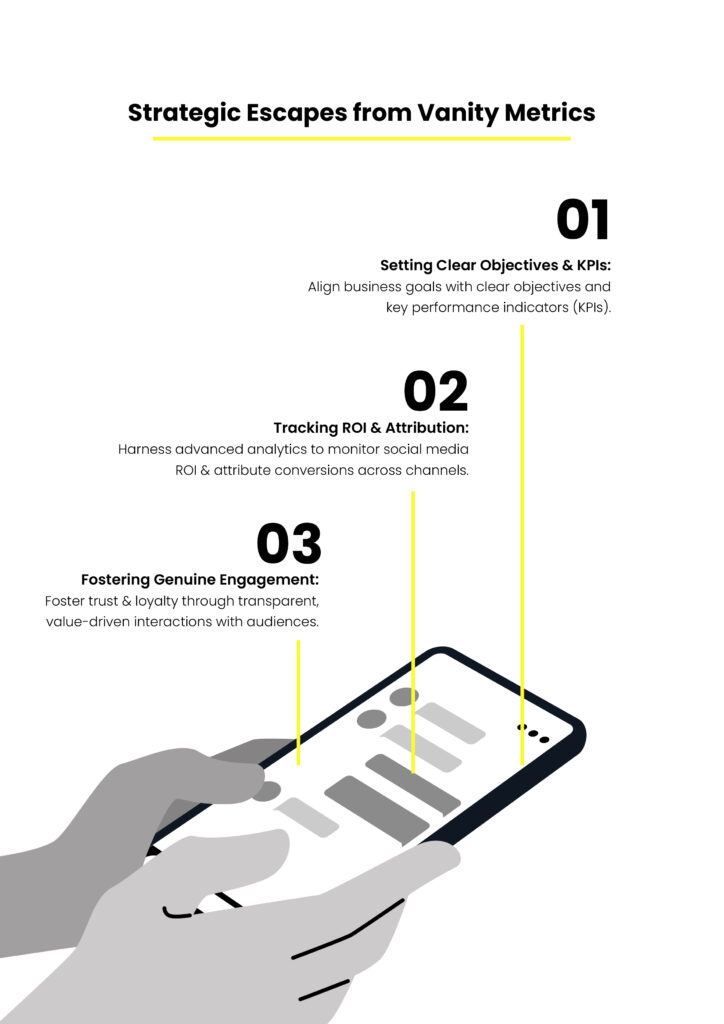
Moving beyond the allure of superficial indicators requires a strategic approach centred on setting clear objectives, leveraging advanced analytics tools, and prioritising authentic engagement.

  • Setting Clear Objectives and Key Performance Indicators (KPIs)

Establishing clear objectives and key performance indicators (KPIs) provides a guideline for measuring success in alignment with overarching business goals. By defining specific metrics that reflect desired outcomes, organisations can focus their efforts on activities that drive tangible results and meaningful impact.

  • Utilising Advanced Analytics Tools: Tracking ROI and Attribution

Advanced analytics tools offer invaluable insights into the effectiveness of marketing efforts, enabling businesses to track social media ROI and attribute conversions across channels. By harnessing the power of data-driven analytics, organisations can optimise resource allocation, refine targeting strategies, and maximise the efficiency of their marketing campaigns.

  • Fostering Genuine Engagement: Building Authentic Relationships with Audiences

Meaningful measurement touches base with the cultivation of genuine engagement and authentic relationships with audiences. By prioritising transparency, responsiveness, and value-driven interactions, businesses can foster trust, loyalty, and advocacy among their customer base.

By recognising the limitations of vanity metrics, we can begin to shift our focus towards more meaningful measurement strategies where excessively anal socials are no longer the score. Setting clear objectives, leveraging advanced analytics tools, and fostering genuine engagement with our audiences are essential steps in this journey. It’s time to move beyond the numbers game and embrace a holistic approach to social media marketing evaluation—one that prioritises quality over quantity and aligns with overarching business goals.

5 Best FREE AI Marketing Tools to Help you with Digital Marketing

The advent of AI software has brought a profound transformation to the field of marketing. Numerous businesses, regardless of their size, are increasingly dependent on AI based marketing tools to promote their brands and enhance their marketing strategies. These tools have become essential components of business plans for both individuals and organizations, offering the potential to elevate marketing efforts to new heights.

AI marketing tools encompass software and platforms that leverage data collection and analysis to generate automated decisions. They excel in predicting consumer behavior, often without requiring human intervention. By efficiently processing vast amounts of information from diverse sources like social media and email, AI augments the pivotal role of data in marketing. Moreover, these digital marketing AI tools enable organizations to allocate resources wisely by reducing the need for dedicated staff in such tasks, freeing up valuable time and capital to be utilized in other critical areas of the business.

AI marketing tools have the capability to personalize sales and marketing strategies, enhancing their effectiveness and relevance. Leveraging predictive analytics, these tools delve into profound insights regarding consumer purchasing patterns. Similar to how Google and Netflix excel at providing personalized recommendations, AI marketing tools enable businesses to tailor their approaches to individual customers, enhancing engagement and conversion rates.

Considering the abundance of impressive options available, it is worth exploring the five most notable AI marketing tools in the market that you can leverage for your Digital Marketing.

01.ChatGPT

ChatGPT, developed by OpenAI, is a versatile language model designed for various language-related tasks such as text generation, answering frequently asked questions (FAQs), and facilitating conversations. With its advanced natural language processing capabilities, ChatGPT has gained significant attention in the industry.

Features & Benefits of ChatGPT:

  • Natural Language Processing: ChatGPT exhibits highly advanced natural language processing skills, outperforming many other similar tools in the market.
  • Versatility: It can be used for content creation as well as customer service, offering flexibility in its applications.
  • Time-Saving: By automating language-related tasks, ChatGPT can help save time and streamline workflows.

Example of Uses:

  • ChatGPT excels in content creation by generating initial drafts for articles, blog posts, and social media content. It can also assist in customer service by providing real-time, accurate responses to common inquiries.


02. Beacons

Beacons is a platform specifically designed for content creators, offering a centralized solution to streamline their business operations. While known for its impressive link-in-bio functionality, Beacons goes beyond being just a link-in-bio app. It also includes an AI Brand Outreach app that leverages artificial intelligence for email marketing purposes.

Features & Benefits of Beacons:

  • Link-in-Bio Functionality: Beacons provides content creators with a single platform to showcase their offerings and relevant links, making it easy for their audience to access desired content or products.
  • AI Brand Outreach: The AI Brand Outreach app within Beacons enables creators to leverage AI for email marketing. It automates the creation of personalized emails by combining recipient information and user-specific details, resulting in professional emails tailored to the right tone and pitch.
  • Personalized Emails: With Beacons’ AI-driven email marketing, content creators can send personalized emails that have a higher likelihood of converting, enhancing their engagement and conversion rates.
  • Custom Domain and Digital Storefront: Beacons offers features such as custom domains and digital storefronts, allowing creators to have their own branded online presence and sell products or accept donations.
  • Analytics and Integration: The tool provides advanced analytics to track performance and integrates with marketing tools, email/SMS platforms via Zapier, and other marketing integrations to streamline workflows.

Beacons’ Example of Uses:

  • Beacons consolidate important links in one place for easy audience navigation. With AI-powered email marketing, creators can automate personalized campaigns.


03.Google Bard

Google Bard is an AI-powered conversational bot developed by Google. It is based on the Large language model (LLM) called LaMDA (Language Model for Dialogue Applications) and aims to provide natural language queries and comprehensive search results. Bard can generate human-like text and images, respond to prompts and queries, and create stories and summaries on various topics. It can be integrated into third-party platforms such as websites, applications, and messaging platforms.

Features & Benefits of Google Bard:

  • Cutting-Edge Model: Google Bard is built on the PaLM2 model, which offers advanced multilingual abilities (over 100 languages) and reasoning skills.
  • Conversational Responses: Bard provides human-like responses to prompts and queries, enhancing the conversational experience.
  • Generative Potentials: Bard can generate text in different formats and styles, including news articles, letters, blog posts, and code in various programming languages.
  • Real-time Information and Internet Access: Bard extracts information from the web using Google search, providing up-to-date and relevant responses to prompts.
  • Extensions Through Plugins: Users can extend Bard’s functionality through plugins, enabling integration with various apps and sites.
  • Voice Command Compatibility: Bard supports voice commands, allowing users to interact with the tool using voice input.

Example of Uses:

  • Google Bard helps content creators generate articles and blog posts, aids in real-time information retrieval, enables multilingual communication, and offers integration with third-party platforms for conversational interactions, recommendations, and image generation.


04.Chatsonic

Chatsonic is an advanced AI-powered conversational chatbot that offers superpowers beyond ChatGPT. It is built on the latest GPT-4 model and utilizes Natural Language Processing (NLP) and Machine Learning (ML) technology to automate text and image generation. With its wide range of capabilities, Chatsonic is designed to provide quick and accurate results, making it an exceptional tool for content creation and customer service operations.

Features & Benefits of Chatsonic:

  • Quick and Accurate Results: With integrated Google search, Chatsonic delivers relevant and up-to-date information promptly, saving time and effort.
  • Customizable and Easy-to-Use: Users can easily customize their requests and preferences, such as personality types and memory settings, without requiring technical expertise.
  • High-Quality Content: Chatsonic produces original and detailed content, free of plagiarism, with the ability to detect and correct grammar or spelling errors.
  • Automation Capabilities: Chatsonic streamlines workflows by automating text and image generation tasks, saving time and energy.

Example of Uses:

  • Chatsonic is well-suited for customer service operations. It also assists in content creation, research efficiency by retrieving accurate information from multiple sources and streamlining workflows.

05. Jasper AI

Jasper AI is an advanced and versatile artificial intelligence tool designed to assist individuals and businesses across various domains. Developed using machine learning and natural language processing technologies, Jasper AI is geared towards enhancing productivity, decision-making processes, and overall efficiency. The tool is designed to analyze and process complex data sets, generate insights, provide recommendations, and automate tasks, all while offering a user-friendly interface for seamless interaction.

Features & Benefits of Jasper AI:

  • Advanced Data Analysis: Jasper AI excels in analyzing large and intricate datasets, uncovering patterns, trends, and correlations that might be challenging for human analysts to identify.
  • Real-time Insights: The tool can provide real-time insights into ongoing processes, allowing users to make informed decisions promptly.
  • Personalized Recommendations: Jasper AI can offer tailored recommendations based on historical data, user preferences, and current trends, assisting businesses in optimizing their strategies.
  • Automation of Repetitive Tasks: The tool can automate routine and repetitive tasks, freeing up human resources for more creative and strategic endeavors.
  • Natural Language Interaction: Jasper AI employs natural language processing, enabling users to communicate with the tool through natural language queries and commands, making it accessible to non-technical users.
  • Scalability: The tool’s architecture is designed to handle scalability, making it suitable for both small businesses and large enterprises.
  • Risk Management: Jasper AI can assist in identifying potential risks by analyzing historical data and recognizing patterns that might indicate impending issues.


Tips & Choosing the Best AI Tool

Choosing the best free AI marketing tool can bring numerous benefits to your business. Here are a few tips to go about this:

  • Define Your Needs: Determine your specific requirements and goals before selecting an AI tool. Identify tasks for automation or improvement, like content creation, data analysis, customer support, or marketing.
  • Research and Compare: Conduct thorough research on available AI tools in the market. Compare features and customer reviews to find reputable AI tools for digital marketing that align with your needs.
  • Ease of Use and User Interface: Evaluate the user interface and ease of use of the AI tool. Look for a user-friendly interface with intuitive navigation to enhance productivity.
  • Training and Support: Assess the training and support provided by the AI tool vendor. Check for tutorials, documentation, and reliable customer support to maximize the tool’s potential.
  • Reviews and Recommendations: Seek feedback from trusted sources like industry experts or colleagues who have used similar AI tools. Consider their experiences and recommendations to make an informed decision.


Conclusion

The availability of free AI marketing tools has opened up incredible opportunities for digital marketers. These tools offer a wide range of benefits, from automating tasks to improving decision-making and enhancing customer experiences. The power of AI is no longer limited to large companies with substantial budgets. Even the smallest startups can now leverage these free AI tools to compete on a global stage and achieve remarkable success.

As we continue to embrace the AI technology revolution, let us appreciate the immense value these free AI marketing tools bring to the world of digital marketing. They empower marketers to reach new heights, unlock untapped potential, and transform the way we connect with our audiences. Embrace the power of AI in digital marketing, explore the capabilities of these tools, and embark on a journey of innovation and growth.  

The future is bright, and with these free AI marketing tools at our disposal, we have the power to reshape the marketing landscape and achieve remarkable results.


Got questions? Reach out to us

Cryptocurrency And Its Endless Possibilities

Whether represented by a cowrie shell, leather, a metal coin, a piece of paper, or a string of code electronically mined by a computer, money has always had three functions. According to a podcast by the Federal Reserve Bank of St. Louis, it serves as a store of value, a unit of account, and a medium of exchange.

Until the emergence of mobile phones and online banking, when it became possible to do business without needing to move actual money around, the most acceptable forms of currency have been the dirham, dollar, pound, and other fiat (authorised) currencies. But the world never ceased dreaming of newer possibilities, and we have woken to the reality of an entirely new type of currency – cryptocurrency.

What Is Cryptocurrency?

Cryptocurrency is a virtual currency that is exchanged using designated software, applications, and networks. The term crypto is derived from the English word ‘encrypt’, which means to code. The foundation of bitcoin is sophisticated coding that stores and transmits data between wallets and public ledgers.

Fiat currencies are government-issued currencies with sovereign backing; cryptocurrencies, on the other hand, are decentralised digital funds or assets held together by blockchain technology. The blockchain is a distributed public ledger that records transactions in blocks (code). A single transaction is represented by a block, and each new block is linked to the preceding one as new transactions occur. The blockchain (ledger) is updated every time a new transaction occurs by debiting one account and crediting the other. Mining for cryptocurrency is the process of creating new digital “coins.”

Today, there are numerous cryptocurrencies. Bitcoin (BTC), Ethereum (ETH), Cardano (ADA), Ripple (XRP), Binance coin (BNB), Dogecoin (DOGE), Litecoin (LTC), and Polkadot (DOT) are a few notable ones that all run on their own blockchain.

Use Cases Of Cryptocurrency

A currency is only as valuable as what people claim it can do for them, which determines its demand and supply. Blockchain technology and cryptocurrencies have the ability to alter the way people engage, communicate, work, and play, and the possibilities are limitless.

  • Payments

If you need to transmit $1,000 to someone in another country right away, using a banking system would be a nightmare. After all, urgent situations cannot afford to wait three to seven days for a payment to be processed. With cryptocurrencies such as Bitcoin (BTC), Ether (ETH), or XRP, transfers will reach the receiver’s account almost instantaneously. 

  • Store of value

Cryptocurrencies are not only a highly efficient mode of payment, but they are also a more secure store of value. 

Traditional currencies are inflammatory, which means they lose value over time. Cryptocurrencies, on the other hand, use better supply systems that limit inflation and may increase in value as demand increases. As a result, when you hold your funds in cryptocurrencies, they may grow value rather than lose value over time.

  • Borrowing and lending

What if you could acquire a loan without filling out a single form or signing a contract? Decentralised financial applications have removed the middleman from the lending and borrowing process. They enable people to lend and borrow money almost immediately utilising cryptocurrency. Furthermore, because cryptocurrencies are global currencies, you can lend or borrow from these platforms no matter where you live.

  • Tokenization of assets

With the emergence of cryptocurrencies, it is now possible to tokenize physical assets. Copyrights, real estate, art, and commodities can all be tokenized and represented in the form of a cryptocurrency token. This adds liquidity to an otherwise illiquid asset and facilitates the interchange of even non-liquid assets. In addition, buying and selling these assets becomes more cost-effective, quick, and transparent.

  • Gaming

With the dawn of Web3 and the metaverse, the gaming industry has already been disrupted by cryptocurrency in the form of non-fungible tokens (NFTs). NFTs are crypto tokens in the gaming sector that represent a unique digital asset within a game. Because each NFT represents something distinct, their values differ and they are not interchangeable. This provides each user with a truly real in-game item that no one else owns. The most well-known example of blockchain-based NFTs is Crypto Kitties, which are digital cats.

  • Storage

The centralised cloud storage platforms have numerous significant flaws, ranging from excessive prices to server outages. This has paved the way for decentralised storage enabled by blockchain technology. 

Risks And Returns Involved

Volatility: Cryptocurrencies are extremely volatile, with price fluctuations occurring at an alarming rate as a result of unforeseen shifts in market sentiment. Your $5,000 in Bitcoin now, for example, could be worth $50 in a few months. On a good day, your $5000 may be worth $50,000. The cryptocurrency market moves in a continual cycle of highs and lows.

Unregulated: Because cryptocurrencies are not currently regulated by the government or financial institutions, they are unaffected by the inflation rate, monetary policies, and other economic growth factors used to measure fiat currencies. Instead, the price of cryptocurrencies is impacted by the coin’s supply and demand, the cost of mining, the number of competing cryptocurrencies, the regulation governing its usage and sale, news developments, and the state of its internal governance.

Susceptible to theft, fraud, and other misfortunes: A cryptocurrency exchange can be hacked, and funds from user wallets can be taken. Users may also lose money if they deal with scammers, particularly on untrustworthy sites, or if they move coins to the wrong wallet address, as this is an irreversible operation. If you forget your wallet’s passcode, it may be compromised.

Can be discontinued: A cryptocurrency project may fail for a number of reasons, and individuals who invested in the coin will have to bear their own losses.

Returns: The blockchain technology that cryptocurrencies are based on has the potential to transform the way businesses are conducted in various industries. Thus, crypto aficionados who trust in the future of this technology and invest in it stand to profit handsomely if the projects succeed.

The Future Of Cryptocurrency

We can speculate about the value of cryptocurrencies for investors in the future months and years (and many will), but the reality is that it is still a new and speculative investment with little history on which to build forecasts. 

Cryptocurrencies may find their way into consumer digital wallets on a massive scale when government organisations work out a legal framework and taxation structure. Despite the fact that Bitcoin became legal cash in El Salvador in 2021 and the Central African Republic in 2022, the remainder of the world is unlikely to follow suit anytime soon.

Nobody knows what the future of cryptocurrency is like, no matter what an expert thinks or says. That is why it is critical to only invest what you are willing to lose and to stick to more traditional assets for long-term wealth building. Keep your investments minimal, and avoid prioritising crypto investments over other financial goals such as retirement savings and debt repayment.


Got questions? Reach out to us.


How Segmenting Your Customers Can Increase Content Marketing Reach

You may have decided to jumpstart your content marketing with a blog that’s highly relevant to your business because you read online that businesses with blogs get 67% more leads than other companies. However, regardless of this thinkpiece being the most helpful content you have ever published, it’s drowning in a sea of content noise.

At the core of every effective content marketing strategy is getting the right content across to the right buyer. You might have a general understanding of who your customers are, but not a full understanding of what distinguishes them from one another, and that is why it’s vital that you research your audience before you start creating high-quality, relevant content.  When you understand your customers and what is important to them, the content you create will increase conversion rates.

Organizing your customers into distinct segments allows you to target your content more efficiently and successfully. You will not waste time or effort on generalized content, and you will be able to promote that content to ensure it reaches as many viewers as possible from your target group.

Read on to find out how you can segment your target audience to maximise your content reach, optimising your content marketing ROI.

What Is Customer Segmentation?

In order to attract leads that convert, you must target a small group of clients who are most similar to your best current customers, rather than a vast universe of possible customers.  Customer segmentation is the separation of potential customers into different categories in a given market based on shared traits. This provides you with an easy way to organise and manage your company’s relationships with its customers while tailoring and personalising your marketing, service, and sales efforts to the needs of specific groups. As a result, this improves customer loyalty, reach and conversion rates.

Types Of Customer Segmentation

Content reach is a crucial facet of a company’s online presence and represents chances for businesses to communicate with their customers. These popular models and types of segmentation will help you to divide your clients into groups based on common characteristics.

  1. Demographic Segmentation

Demographic segmentation divides a targeted audience according to variables like age, gender, income, education level, family size, ethnicity, and others. Since most products cater to specific individual requirements related to at least one demographic element, this is the most widely used form of segmentation used in content marketing.

  1. Geographic Segmentation

This type of segmentation divides target users into groups based on predefined geographic boundaries. A market can be defined by its location, such as a town, county, or country. You can also categorise them based on their climate or population density. It is simple but effective because knowing where your customers live allows you to better comprehend their needs and target them with location-based ads. 

  1. Technographic Segmentation

Customers are classified based on their ownership, usage, and attitudes toward information and communication technologies. These technologies are a defining force and a central focus in a wide range of occupations and lifestyles. This data also assists content marketers in determining the most effective channels for reaching out to their customers.

  1. Behavioural Segmentation

Behavioural segmentation focuses on the customers’ specific reactions and how they proceed with their purchasing processes. It captures challenges such as their attitudes toward a brand, how they interact with it, and how knowledgeable they are about industry issues. This information is essential because it relates to how customers interact with your content. When you know their behaviour, you can market your products and services more effectively.

  1. Needs-Based Segmentation

This model uses consumers’ validated reasons for purchasing a specific product to segment the market. Market research is used to identify and validate customer needs and marketers can use this information to generate leads through their content.

  1. Psychological Segmentation

This segmentation is concerned with the intrinsic characteristics of your target market. Customers are classified according to their values, interests, personality traits, attitude, and ways of life. At this level, use focus groups, surveys, interviews, and audience testing to better understand your audience.

  1. Value-Based Segmentation

This model classifies consumers according to their monetary worth. Consumers who have similar values in the same segment think alike, making it simple to target and market to them.

Creating Targeted Content

To be successful, any piece of content must be tailored and speak to a specific person (a potential customer) with a specific need at a certain moment in their buyer journey. In other words, you must have tailored content that shows a thorough awareness of who your audience is and where they are on the route to purchase.

You might consider starting with your content, such as conducting a content audit of what you already have and everything your competitors have. This is crucial, but it comes later.

You should actually begin with these two critical steps:

  • Learn about your target audience.
  • Recognize your own limitations as a marketer.

These two stages must be completed prior to conducting any audit of your own or rival content.

Know your audience

Many brands believe they know who their target audience is. However, they frequently get stuck thinking about who they want their audience to be. Customers aren’t looking for a definition of something 9 times out of 10. They want a solid comprehension of a topic or a solution to a problem. Your content should not only target a certain audience, but also a specific problem that they need to solve.

Although collecting demographic information is part of knowing your audience, learning their pain points and their thoughts is far more beneficial to a marketer looking to earn and keep customers. 

What are your marketing growth constraints?

You will be able to plan content at different stages of the product funnel, but first, you must consider what growth constraints your company has and where they sit in the funnel. Since raising awareness is a common growth constraint for firms, it’s common to focus on creating content for that top-of-funnel awareness stage. But what if your awareness is high, but your conversions at the bottom of the funnel aren’t as high as you’d like? Locate the cause of the constraint, find the gaps, and target your content there.

Consider creating material that does two things: it keeps the searcher’s objective in mind while also providing insight into unresolved subjects and questions. This will provide your content marketing with a competitive advantage. You don’t just know what your competitors know; you also know what they don’t know.

You should be generating content that resonates with your prospective investor at every stage of the buying process, from awareness to consideration to sale. So creating sales-funnel-specific content is another critical step in ensuring your content is well targeted, not just to a specific category of the buyer but also to buyers at different stages of evaluating your product. 

 Where Do You Start Creating Targeted Content?

Whether you are debating between topical and evergreen content, there are four different types of content you can create for buyers no matter what product or service you sell.

  • Provide high-interest content with a lighter tone and basic information to potential customers.
  • Introduce your company to new customers and provide them with useful information and tips.
  • Focus on convincing and converting experts on your type of product or service with meticulously researched information and plenty of detailed information.
  • Use self-promotional content to make insiders feel like they’re a part of a group. Give them the inside scoop on every new product or option.

How Do B2B Segmentation And Content Marketing Work?

If you’re dealing with businesses rather than individuals, your approach to segmentation will have to be a little different. You can create market segments based on similar geographic variables, or you can differentiate based on company size, industry, organizational policies, purchasing habits, or urgency. Keep your content for them concise and clear at all times. Focus on the concrete benefits for that specific group of businesses when personalising the content for each segment.

How Can You Gauge Your Content Marketing Reach?


One word – analytics!

You can monitor the success of your content using Google Analytics and other platforms. You can quantify things like:

  • Search rankings
  • Click-through rate
  • Website traffic
  • Domain authority
  • Links
  • Subscriber growth

All of this information will assist you in making solid, data-driven decisions for future content. Properly utilizing customer segmentation models in your content marketing can influence every aspect of your organization—sales, marketing, product development, customer service, and others. Your company’s customer focus and market clarity will improve, allowing it to scale in a far more predictable and effective manner.

Regardless of whether you decide to use a content marketing agency, or take matters into your own hands, make sure you create content to attract, engage, and sell, allowing your brand’s expertise and unique value to come through. With some forethought and systematic content marketing, you too can reach the right people and build brand loyalty.


Got questions? Reach out to us.


Home Of Performance Becomes A Facebook Preferred Partner

Home of Performance has been approved as a Preferred agency partner in Facebook Marketing Partners for Agencies. Awarded to agencies that demonstrate advanced knowledge of the platform, the coveted badge gives access to a wealth of resources, enabling the select few to grow their expertise and help their clients succeed.

John von Hofsten, Founder and Managing Director of Home of Performance said “We have focused on growing with strong partnerships since the inception of HOP. To add Facebook Marketing Partner to our brand further demonstrates the growth of our capabilities and the amazing work done by our team.” 

Facebook Marketing Partners are listed in the Partner Directory, benefiting from increased exposure to potential clients, access to more advanced agency-specific resources, advanced support, and a host of training options.

How Did Home Of Performance Achieve This Status?

In order to earn the Facebook Marketing Partner badge, agencies are put to the test and must pass with flying colours. Thoroughly evaluated across a combination of criteria, including allocation of spend to direct response campaigns, level of spend, and usage of advanced marketing tactics like automatic placements, leverage of various channels and adoption of best practices, the agencies must prove their superior advertising skills.

The Facebook Marketing Partners for Agencies program is designed specifically for agencies that manage advertising campaigns on behalf of brands or other businesses. A global community of third-party Facebook solutions selected for their solid track record of success in advertising, selling or engaging, the program includes three tiers: account, preferred partner, and premium partner. Preferred and premium tiers are offered additional one-to-one technical support, creative consultation, and training resources like events in an effort to support the agency. 

What Does It Mean To Work With A Preferred Marketing Partner?

Vetted and certified based on consistent excellence in delivering marketing success for their clients, a Preferred Marketing Partner meets Facebook’s standards. For clients of HOP, this means that they will be working with an agency:

  • that gets access to a myriad of analytics tools, advanced reporting, and recommendations
  • that can  recommend the right ad formats for the client’s goals, and what kind of return can be expected on an investment.
  • that has a team of experts who receive cutting-edge training on the very latest features and tools, keeping clients a step ahead of their competition. 
  • that can ensure that any questions or issues are resolved quickly and satisfactorily.

According to Managing Director, John von Hofsten, “With the new updates in regards to privacy coming live, a close collaboration with the publishers is needed to ensure high performance for the brands we work with. Our new Partner tier with Facebook will give us more support, better insights and stronger capabilities to keep giving value for our clients.”

About Home Of Performance

Home of Performance is a full-scale boutique digital marketing agency that is guided by the true ‘Digital Partner’ approach for its clients. Gaining traction as one of Dubai’s most advanced digital performance agencies, HOP is a data-driven, customer-focused and creatively-fuelled team of passionate and highly qualified digital consultants to deliver high impact business growth in a short period.

Offering their services for some of Dubai’s fastest-growing, most innovative and creative businesses, HOP challenges conventional strategies, placing outcomes, information and creativity at the core of their model while delivering knock-out performance through in-house experts.


Got questions? Reach out to us.


WHY LUXURY BRANDS NEED SOCIAL MEDIA

Social media platforms are increasingly becoming a popular way to establish brand presence and two-way communication with clients. This asks for an effective social media management strategy. Social media management refers to the management of content which any business posts on their social media channels – whether images, short videos, blogs; along with communication management with the audience. For example, responding to customers’ comments.

Almost all brands have some kind of social media presence as it is a cost-effective marketing tactic and yields lots of benefits. While social media apps are considered “for everyone,” luxury brands give the exact opposite impression; they are exclusive. However, if you are a luxury brand, you should consider a social media management plan. Read on to learn more about how luxury brands can benefit from effective social media management.  

  1. Visual impact 

If you are a luxury brand, you already understand the impact of unique designs. Imagine high-quality images of your products on your social media channels that potential customers can see. 

According to research, our brains process visual content faster than text. As a luxury brand, you can benefit from posting stunning visuals of your product range on Instagram. Today, users have so much content to scroll through, and they usually do not spend more than a few seconds per post. In simpler words, if you want people to shop from you, you have to show them what they should be purchasing. Below are some tips on how you can create a visual impact:

  • Create a theme

Many social media accounts, especially Instagram, maintain a particular theme that makes their content coherent and aesthetically pleasing. You can do a theme per collection for a luxury brand- design your feed with prominent colors in the collection. 

  •  Switch up the visuals

If someone keeps posting the same kind of content, would you not get bored after a while? The same goes for your audience.  Do not just stick to pictures; shoot video content (short, engaging videos immediately catch the users’ attention), use infographics to lend an air of credibility to your brand, conduct story polls, and more. 

  • Pinterest boards 

Pinterest has always been famous for creating mood boards and collecting artistic photos. As a luxury brand, if you want to use visuals to attract new clientele, Pinterest will go a long way. A good example would be Chanel. If you search Chanel on Pinterest, lots of aesthetic content shows the brand’s core. As of 2013, Chanel was the most pinned brand on the app. 

2. Increase in potential and future customers

While mass-produced brands target a younger age demographic, luxury brands are particular about their target audience. According to a study conducted in 2019, the millennial generation (between the ages of 23-36) form the largest audience for luxury goods. This is one reason why, as a luxury brand, you may be hesitant to join the wave of social media. However, different platforms on social media can help you target millennials specifically. 

In addition, although a specific social media platform’s user base may be younger than your target audience, you could consider it as a platform. Think about it: what if gen Z users see your products and add them to their brands-I-want-to-shop-from when I get to an older list? Through social media, you would be creating future customers for your brand. While it may not be fruitful immediately, it can go a long way in increasing your customer base and, in turn, your profitability. 

3. Community management

An essential part of social media management is community management. It refers to the creation and maintenance of two-way communication with your customers as well as your employees. Or simply, community management is what makes your brand seem human. For your luxury brand, having a social media presence where you can engage in a conversation with your customers yield lots of benefits:

  • You can receive valuable feedback from users in real-time.
  • You can learn what kind of content users engage with more and use that type of content for your luxury brand.
  • Establish your brand presence online- be known for your products as well as your outstanding customer service.

4. Platform-specific content

There are many social media platforms; Instagram, Facebook, YouTube, Snapchat, Twitter & TikTok being the most popular ones. Each forum has a different user demographic, and one-size-fits-all content does not work across all platforms. For your brand, the first step you need to take is to decide which platform(s) is most relevant for you to showcase your luxury goods and reach out to your audience.

Having a social media management strategy helps a great deal in finding out what type of content will be most successful on each platform. A diversified content range will strengthen your brand awareness amongst a more extensive audience, e.g., video content does well on Facebook, and image content is most popular on Instagram. 

To Conclude

Social media management has become an essential part of marketing that holds lots of advantages for a business, in this context, a luxury brand. These advantages include increased user engagement, efficient customer service, new customers, and eventually, increased profitability. 

It is crucial to analyze your brand and the social media platforms you want to use to connect with users. Having multiple social media pages but average content does not do anything for your brand. Instead, carefully select the platforms which align with your brand personality. When done correctly, social media management will prove to be a useful tool for your luxury brand. We at Home of Performance offer Social Media Management services to brands where we manage your social media presence as well as provide guidance. We ensure an increase in your business efficiency. 


Got questions? Reach out to us.


The Takeover: Phrase Match absorbs Broad Match Modifier in the latest Google Update

Reducing clutter, getting rid of wasteful expenditure and reaching out to more refined audiences is every paid search manager’s modus operandi. Building on its goal to continually enhance relevant audience targeting through automation, smart bidding solutions and matching keywords to the meaning of a search, Google has surely reinforced their understanding of intent in order to make it easier for advertisers to reach target customers.

And, as 2021 is the unambiguously the year of new hope, where we make difficult things easy and complex things simpler, the search engine giant has followed suit through its latest update.

What is the new Google Update?

Last week Google announced that it will be phasing out its Broad Match Modifier (BMM) keyword match type permanently. This change will result in Phrase Match Type absorbing the search traffic generated by Broad Match Modifier, further fortifying its effectiveness.

How does that effect Paid Search?

Currently, advertisers reach out to their potential audience using the following keyword match types-

Broad Match – (max reach, min relevance)

Example: home of performance

Broad Match Modifier – (slightly lower reach, greater relevance)

Example: +home +of +performance

Phrase Match – (medium reach, medium relevance)

Example: “home of performance”

Exact Match – (min reach, max relevance)

Example: [home of performance]

With this new update, Google is expanding the phrase match type to include additional broad match modifier traffic, effectively eliminating the broad match modifier category. The changes will take place in the next two weeks and from July 2021, creating broad match modifier match types will no longer be possible.

So, what’s in it for Paid Search Managers?

Well, for one, they will get the broad reach and refined relevancy in one single match type!! 

The update allows both phrase and broad match modifier keywords to have the same matching behavior, and trigger ads on searches that include the meaning of the target keyword, in addition to continuing to consider word order when relevant to the meaning.  So, not only will this change make it easier to reach relevant customers, it also will help in focusing on the searches you want and not fussing over unwanted search results that make you lose money. 

And, let’s admit, it will also save some good time spent in streamlining keywords to the often-similar BMM and Phrase match types.

How about an example?

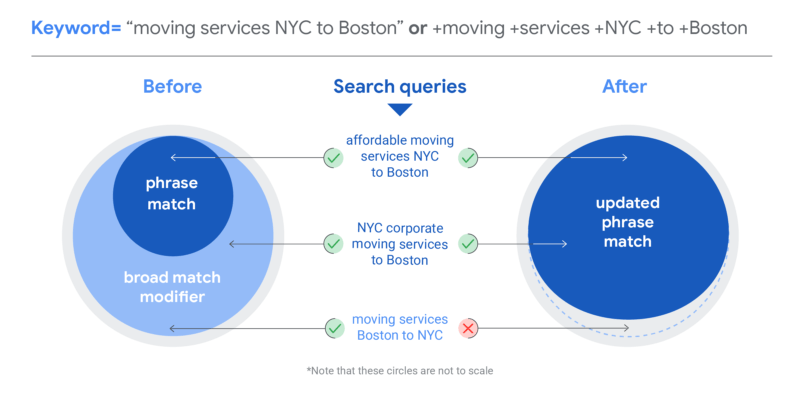
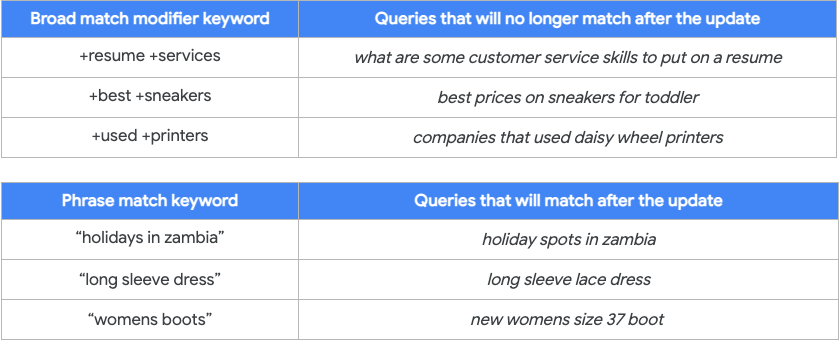
The update uses the following example to showcase the change. Here’s how the keywords for “moving services NYC to Boston” (phrase match) or +moving +services +NYC +to +Boston (modified broad match) would be treated after the update is in effect:

Your Takeaways

  • Phrase Match searches will now include traffic sourced through a Broad Match Modifier Match type
  • The word order will continue to be in effect when it’s relevant to the meaning
  • The rollout will be globally complete by July 2021, after which advertisers will no longer be able to create new BMM match types. The existing ones will automatically adapt to the new behaviour
  • Since the update applies to both match types, there’s no need to migrate keywords and advertisers will get to keep their performance data
  • This change will have no impact on negative keyword match types and Quality Score


Got questions? Reach out to us.


Digital Marketing Trends 2021.

Introduction 

Do you feel the pull of new media? Consider this: how often do you use the internet in your daily lives? The number of social media apps you switch between on your phone? The answer, from experience, is too much. To imagine a life without digitalization is beyond understanding in today’s world; that is the pull and power of new, digital media. It is not just for personal use, though. Brands realize that they can use the digital world for marketing and promotional purposes.

Digital Marketing: What is it?

Digital marketing is when brands reach their audience to promote their products/services via the internet, mobile phones, social media platforms, and other digital options available to people. 

Digital Marketing in 2020 

While it is a universally accepted fact that 2020 has been an unfortunate end to the decade, that is not the case with digital media activities. Covid-19 pandemic and the ensuing need for social distancing made digitized activities a hit among people of all ages. For example, the use of e-commerce rose exponentially: a rise of 30.1% in e-commerce in just the first six months. People were stuck in their homes while schools/workplaces were shutting down- what else is there to do when binging Netflix gets boring after a while? Retail therapy, but make it online.

Digital Marketing Predictions for 2021

Digital marketing is on the rise and is likely to continue in 2021. Field experts have predicted a set of trends that you can use for your business to enhance productivity and get a better ROI. Lets look at the top digital marketing trends for 2021

  1. Social Media a leading channel for purchases

Late in 2020, Instagram introduced a Shop feature on its app. The feature allows users to browse through products and make purchases without leaving the app. Naturally, you can add this to your brand’s marketing strategy. Open your Instagram right now and look at all the brands on Instagram Shop. There are so many brands available to choose from. What are you waiting for? Become one of them!

  1. Virtual events / Live streams

Do you also get tons of notifications a day informing you that one of your friends has gone live on social media? It turns out that they are not the only ones doing it. There was a surge in virtual events in 2020, i.e., live streams of events that, under normal circumstances, would have been held in-person. 

An example of such a virtual event is the Louis Vuitton show for Paris Fashion Week 2020. Brands took the opportunity to present their events via Facebook and Instagram live as entertainment during the harsh realities of the lockdown period. According to statistics, there was a rise of Instagram live viewing up to 70%- that is a considerable increase. 

  1. Voice Search 

An estimate of 3.25b people uses voice search. Let that sink in.

AI voice-activated technology like Amazon Alexa and siri has become quite popular as it can make calls, play music, read audiobooks, answer questions, and so much more. 71% of consumers prefer to make inquiries using voice search, making it a popular search method. Using it as a customer service tool can enhance your customers’ experiences. According to search engine journal, 2021 and beyond voice search plays a huge role in SEO. 

  1. Rise of Chatbots 

Have you seen the little chat box pop-ups when you visit a website, asking if you need help with anything? That little thing is called a Chatbot.

Companies use AI technology to communicate between a brand and its customers in real-time. Using it holds plenty of benefits for your business, number one being the availability for 24/7.

  1. Personalization 

In today’s world, personalized marketing material for different target segments proves to be far more effective. 

One of the most prominent examples of customized content is everyone’s best friend in 2020: Netflix. Statistics say 80% of people said they are likely to use brands that offer personalization. Following up on this could go a long way for your company, especially when the competition is high. 

  1. Programmatic Advertising 

AI technology has made possible what would have been impossible just a few decades ago. If you think about it, much of what brands achieve through digital marketing would have been regarded with suspicion, too, at that time. 

Programmatic advertising is a tool whereby businesses buy ads via an automated system. It is time to invest in this type of ad buying as it is increasingly becoming a popular way for brands to advertise to their audience. 

To Conclude

Digital marketing 2021 has a lot to offer to your business; the wide variety of platforms available to leverage your business launch your promotional activities, e.g., social media marketing, SMS marketing, chatbots, email marketing, etc. Want to tap into this world but do not know where to start? Home of Performance is a boutique digital marketing agency where we provide expert guidance on navigating digitalized ads and ensure that your business reaches the next level.


Got questions? Reach out to us.


MENA 2020 Search Award Winner.

UAE [09/12/2020]:  The Annual MENA Search Awards returned last night, and we are delighted to announce that we won an award within the “Best use of Search- B2C” category. We were awarded for our work “HTMi” a premium hotel management institute in Dubai, offering courses related to hotel and hospitality management. For a new agency to be shortlisted for 6 categories in its first year is a big achievement, so to be winning an award is more special. 

To all our partners; Thank you for being a part of our journey and for believing in us all through to make this possible. 

ABOUT HOME OF PERFORMANCE

Home of Performance (HOP) is a full-scale boutique digital marketing consultancy guided by the true ‘Digital Partner’ approach for clients. We strive to offer tangible value in everything we do. We are data-driven, customer-focused, and creatively-fueled. 

As a full-service provider at the boutique level, we consist of a small, lean, and experienced team of digital experts that rapidly engage with clients and drive high-impact business growth in a short time. We have worked with 40+ brands across three continents.

Digital marketing is an ever-changing landscape. Trends that worked today may not work tomorrow. Commitment is the only way to stay ahead. We at HOP are pushing the boundaries and defining the trends that matter as recognized experts on best practices in the industry. 

ABOUT MENA SEARCH AWARDS

The MENA Search Awards celebrate the very best in PPC, SEO and Content Marketing from across the Middle East and North Africa. Brought to you by We Are Search and British events agency, Don’t Panic – reputable, ethical and credible awards organisers, who deliver the highly successful international awards series The Search Awards comprising the UK Search Awards, the European Search Awards, the US Search Awards, the Canadian Search Awards, the APAC Search Awards, and the Global Search Awards.


Got questions? Reach out to us.


The 9 Most Important SEO Ranking factors

In this digital age, how do you think your prospects will find you: they go and search online. Say, for example, if they want to find an agency providing Local SEO services, they go online search for best “Arabic SEO services”. If you are spotted on the first page of Google, there is a higher chance that you will be converting that prospect into a client. How do you get yourself on the first page of google? 

Well paid ads are the best way to gain instant exposure, nothing can get better credibility than getting them in the top of the search engines organically. No matter what business you own, being there at the top of the search engine is important for the long run if you want to attract the prospects and drive revenue. 

What is SEO? 

Defined by Ahrefs,  SEO (Search Engine Optimization) is the practice of optimizing content to be discovered through a search engine’s organic search results. 

What are the ranking factors?

Ranking factors are certain aspects of your website that determines how well your page will perform in the organic search.  Well, there are more than 200+  factors that will have an impact on your search rankings. Not all are equally important, but some are very important enough to have an impact on your organic performance. In this blog, we are going to discuss those important factors.

How does google algorithm have an Impact on this? 

The reality is that no one could control the search engine algorithm. What you can focus on and what you should do is about optimising your website with various ranking factors. In this post, let’s look at some of the very important factors that you should take into account while optimising your website. 

Before we deep dive into details; these factors can change as google updates its algorithm very frequently to provide a better user experience. So it is important to stay up to date on the latest Google algorithm changes to ensure that you are up to date with the best SEO practises.

The Important 9 SEO Factors

  1. Security

In most of the updates, Google has stressed the importance of site security. Over the years now, it is one of the most important factors that can have an impact on your ranking. Always use HTTPS encryption, which gives an SSL certificate to your website, ensuring a secure connection between you and your end to end-users. Search engines always prefer to drive users to trusted websites.

  1. Crawlabity

Search engines cant rank your website if they can’t find it. Search engines must crawl your website to determine what the website is all about, review the content and determine how it should rank. There are certain steps you need to follow to allow search engines to crawl your website

  • Submit the sitemap
  • Use Google search console to find out the number of pages Google has crawled
  • Use robots.txt to tell search engines which pages they should consider and the pages they should ignore.
  1. Core Web Vitals

User experience is what matters most for google. Every factor that has a direct relation to user experience plays an important role in the ranking factor. In that case, page load speed is an important factor taken into account. Starting in May 2021, Google is rolling out the Core Web Vitals update which is said to have a significant impact on your SERP visibility. Read our blog to know more about what is core web vitals and their metrics.

Audience want answers and they want it quickly, search engines know that and they prefer to rank sites that load quickly to provide a better user experience. This is not only applicable to the desktop but the mobile version too since most of the searches are now happening in the mobile version.  Use Google page speed insights to determine the speed at which your website loads. 

  1. High-Quality Content

SEO is irrelevant without content. Quality content forms the crux of SEO as it is one of the most important factors which has an impact on ranking. To get the attention of the search engines you need to be consistent on posting content. Ensure that each page has a minimum of 300 words. Update all the existing thin content.

Google always prioritizes the users and they want to give the users the best search results. An in-depth, well-structured content always leads the race. Break down the content into shorter paragraphs, sub-headings, bullet points that make it easier for the users to consume the content and make it easy for Google to scan the content.  

  1. Content Optimization

Optimising the content is equally important as producing quality content. Optimising content doesn’t mean keyword stuffing. Optimize the page for one or two most important keywords that are relevant to the content on the page. Never optimise for the same keyword for more than one page. Avoid keyword cannibalization.  

Read our blog on the On-page SEO checklist to make sure you are aligned with the best on-page SEO practices. 

  1. Structured Data or Schema Mark-Up

Schema mark up is the data at the back end of your website. Implementing schema mark up tells search engines on how to classify and interpret pages and their intent. It can also contribute to the factor that your content can be featured in the rank zero or featured snippets which can improve the CTR. 

  1. Backlinks

Backlinks are one of the most important factors that will have an impact on your ranking. When you drive traffic back to your website from high authority websites it gradually increases your website DA. The higher the domain authority the more authoritative will be your website. So to improve your ranking it is important not to neglect this important off-page SEO tactic.

Plan your link building strategies through guest posting, directory submissions, digital PR and other link building techniques. But keep in mind when it comes to link building “Quality matters the most”.  

  1. User Engagement

What is the whole point of creating content if users are not engaging with the same? Google uses the advanced AI tool Rankbrain to determine user engagement. Click through rate and dwell time are two metrics that determine how engaging the content is. Use internal links throughout the content to keep the users engaged that will increase their time spent on the website. 

  1. Keywords

Create content around a cluster of keywords that can drive quality traffic to your website. Do proper keyword research and mapping before getting started with content creation. When doing keyword research and mapping keep three things in mind

  • Target long-tail keywords: With Alexa and Siri gaining popularity users are more likely to search for long phrases and questions. Structure the content with long-tail keywords in addition to the primary keyword to target the content. 
  • Focus on search intent: Matching the search intent boosts ranking for your page that matches the search intent.

To Conclude

SEO consists of several different acts but is not just a one-time thing or something you can buy off the shelf and expect it to work right away. Looking ahead, the Future Of Digital always remains bright. Who doesn’t want to invest in the bright future? SEO is always an investment for your business in the long term.


Got questions? Reach out to us.