What is Google My Business and Why Your Business Needs It to GROW

Out of the 7.8 billion people living on the planet, 4.3 billion use Google to find answers on the internet.  The gargantuan search engine boasts over 92% market share and processes over 99,000 search queries every second. This tells a lot about the sheer dominance of the technology giant over the search engine market. Every second someone is looking up for the nearest coffee shop, places to eat, skincare tips, fashion trends, scientific facts, or staying updated with either celebrity gossip or economic trends. The spectrum of possible search terms is endless. Adding to it, due to the evident shift in consumer behavior post the pandemic lockdown, local “near me” Google searches grew globally by more than 100% in 2022. This is why it has become crucial for businesses to get a leg up on where customers start their journey – on Google. The more “searchable” your business is, the better the chances are of leading potential customers your way. 

This is where Google Business Profile, formerly known as Google My Business (GMB) comes into the picture and steals the limelight.

What is Google Business Profile?

Google Business Profile or Google My Business is a free internet-based service designed to help promote local businesses online. It allows you to provide details and photos of your business, including your location, services, and products and enables business owners to manage how their business appears online and make it stand out. Information from your Google Business Profile may appear in Google Search, Google Maps, and Google Shopping.

Although Search Engine Optimization (SEO) is the primary direction taken by businesses to enhance their online visibility and needless to say is the more popular digital marketing strategy used by businesses, Google Business Profile however, remains an underrated but highly effective online marketing tool to benefit businesses of all sizes, making it indispensable. 

Who can benefit from Google Business Profile?

If you are a business that corresponds with customers whether through a physical presence like a store, office, or restaurant or provides services by meeting with clients like consultants or repair works, you can create a Google Business Profile. But if you have an online-only business, with no physical presence or client interaction, you will have to stick to other Google tools like Google Ads and Google Analytics.

How can Google Business Profile or Google My Business help your business?
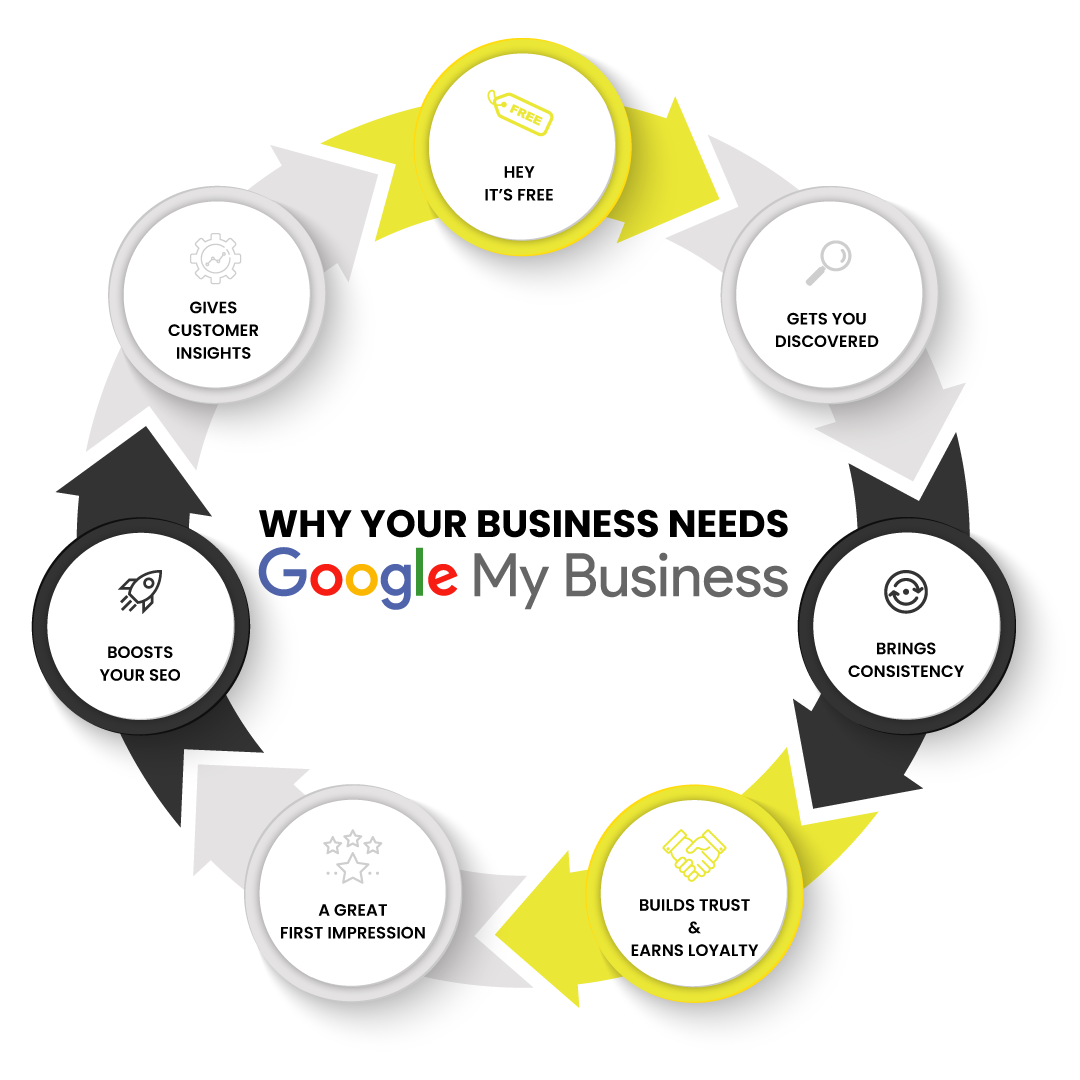
  • Google My Business is Free

One of the most attractive features of GMB is that is available for free to everyone. All you need to do is sign up and fill out your business profile with your website and contact details, pictures, location, and working hours along with some more information you like to share.

  • Google My Business Makes You Seen

It’s the tool that puts you on the global map, quite literally with Google’s ubiquitous usage around the world. Not to mention, the ‘near me’ search queries have increased twice over the past year, making GMB the most formidable asset for any local business.

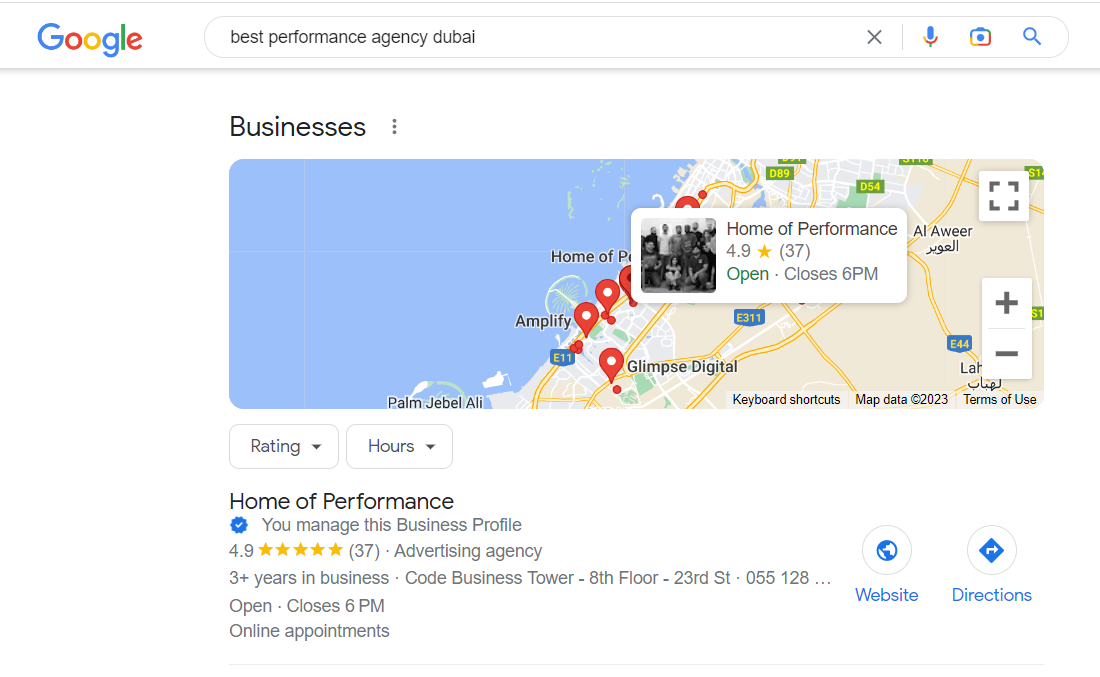
For example, a search query for ‘best performance agency dubai’ gives way to the GMB listing of Home of Performance at the top spot.
  • Google My Business Keeps You Consistent

GMB offers a seamless way to keep your target audience updated with changes your business undergoes. Customers don’t like jumping through hoops in order to find or contact you. With GMB, all it takes is updating your profile with your new address or contact information and you are easy to find.

  • Google My Business Makes a Great First Impression

Every business should be a brand of its own but not all of them are. Marketing priorities differ for many but they ideally should not. Whatever the case may be, GMB provides a platform to easily showcase your business in the best way possible with no cost attached. GMB allows you to add images to your profile to help present your business better. You can add images of your office space or shop, team members, nearby landmarks, and events that you participate in.

  • Google My Business Becomes Your Biggest Cheerleader

The most lauded feature of GMB is that it allows your clients to leave ratings and reviews about your products and services. This becomes important as it acts as the perfect source of trust-building and brand affirmation. The reviews are in fact the precious testimonials every business needs in order to grow and succeed. 

But it is a mixed bag as it is open for everyone to remark about your business. Sometimes, a disgruntled customer might leave a not-so-positive feedback. This gives you the perfect opportunity to comfort an unhappy customer and make up for their unexpected experience. Responding positively to negative reviews proves that you are a conscious business keeping its customer’s opinions in high regard and wanting to service them in the best way possible.

  • Google My Business Boosts Your SEO

GMB serves as one of the most important platforms to help enhance the impact of the SEO strategy. But just adding contact details would not be enough to aid SEO.
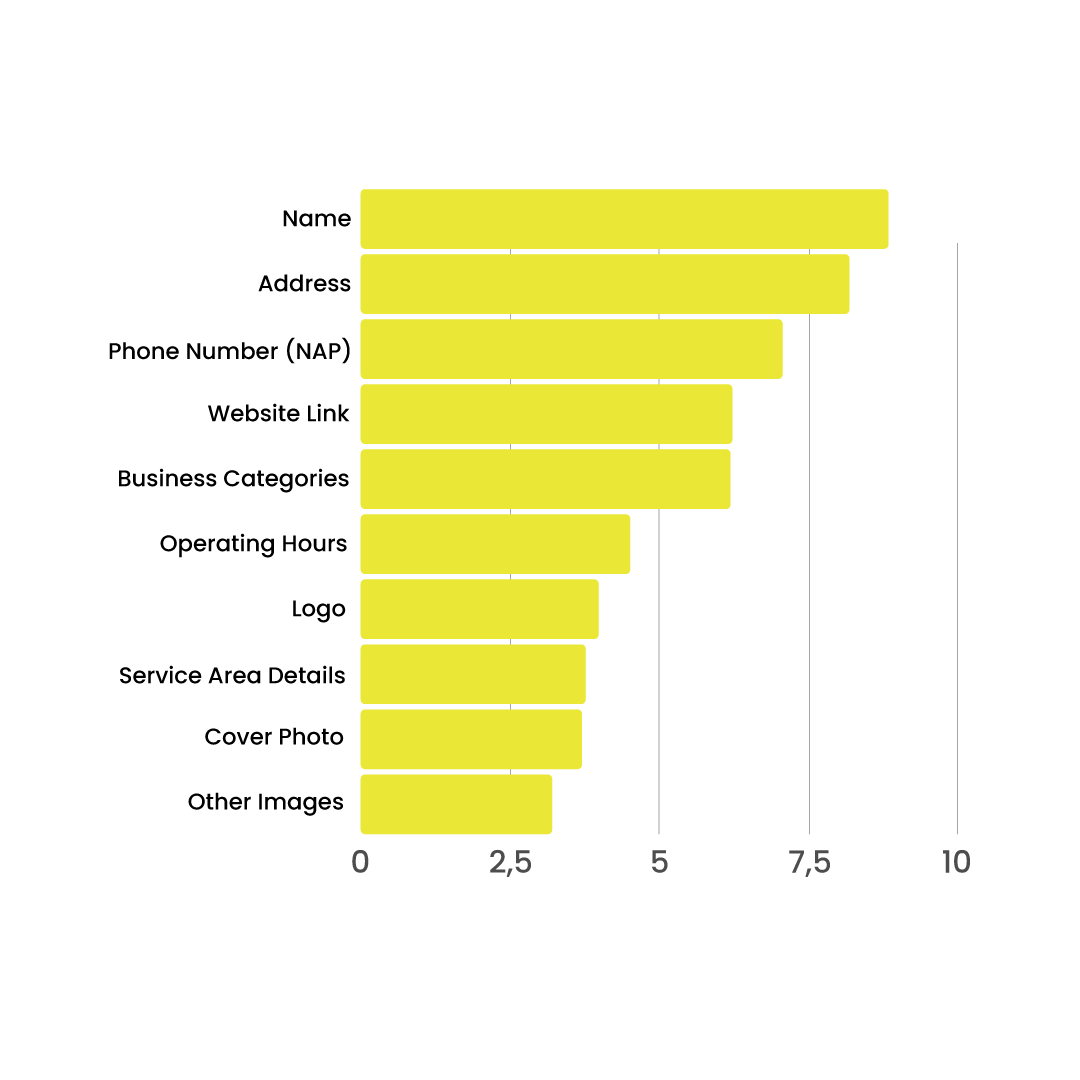
Here is a list of essential items, ranked by importance, that you should optimize for your Google My Business to work in favor of ranking and SEO.

  • Google My Business Gives You Insights

GMB offers customer insights that can help your business to scale and adapt to what your customers prefer. It provides you data on – 

  • Number of views your GMB profile had
  • How and where customers find your GMB listing
  • What actions customers took on your listing
  • Other interactions customers have with your GMB listing

The internet is filled with innumerable businesses trying to find their way to reach their target audience. Any opportunity that can help your business be visible in this organized chaos is worth putting an effort into. Google My Business is one such opportunity that allows your customers to find you easily and effectively. 

Got questions? Reach out to us

Website Architecture And Its Impact On SEO

Whether you are working on a website that needs structural help as a result of legacy decisions made by a previous team, or you are making the smart decision of getting your site architecture right the first time around, there is no doubt that it is an important part of SEO. Still, people often highlight the importance of on-page, off-page and various other factors when talking about SEO, but hardly anyone talks about the site architecture and its importance.

As a basic foundation for SEO, the site navigation and URL hierarchy are extremely important factors that determine how well your site can rank for the important keywords. Regardless of whether you put the best content related to the subject, if your site lacks a perfect site architecture the users will find it difficult to navigate and so will the search engines when they need to crawl. This will affect the organic performance of your website. The best way is to get the foundation laid at the beginning and it’s incredibly easy to implement it from scratch. 

Site Architecture: How Does It Help SEO?

Having a well-organised site structure with smart internal linking will allow users to navigate and search engines to crawl your website easily. This is very important from an SEO point of view. But in a real case scenario, how does it help in increasing your search visibility and organic performance?

  • User Experience: Ranking for the important business-related KW partially depends on how easy your website is to use and navigate. Ideally, the depth should be 3 clicks from the homepage. Search engines evaluate the whole structure of the website. Even though they serve page-based rankings, they also look at where a given page stands in the website’s structure.
  • Sitelinks and other SERP features: A well-built site architecture increases the chances of your website featuring sitelinks and other related SERP features.  Sitelinks are blocks that feature several internal URLs along with your main domain. Sitelinks make your website stand out from other search results and tend to increase the CTR. Organic sitelinks are automatically pulled out by Google and the only way you can influence this process is to build a well-defined site architecture
  • Minimise Technical SEO errors: Most of the crawling and indexing errors arise due to poor site architecture. A proper site architecture would eliminate most of the crawling and indexing errors. 
  • Optimising the Crawling Budget: Site structure not only makes the crawling process easier but also influences the crawling budget. The crawling budget varies from website to website depending on the size. 

How To Create An Seo Friendly Site Architecture?

The time and complexity of the site architecture depend mainly on two things. 

  1. How big is your website?
  2. How extensive is the KW research that you have done?

Let’s deep dive into the steps of building a perfect site architecture.

  1. Competitor Analysis

Depending on the scale of your website, planning the structure of your website from scratch can be quite difficult. So, first, take some inspiration from your top-performing competitors’ websites, as their layouts are likely to be near optimal. Using a framework that is comparable to your competitors also gives your visitors a sense of familiarity.

  1. Keyword Research

Most website owners push this to a later stage, without realising the importance of Keyword research in site architecture. Extensive Keyword research will help you identify the top-level pages based on the keywords that have the potential to drive organic traffic. 

Categorising your Keywords will help you create a content hierarchy. This is highly important and useful in larger e-commerce sites. Keyword categorization will help you choose the primary keywords in the specific category and create hierarchies like subcategories, pages and filters that need to be implemented.

  1. Use An SEO Friendly URL Structure

The URL structure of your website should be relevant to your landing page. It is always advisable to follow a simple URL structure that follows your website hierarchy. The best way to structure your URL is

URL: mysite.com/main-category/sub-category/

Avoid using any unnecessary symbols. Use relevant KW inside the URL structure. 

  1. Structuring The Internal Links

It is important to provide a clear connection between the pages on your website. This enhances the site’s navigation and passes link equity, or link juice through the set of pages organised within the website. The basic rule is that each and every page on your website should have a link pointing to and from it. This will help the crawlers find all the content on your website. Make sure to do the internal linking based on the priorities. If there is a page that has the capability of attracting larger traffic, make sure that you have more links pointing to that page. 

Avoid orphaned and dead-end pages on your website which don’t have links pointing to and from it. 

  1. Establish A Simple Site Navigation 

When we talk about site navigation, we can’t ignore the header part. Headers are the blocks that are placed on the top of the website. Make sure to include all the important pages of the website in the header section. 

Establish simple site navigation that will connect your pages and make it easy for visitors to navigate through. In most scenarios, the visitor’s journey starts with the Menu. So make sure that you have most of the important sections covered in the navigation menu. This will help the users navigate to the internal pages easily.

As we discussed earlier, your important pages should be just 3 clicks or less from the home page. This 3 click rule helps in improving the usability of your website and also helps the spiders crawl the pages faster and index them. 

In Conclusion

Do not underestimate the impact your website architecture can have on your SEO performance. Consider planning a structure that is both user-friendly and search engine-friendly. Group your pages by topics, distribute link authority effectively, and help people get to the pages they are looking for fast.

Once you have implemented the best site architecture for your website, you will also need to maintain it. Websites have a tendency to change as they grow – pages get created in the wrong folders, duplicate versions may appear without anyone realising, and so on. Therefore it is important that you stay on top of things with regular audits and maintain your site architecture. With careful planning and organisation, you can create a website structure that enhances SEO and boosts your ranking effortlessly.


Got questions? Reach out to us.