Mastering Content Marketing Measurement: Building a Framework for Success

In a world where every click, view, and engagement matters, quantitative content marketing analytics serve as the compass guiding businesses through the vast ocean of online content. They provide the means to decipher the effectiveness of your campaigns, offering precise metrics and quantifiable results. These analytics offer invaluable insights into consumer behaviour, enabling you to refine your strategies, enhance user engagement, and drive tangible business outcomes.

Clear objectives are the North Star that directs your content marketing endeavours. They not only define your goals but also shape the metrics you need to measure. Meaningful measurement goes beyond mere numbers; it delves into the heart of consumer interactions, understanding not just how much but also why and how users engage with your content. By aligning your objectives with your measurement techniques, you not only track success but also uncover the nuances of audience preferences, allowing you to tailor your content for maximum impact.

The Foundation: Shared Objectives and Understanding

A. The Role of Objectives in Business and Marketing

Content marketing objectives serve as the pedestal upon which successful businesses are built. In the realm of content marketing, these objectives are not mere goals; they are strategic roadmaps that outline the path to success. Clear objectives align marketing efforts with broader business goals, ensuring that every piece of content created serves a purpose, whether it’s increasing brand awareness, driving conversions, or fostering customer loyalty.

B. The Pitfalls of Analytics Without Objectives

Analytics without objectives are like a compass without a destination — they provide data but lack direction. In the absence of clearly defined objectives, businesses risk drowning in a sea of irrelevant metrics. Vanity metrics might inflate egos, but they rarely contribute to meaningful growth. Understanding what you aim to achieve allows you to measure the metrics that truly matter, providing actionable insights that steer your content strategy toward success.

C. Creating a Shared Understanding of Success

Success is a multifaceted concept, and defining it requires collaboration and alignment. Creating a shared understanding of success involves engaging all stakeholders, from marketing teams to executives, in meaningful discussions about goals and expectations. By fostering open communication and consensus, businesses can ensure that everyone is working towards a unified vision. This shared understanding guides content creation, allowing every piece of content to contribute meaningfully to the overarching objectives of the business.

The Content Marketing Measurement Pyramid

A. Overview of the Measurement Pyramid

The Content Marketing Measurement Pyramid is a structured framework designed to provide clarity and depth to the evaluation of content marketing efforts. Similar to Maslow’s Hierarchy of Needs, this pyramid explains the essential elements necessary for a comprehensive measurement strategy. It begins with establishing clear objectives, forming the foundation upon which every subsequent level is built, ensuring a strategic approach to content analysis.

B. Four Levels of the Pyramid: Objective, Key Results, KPIs, Analytics

  1. Objectives: At the base of the pyramid lies the bedrock of content strategy – objectives. These are broad, overarching goals that align with business objectives. Objectives serve by setting the direction for content efforts.
  1. Key Results: Directly above objectives are Key Results. These are specific, measurable outcomes that indicate progress towards objectives. Key Results act as milestones, offering a tangible way to track the journey toward achieving broader goals.
  1. Key Performance Indicators (KPIs): The middle layer comprises KPIs, which are quantifiable metrics directly tied to Key Results. KPIs provide a more granular view, measuring specific aspects of content performance, such as website traffic, engagement rates, or conversion percentages.
  1. Analytics: The pinnacle of the pyramid is Analytics – the detailed data derived from KPIs. Content marketing analytics offer in-depth insights into audience behaviour, content effectiveness, and campaign success. This layer represents the culmination of efforts, providing actionable data for future strategies.

C. Contribution to Clear Measurement

The pyramid’s levels are integral: Objectives set the vision, Key Results offer milestones, KPIs provide focus, and Analytics unveil audience interactions. Together, they form a cohesive structure enabling data-driven decisions, refining strategies, and maximising impact.

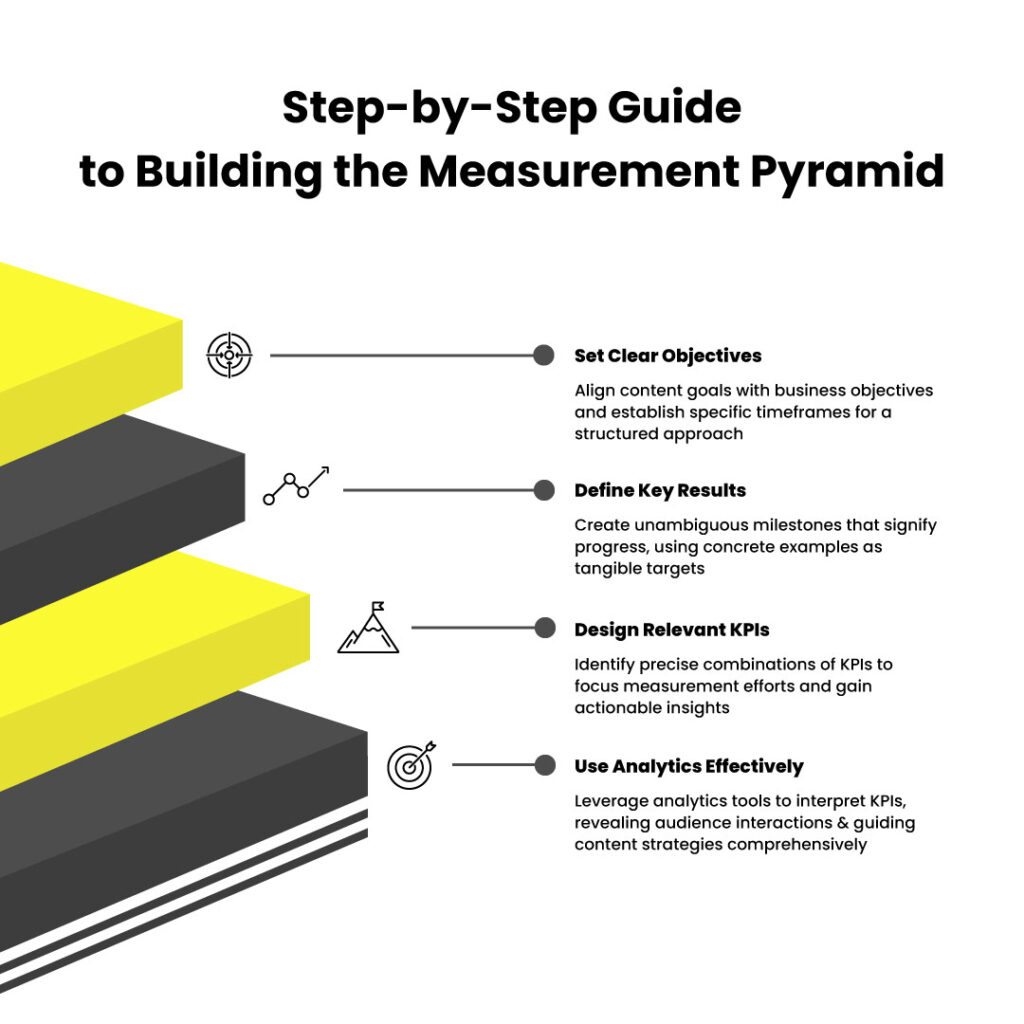
Step-by-Step Guide to Building the Measurement Pyramid
A. Step 1: Setting Clear and Shareable Objectives

Setting the foundation starts with aligning content objectives meticulously with overarching business goals. Clearly defined objectives guide content efforts effectively. Additionally, establishing specific time horizons for objectives ensures a structured approach, allowing teams to measure progress within defined periods.

B. Step 2: Defining Key Results for Objectives

The second step involves defining Key Results with unambiguous success criteria. Clarity is key here, ensuring that these results serve as unmistakable milestones indicating progress. Concrete examples of Key Results provide teams with tangible targets, offering a clear vision of what constitutes achievement within the defined objectives.

C. Step 3: Designing KPIs for Key Results

In this phase, understanding the right combinations of Key Performance Indicators (KPIs) is vital. Each KPI combination illuminates specific facets of progress. Identifying the most relevant KPIs for tracking ensures a focused measurement strategy. These KPIs become the pulse of the content’s performance, providing actionable insights.

D. Step 4: Assembling Analytics for KPIs

Assembling analytics tools forms the final step, granting depth and context to chosen KPIs. Analytics serve as the lens through which KPIs are interpreted, revealing intricate details of audience interactions. Selecting granular measurements tailored to KPIs offers nuanced insights. This step involves a meticulous process of choosing the right metrics, allowing businesses to gauge content effectiveness comprehensively.

The Challenge of Implementing Comprehensive Measurement

A. Acknowledging the Effort Involved

Implementing comprehensive measurement demands a significant investment of effort and resources. Acknowledging the complexity of gathering, analysing, and interpreting data is essential. It requires dedicated teams and time to ensure accurate measurement and meaningful insights. Understanding this effort is crucial to embracing the challenges that come with robust measurement strategies.

B. The Necessity of Replicating the Process for Multiple Objectives

One of the significant challenges lies in the necessity of replicating the entire measurement process for multiple objectives. Each objective requires a tailored approach, involving specific Key Results, KPIs, and analytics. Replicating this meticulous process across various business goals demands consistency, attention to detail, and a deep understanding of each objective’s unique metrics. Balancing this necessity with efficiency is a challenge, requiring careful planning and strategic execution.

C. Adapting Strategies Based on Insights

The challenge extends to adapting strategies based on insights derived from comprehensive measurement. Insights often reveal the need for strategic shifts or optimisations. Adapting content strategies, marketing techniques, and even business models based on data-driven insights requires agility and flexibility. Implementing changes promptly and effectively, while ensuring they align with overarching business goals, demands careful planning and a deep understanding of both the data and the business context.

In conclusion, 

A meticulously crafted framework not only illuminates the effectiveness of content strategies but also empowers businesses with actionable insights, allowing them to make informed decisions that resonate with their audience.

Through this framework, businesses gain the ability to decipher the nuances of customer engagement, transforming raw data into meaningful narratives. It bridges the gap between creativity and analysis, fostering a symbiotic relationship where imaginative content meets empirical validation. Moreover, a robust measurement framework instils a culture of data-driven decision-making within organisations, promoting adaptability and innovation in response to market dynamics.

As businesses continue to navigate the complex digital landscape, a well-crafted measurement framework stands as a beacon, illuminating the path toward meaningful and sustainable content growth. 

Digital Marketing Trends 2021.

Introduction 

Do you feel the pull of new media? Consider this: how often do you use the internet in your daily lives? The number of social media apps you switch between on your phone? The answer, from experience, is too much. To imagine a life without digitalization is beyond understanding in today’s world; that is the pull and power of new, digital media. It is not just for personal use, though. Brands realize that they can use the digital world for marketing and promotional purposes.

Digital Marketing: What is it?

Digital marketing is when brands reach their audience to promote their products/services via the internet, mobile phones, social media platforms, and other digital options available to people. 

Digital Marketing in 2020 

While it is a universally accepted fact that 2020 has been an unfortunate end to the decade, that is not the case with digital media activities. Covid-19 pandemic and the ensuing need for social distancing made digitized activities a hit among people of all ages. For example, the use of e-commerce rose exponentially: a rise of 30.1% in e-commerce in just the first six months. People were stuck in their homes while schools/workplaces were shutting down- what else is there to do when binging Netflix gets boring after a while? Retail therapy, but make it online.

Digital Marketing Predictions for 2021

Digital marketing is on the rise and is likely to continue in 2021. Field experts have predicted a set of trends that you can use for your business to enhance productivity and get a better ROI. Lets look at the top digital marketing trends for 2021

  1. Social Media a leading channel for purchases

Late in 2020, Instagram introduced a Shop feature on its app. The feature allows users to browse through products and make purchases without leaving the app. Naturally, you can add this to your brand’s marketing strategy. Open your Instagram right now and look at all the brands on Instagram Shop. There are so many brands available to choose from. What are you waiting for? Become one of them!

  1. Virtual events / Live streams

Do you also get tons of notifications a day informing you that one of your friends has gone live on social media? It turns out that they are not the only ones doing it. There was a surge in virtual events in 2020, i.e., live streams of events that, under normal circumstances, would have been held in-person. 

An example of such a virtual event is the Louis Vuitton show for Paris Fashion Week 2020. Brands took the opportunity to present their events via Facebook and Instagram live as entertainment during the harsh realities of the lockdown period. According to statistics, there was a rise of Instagram live viewing up to 70%- that is a considerable increase. 

  1. Voice Search 

An estimate of 3.25b people uses voice search. Let that sink in.

AI voice-activated technology like Amazon Alexa and siri has become quite popular as it can make calls, play music, read audiobooks, answer questions, and so much more. 71% of consumers prefer to make inquiries using voice search, making it a popular search method. Using it as a customer service tool can enhance your customers’ experiences. According to search engine journal, 2021 and beyond voice search plays a huge role in SEO. 

  1. Rise of Chatbots 

Have you seen the little chat box pop-ups when you visit a website, asking if you need help with anything? That little thing is called a Chatbot.

Companies use AI technology to communicate between a brand and its customers in real-time. Using it holds plenty of benefits for your business, number one being the availability for 24/7.

  1. Personalization 

In today’s world, personalized marketing material for different target segments proves to be far more effective. 

One of the most prominent examples of customized content is everyone’s best friend in 2020: Netflix. Statistics say 80% of people said they are likely to use brands that offer personalization. Following up on this could go a long way for your company, especially when the competition is high. 

  1. Programmatic Advertising 

AI technology has made possible what would have been impossible just a few decades ago. If you think about it, much of what brands achieve through digital marketing would have been regarded with suspicion, too, at that time. 

Programmatic advertising is a tool whereby businesses buy ads via an automated system. It is time to invest in this type of ad buying as it is increasingly becoming a popular way for brands to advertise to their audience. 

To Conclude

Digital marketing 2021 has a lot to offer to your business; the wide variety of platforms available to leverage your business launch your promotional activities, e.g., social media marketing, SMS marketing, chatbots, email marketing, etc. Want to tap into this world but do not know where to start? Home of Performance is a boutique digital marketing agency where we provide expert guidance on navigating digitalized ads and ensure that your business reaches the next level.


Got questions? Reach out to us.


Top 6 Marketing Automation Tools for 2021

[vc_row][vc_column width=”2/3″][vc_column_text css=”.vc_custom_1612167681075{padding-right: 50px !important;padding-left: 50px !important;}”]

What is Marketing Automation? 

Marketing automation refers to the software and platforms that allow companies to effectively increase marketing across multiple channels online and grow. Marketers can specify criteria they want to focus on and use marketing automation tools to achieve their targets. Marketing Automation increases the marketing department’s efficiency and overall performance of the organization.

Here we discuss the 6 marketing automation tools that you, as a marketer, can incorporate in your operations to get the best results.

The 6 Marketing Automation Tools

  1. ActiveCampaign

ActiveCampaign is an all-rounder when it comes to increasing revenue and enlarging customer base. It is ideal for small and medium scale businesses looking for an active interaction to enhance their customer relationships. Inbuilt features like lead scoring, lead win probability and segmentation makes it a perfect deal-closing marketing automation tool.

Pros of ActiveCampaign 

    • In-built marketing automation platforms for businesses. It contains features for email marketing, CRM, and social media personalization.
    • Easy to understand and use hence, does not require training.
    • Affordable price. The price of the software is budget-friendly and it remains affordable as your business grows.

Cons of ActiveCampaign

    • It can become a little ambiguous as it provides insights on multiple sales and goals conversions.
    • Does not have a free version

For Free Trial of an activecampaign, click here .

  1. Autopilot

There are several email automation tools in the market, but Autopilot takes a special seat because of its fun design for email automation sequences. With no technical background needed, Autopilot is very easy to learn and use with amazing customer support and enough resources online for self-learning.

Pros of Autopilot

    • Simple and easy to use
    • No technical background needed
    • Excellent customer support
    • Can be integrated with lot of tools

Cons of Autopilot

    • When compared with its competitors, it is priced on a higher level. Not everybody can afford the tool.
  1. Convertkit

A Perfect marketing automation tool that is ideal for bloggers and content creators. The automated tag and segment feature helps you organise your subscribers based on your interests, location and other important factors to know more about the customers and map them to your marketing funnel.

Pros of Convertkit

    • Converkit has a seamless dashboard design.
    • It has built-in landing page templates.
    • It provides easy to understand data analytics. This can help you keep track of your growing subscriber’s list.

Cons of Convertkit

    • It does not provide e-commerce integration.
    • It does not offer lead scoring.
    • It is not appropriate for large scale  businesses because of its limited features.
  1. Omnisend

Another very simple to use marketing automation tool is Omnisend, targeting sales-driven marketers. With personalised messages and seamless automation workflows, omnisend helps you reach a wider audience and increase your sales. The  easy-to-use editor feature helps you grow  your subscriber list with a customised sign up forms and newsletters.The biggest advantage of Omnisend is that it works with all major e-commerce platforms like Shopify, Woo-commerce, Magento etc.

Pros of Omnisend

    • Omnisend offers e-commerce integration. This allows you to automate several e-commerce platforms through one software.
    • It is easy to understand and use.
    • It is ideal for sales-driven business.
    • Excellent customer support.

Cons of Omnisend

    • The price remains reasonable but it is still costly as compared to other marketing automation software.
  1. Hubspot

Be it for marketing, sales, service or a powerful CRM, Hubspot offers these solutions under the roof that helps businesses to grow better. When it comes to inbound marketing, Hubspot marketing hub offers you everything you need to run an efficient inbound marketing campaign.

Pros of Hubspot

    • It is non-technical. Hubspot is highly intuitive, which allows business owners to use the software without difficulties.
    • It has several automation tools including CRM software for sales, email marketing automation, social media management, and a lot more.

Cons of Hubspot

    • It gets expensive. As a business grows the plans become expensive.
    • The plans cannot be cancelled once the contracts have been signed. Owners have to pay for the tools until the contract ends.
    • The free version offers limited tools, which might not be useful for growing businesses. This means they will have to purchase the plans offered by Hubspot.
  1. Drip

Drip is a CRM designed marketing automation tool that helps sales-driven businesses to increase their customer base and convert leads to paying customers. Detailed tracking, segmentation and powerful email marketing automation makes drip a perfect choice for scaling up the sales-driven business.

Pros of Drip

    • Excellent email marketing automation support. This makes the software ideal for online businesses to allow them to expand their customer base.
    • It allows e-commerce integration, which makes automation easier for businesses.

Cons of Drip

    • It becomes expensive as the business grows.
    • The social media integration offered is not the strongest feature of the software.

Conclusion:

There are several benefits of incorporating marketing automation tools in your business, especially if you are entirely an online enterprise. Using the tools for time-consuming yet a little less important tasks can save you and your employees time, which can be allocated to more important tasks.

Secondly, marketing automation tools lead to a positive return on investment (ROI). The main reason it happens is when labour is not invested in doing small tasks, they can invest their time and energy in making breakthrough decisions. It also reduces labour costs.

Thirdly, marketing automation leads to increased accountability. When the processes and the company’s performance are clearly defined and transparent, it becomes easy to recognise the area needing improvement. Hence, promoting accountability amongst employees to perform their part effectively.

Overall, there are multiple perks of marketing automation that can prove to be beneficial for businesses, especially eCommerce businesses.[/vc_column_text][/vc_column][vc_column width=”1/6″][/vc_column][/vc_row][vc_row][vc_column][vc_column_text]

Got questions? Reach out to us.


[/vc_column_text][/vc_column][/vc_row]

Home of Performance Becomes Certified Criteo Partner Agency In UAE

UAE, September 23, 2020: Home of performance (HOP), a Dubai based performance marketing agency, has officially launched its new agency partnership program with Criteo recognizing HOP as one of the leading digital marketing and consulting agency in the Middle East.

About Home of Performance

Home of Performance is a full-scale boutique digital marketing consultancy that is guided by the realistic digital approach for our clients and strives to offer tangible value in everything we do. We are a data-driven, customer-focused and creatively fuelled team of passionate and well-experienced digital consultants with an aim to continuously deliver high impact for business progression.

Home of Performance operates as a full-service provider at boutique level, meaning we consist of a small, lean and experienced team of digital experts that rapidly engage with clients and drive high impact in a short time. Now joining hands with Criteo, it helps us to align with our partner’s goals and drive greater value for our partners. 

About Criteo

Criteo is one of the leading advertising platforms that is built on the open internet. With a holistic suite of advertising solutions, retailers, brands, and publishers of all sizes can access the data and technology they need to best attract and keep their customers.

Criteo is one of industry-leading AI platform that brings you unparalleled commercial data

Criteo AI Engine

With three key components — DCO+, Product Recommendations, and Predictive Bidding — the Criteo AI Engine powers our best-in-class solutions, designed to drive results.

Criteo Shopper Graph 

Our massive pool of granular data combines three key components — interest, identity, and measurement — to give you a better understanding of your shoppers.

Criteo Ad Platform

Create and manage campaigns that will help you get noticed, get traffic, and get sales with our easy-to-use self-service display advertising platform

To know more contact us: https://hop.rocks/contact-us/

To learn more on Criteo: https://www.criteo.com/ 

—ENDS—


Got questions? Reach out to us.


4 Tips on how to maximize sales during Corona

Most of us have been impacted by the current situation in one way or another. For service providers, most probably you have seen retainers being cut and planned projects pushed to the future. 

For any operation that offers B2B services, this is the harsh reality of any time. It can happen during a “non-corona year” as well. Right now it just happens to a lot of companies at the same time. For us who operate in UAE or for that reason, any country where monetary support from the government is not to be counted own – It’s up to ourselves to manage the situation. 

I will share my best practice on how to handle it without having to save cost or reduce staff – And ultimately put your company in a better position than it was going into the epidemic. (I do know that this differs from vertical to vertical and I’m only talking based on my own experience)

  1. Increase your sales efforts

When revenues are down – The No 1 priority should be on increasing your sales. This needs to be done hands-on from the top of the organization. Increasing sales comes down to 3 key core pillars

  • Activity (No of Meetings, Quotations, Strategy documents, etc) Make sure that you increase the number of activities that drive sales. Don’t look too much at the numbers you need to get in terms of total revenues, focus on the path that will lead you there. It’s much to easier to “control” the number of meetings you are having than exactly how much your sales will produce a given month. Having control of your sales process is key to succeed, put yourself, and your team in a position where you can decide to win every day. 
  • Average deal size – Make sure that you price your services at the right level of pricing, but the easiest way to increase your revenues is to increase your price, which might be difficult at this moment. But I’m not talking about increasing your standard rate. Bundle your services, give more to your clients and price it at a discount, always try to find what additional value you can bring to the clients. It may turn out that you can increase the engagement from your clients and your billings at the same time that you can lower their total cost. 
  • Hit Rate – It’s a given, the better you are at closing your proposals or meetings, the more you will sell. Make sure you know the foundations, stakeholders, budget, and timing. Qualify your prospects early on not to waste time. Make sure to customize your offering and that you actually understand what challenges the client is facing. Being able to close a lot of deals comes down to understanding the prospect. Make sure that you put ample time in the start to understand their situation and business. You will realize that selling is very easy when you just listen and try to avoid selling 🙂
  1. Increase your marketing efforts

Comes hand in hand with sales. But it’s vital to focus your marketing efforts right now. Put as much as you can of your allocated budget towards the end of the funnel marketing. Branding is amazing, but if you need to increase your sales tomorrow – Focus on the quick wins. Make sure to know your high converting channels, whether its email, paid search, social, etc. And leverage your money towards that. Use your SM channels to work on your brand positioning. If you have done your homework from the start it should be fairly easy to get an instant overview in your CRM where your clients are actually coming from. If you don’t, make sure to set it up now and you will benefit in the future. 

  1. Make your clients understand you are in this together  

Selling is always important – But more importantly, it is to retain your current clients. Make them understand that you are in this together – Talk to them weekly, ask them how you can help, if they need relief in any way – Give it! Its an investment in your partners, just like they once have invested in you and your team – its now time to give back. If it means pausing, pushing payments, or to add added value, I always try to do this. I promise you that people remember this. Other than I believe its good for business, I also believe it gives me more business by referrals. 

  1. Leverage your current offering and add more services.

For an agency – the current situation has led to a lot of companies freeing up staff, this means more outsourcing. Review your services, add more services that are aligned with your offering and that are in demand. For a consultancy, I think the key to success is to keep the ear close to the ground and make sure to offer services that drive value at the moment. More services mean more revenues and tighter collaboration with your partners. Of course – this only works if the services make sense in terms of your offering.

Ultimately it comes down to having a strategy and plan that are aligned with how you wanna run your business. For myself, these pillars do not really change whether its a Pandemic or not. We always try to focus of end of the funnel marketing, we always focus on selling, we always try to make our partners feel we are in it together and we always seek to leverage our current offering. The great thing about this strategy is that it works in both good and harsh times 🙂


Got questions? Reach out to us.


Google May 2020 Core Update.

In the midst of the coronavirus pandemic, Google made its second major update of 2020. The update was confirmed on 4 May by @searchliason  and named the “May 2020 Core Update.” The update will go on for 2 weeks from its initial date of release

The rollout takes one to two weeks, according to Google, before all improvements are official.

What to Expect 

In the past core updates from google, we have a mobile-first indexing trend, volume, consistency and relevancy  of the content of . The goal is to provide users with the best search results. 

However, the nature of Google’s search has also transitioned as a result of COVID-19. When you browse the Internet, people equate everything with the current pandemic. 

As the update is the first to be completed in the crisis at COVID-19, SEOs and other experts must carefully study the problem, given the volatility of the search rankings. 

Impact Of  “May 2020 Core Update” 

As Usual Google has not revealed much about the changes that this update will bring into the web world. So as long as Google confirms it, we can’t be 100% sure what serious impact it has on the performance of the websites. But looking back at the previous core updates and the reports that goes till date  has started giving an initial signals of the niche that has been seeing some ranking volatility since the “May 2020 core Update has been announced 

  • Health
  • Technology
  • Finance
  • Dating

These are the sectors that have  been affected by the “May 2020 Core Update” as per reports. 

What Can We Do

  1. Focus On Quality of the Content

As it is said 70% of the SEO revolves around the Content. When we say content, the google algorithm has come a long way on this. Still I see business focusing on very outdated practise of squeezing in Keywords. Volume is ofcourse Important but what is more important is the relevance of the same. You don’t want the target users to land in at the wrong page. 

Google always prioritizes high quality content. The study or the analyzes of a topic should be original and should be accurate. Don’t  go for vague clickbaits that deceives the target audience that affects the bounce rates. Give importance in providing content that is comprehensive, valuable and is relevant to what it is to be. Support the content with insights and analytics that supports the subject. As to say, Content relevant to the context performs better. 

  1. Update All the Thin Content

As per the Initial Reports, the sites that have been affected by the May 2020 core Update is the site with thin content are losing their positions. So Make sure to optimise the thin content. It should be absolutely relevant to the search intent of the user which has landed him to the specific page or topic.

This is a very important topic that needs to be addressed as Google Updates are focussing more on search intent, where the user  gets the most in depth and detailed answers to his search queries. Keep following our content hub, where we will have In-depth blogs on Importance of topical content and the Importance of Content Depth.

  1. Variations is Local Search

Not Confirmed but still there are many reports that suggest there are variations showing in Local Search results.  

Should We Be Worried

Many businesses who have suffered ranking  variations in search results as a consequence of the core update, no need to panic “you have not broken Google Webmaster Guidelines or endured any manual or algorithmic intervention.”According to Google that these updates may have websites that have unexpectedly gone down and vice versa. What you need to focus on is the Content. Keep focussing on creating quality content. While doing the same ask yourself these questions

  • Does the content  have the in-depth  knowledge that lets your audience trust it?
  • Are you creating content that is free from easily detectable factual errors?
  • Does the content lack consistency or structure?
  • When viewed on mobile devices, does it provide a better user-experience?

What’s Next

Since nothing regarding the impact of the current update has been officially confirmed by Google, we need to wait patiently before taking any actions on the website. Keep providing the users with relevant and comprehensive content. Keep on Track with @Searchliason as he keeps you posted on this Core Update.


Got questions? Reach out to us.


5 Best Tech Stack for Remote work.

First, we need to say that if you are reading this post, you are probably one of the lucky in the world right now that actually can do remote work. Even though it’s a challenge, we need to acknowledge that we are extremely lucky to be able to work remotely at this point.

I know social media is flooded with tips on how to succeed with your remote work – Even so 🙂 I will give it a go by outing our 5 best tech apps that we utilize to maximise our effort working remotely.


1. Human Capital

I do know that individuals are not software:) But I strongly believe that the most important component of succeeding remotely is having the right people in your team. At the end of the day, it does not matter which software you are using or how savvy you are. If the team members do not feel accountability and pride in their job, it won’t get done. So the most important investment we can do is the people we hire. 


2. Workplace by Facebook

Workplace chat is very similar to Teams by Microsoft or slack. We happen to use workplace and its been crucial not only during the remote work but also in our “normal” situation. Since we have teams in multiple countries we are used to working in different locations. Having the “Social” part of work even if its vai an app is something I strongly advocate. What gives Workplace an edge is the feeling of “Social Media” for work. We can tag locations, express feelings and create a narrative of the team while working. 


3. Trello

Trello has for us been a lifesaver in terms of meeting deadlines, mapping out projects and getting everyone tasked up. The challenge is making sure everyone is using it:). For us, it helped to put a product owner on it. Ensuring that all the projects are tracked and mapped properly. Make sure to add deadlines, assigning stakeholders and inviting clients when needed. 


4. Google Drive

As an agency, we produce enormous amounts of data on a daily basis. The drive is for us the number one choice of storing it, very easy to share, create sheets, documents etc. A success factor is making sure everyone knows what goes there and what does not. Also, it gives endless opportunities to share data with clients and colleagues. For us using G Suite, it’s, of course, easy to use since it’s fully integrated with the rest of our suite. 


5.Zoom

Seeing each other is extremely important when we are not meeting on a daily basis and are not seeing each other. Zoom gives you amazing video quality both from mobile and desktop and allows you to have hundreds of participants. External meetings and sales effort is also a part of being tested when we are all at home. With Zoom it’s easy to share and see data. As well as adding a personal touch to your meetings

To conclude 

All of the tools we are using have of course similar apps that do more or less the same thing. Which one you will end up using is based on your own preference. But I can’t stress my strong belief that number 1 on the list is the most important. Take care of your team and they will take care of your clients.

Stay safe and let’s hope that most of these apps soon will be redundant!


Got questions? Reach out to us.


Home of Performance Becomes PipeDrive Premium Agency Partner IN UAE.

UAE, February 18, 2020: Home of performance, a Dubai based performance marketing agency, is proud to announce that we have joined hands with Pipedrive as one of the premium agency partners in the Middle east.

About Home of Performance

Home of Performance is a full-scale boutique digital marketing consultancy that is guided by the realistic Digital approach for our clients and strives to offer tangible value in everything we do. We are a data-driven, customer-focused and creatively fuelled team of passionate and well-experienced digital consultants with an aim to deliver high impact business growth in a short time.

Home of Performance operates as a full-service provider at the boutique level, meaning we consist of a small, lean and experienced team of digital experts that rapidly can engage with clients and drive high impact in a short time. Now joining hands with Pipedrive as premium agency partner; our mission mutually is to create a world where everyone, everywhere can sell with certainty. Pipedrive is a weapon of choice for salespeople in scaling companies.

About Pipedrive

Pipedrive is a visual sales tool that gets your team organized and confident about results. No deal will fall through the cracks, and it will help you save time by automating everyday tasks. It is simple to get started but powerful enough to adapt to any sales process and work seamlessly with the tools you love the best. What makes Pipedrive different from other sales automation tools is its ease of use providing an intuitive user experience which makes the same as the primary choice for salespeople.

For more details on Home of Performance visit: https://hop.rocks/

For more details on Pipedrive: https://www.pipedrive.com/

—ENDS—


Got questions? Reach out to us.


5 Benefits of Growth-Driven Design.

What is Growth-Driven Design?

Popularly known as a sprinting cycle of design, research and development, Growth-Driven Design (GDD) is the new and improved way of ensuring your website portrays best marketing performances for prospective buyers who are frequent visitors.

 Why Should You Implement Growth-Driven Design? 

GDD is broken down into 3 pillars: Strategy, LaunchPad and Continuous Improvement from where existing analytics unearth quicker revenue in favour of an effective strategy in the long run.

 If we understand how intensive a new website launch really is, then choosing a methodology that steadily generates data loaded optimization would be the absolute powerhouse. 

 5 Benefits of Growth-Driven Design

 Getting ‘live’ real quick with GDD has its many advantages. Consider the following.

  1. Failures are Encouraged in Bite-Sized Portions 

 There are many opportunities for growth. As an advancing effort to revise without becoming outdated, you can identify, fine-tune, level up your site service standards while quickly shifting preferences for credibility. Since understanding your user’s behavioural changes are considered essential, GDD is tightly integrated to consistency through small scale upgrades without failing twice. 

  • Resources are smartly managed by spreading them over time rather than risking yourself under an umbrella of possible losses that don’t come with “test as you go”.
  • Not confined to one dull routine, therefore creativity is encouraged for a personally enriching experience.

2.Low Up-Front Investment

 Spending is 50% cheaper than a traditional design where it’s compulsory to have the full payment done before going “live”. Whereas when you focus on core actions, you’re able to manage the necessary funds in smaller doses that won’t demand anything beyond the pace of your deadlines.

  • Digestible snapshots of your budget process are made easy with keeping track of estimated outgoings for a set time.
  • Revenue growth can be expected to swell up the volume on ROI. 

 3.Quicker Initial Launch

 GDD believes in Launchpad solutions that prioritize a wishlist phase where specific features, results and functions are compiled as to what is working and what isn’t. So, you’re trimming off the risk of having the site remain untouched for years.

  • The initial development stage and launchpad site takes only 3-8 weeks.
  • A sustainable approach with monthly iterations, so the odds of enduring shaky episodes are low. 

4.Data-Driven Optimization

 While revolving around a time-tested concept, GDD decides after raw data is collected. We can not only create a hypothesis based on “pain points” of your current site but for the benefit of drawing conclusions according to marketing metrics, there’s also the freedom to test the hypothesis during experiments.

  • You can connect with users offscreen on a deeper level.
  • Since fundamental assumptions explain the user’s journey, you’re not left with any indecisive guesswork on what to do next.

 5.User-focused

 Unique features like persona profiles help focus on user experience while digging through challenges that come along the way. The entire process of making changes is mainly responsive to how visitors utilise your site including time spent, whether good or bad ensure if their behavioural patterns align with your business objectives.

  • More than how your site ‘looks’, GDD solely builds upon what a user ‘felt’ during the visit.
  • Taking steps to boost conversions on your site highly rely on the data available from users. 


How Adopting Growth-Driven Design Can Be a Game Changer in Your Design Strategy?

 The traditional design model has frustrated many business owners with its unpredictable stringency where effects are valued. Hence, if you’re keen on minimizing potential dangers that await at the unknown, your website is the next most valuable marketing boon making way for real impact with customers and learning curves for your team all at the same time.

Got questions? Reach out to us.


Google Discovery Ads : All You Need To Know About.

Google Discovery Ads

Google mainly for advertisers it is generally used as a search intent advertising platform. But still, there are exceptions in every case. Not everyone wanders around google to make purchases. There are times when we casually browse through youtube videos and scroll through the Gmail to see if something very interesting is around. With these Users in Mind, Google announced a new ad format which is called the Discovery Ads which are soon becoming available for marketers and advertisers to make use of it.

What Exactly is Discovery Ads

Discovery Ads are no different from other Ad formats from the google that marketers or advertisers normally use. They tend to look like normal display ads in search feeds and Gmail ads in Gmail. But the difference discovery ads make is the intent and their functionality. 

Advertisers need to deliver google a few images, a headline (up to five), and a copy to Google. Google uses machine learning and AI to create the ad and put it to an audience you want to target at the right time and place. The advertisements can appear on Gmail’s Google Discover list, YouTube home feed and social / promotion tabs.

Why Discovery Ads

Google wants to help marketers take people from awareness to purchase. Google aims to push searchers along the marketing funnel to buy by bringing advertisers in front of consumers when they’re in the early stages of the marketing funnel that is awareness and consideration. Since Discovery ads appear on the top of the marketing funnel, a definite call to action that promotes a purchase is not recommended. The primary aim of the ads will be to move the prospect down to the marketing funnel.

All About Google Discovery Ads

  1. Separate Campaign

Like running other Ads Discovery Ads should be running as a separate campaign. In the Discovery Ads, advertisers upload the creatives, the landing page and minimal copy Ideas. Google with the help of machine learning and AI technology optimizes and handles the ad delivery. Primarily in Discovery Ads as we normally say related to search ads the user’s “search intent” doesn’t play a big role. 

Custom intent audiences and in-market audiences should be the main priority of this discovery ad campaign type because the targeted customers are at the top of the marketing funnel.

Always be clear while creating content for discovery ads because the targeted audience will be on the top of the marketing funnel.

  1. Machine Learning and Artificial Intelligence

The whole implication of Discover Ads is that Google’s machine learning algorithms identify and deliver what the users want. 

You must enter a landing page URL, at least one picture, a logo, and up to five headlines and five descriptions when setting up those advertisements. Google’s machine learning from there serves the best combinations over the most relevant and appropriate placements— or where your audience spends most of their time.

  1. Be in the Discover Mode

The Google Discover feed is the equivalent or very much similar to that of Facebook feed but powered by Google’s machine learning algorithms that cover and gathers more than 800 million people all over the world.

But it’s not just this target that advertisers touch and the Discover page is just one place where advertisements show up (on Google’s iOS and Android app, and Google.com’s mobile app).

  1. Avoid these crucial elements while creating Discovery Ads

People come to the Google Discover feed, YouTube and Gmail feed for searching and discovering new content that aligns with their interests. Google recommends that you choose high-quality images that tell the story of your brand to make sure ads appear both real and relevant. Make sure you avoid;

  • Call to Action button or any lookalike clickable elements
  • Clickbait ( content whose main purpose is to attract attention and encourage visitors to click on a link to a particular web page)
  • Very Poor Quality Images

To Conclude

There are existing limitations on how many people you can reach through paid searching. Not every potential customer knows they’re a potential customer, after all. Discovery advertisements on the stages have shown a lot of promise. They’re focused on a different way to expand your scope and get a potentially more interesting audience in front of you than we normally see with most display-type campaigns. That’s all good news for advertisers and it’s going to be fun to see what kinds of results they produce when they end up going online!


Got questions? Reach out to us.