A Guide to Choosing the Right SEO Tools

In digital marketing, SEO tools are worth more than the utilitarian importance they exhibit, no matter how many times you attempt to decipher your search rankings manually. With its labyrinthine algorithms and dynamic user behaviours, the digital landscape demands a meticulous approach, and SEO tools emerge as the compass, illuminating the path towards digital prominence.

If we delve into frontier aspects of SEO tools, it becomes evident that their role extends beyond conventional optimisation – they serve as indispensable assets in deciphering user intent, refining content strategies, dissecting backlink landscapes, ensuring technical excellence, and deriving actionable insights from data analytics.

In this blog, we navigate through the diverse types of SEO tools and delve into the recommendations for industry-leading solutions which will ultimately guide you in the optimal blend of SEO faculties for your digital campaigns. 

Types of SEO Tools

The types of SEO tools are often bespoke to the purpose of your advertising efforts within the same funnel. However, they are classified similarly where each stage is a consecutive process for your attempts at organic and paid search rankings. 

  • Keyword Research Tools

At the heart of SEO lies the strategic mastery of keywords. Tools like Ahrefs and SEMRush empower marketers to decode the language of their target audience. Beyond merely identifying keywords, these tools offer insights into search volume, competition, and related keywords, enabling businesses to meticulously tailor their content to meet user intent and search engine requirements.

  • On-Page SEO Tools

Crafting individual pages that resonate with both users and search engines demands precision. Google Search Console and ScreamingFrog are invaluable allies in this endeavour, offering a granular view of on-page elements. From identifying crawl errors to analysing meta tags, these tools ensure comprehensive on-page optimisation for enhanced search engine visibility.

  • Backlink Analysis Tools

Backlinks are the currency of online authority, and tools like Ahrefs and SEMRush are instrumental in dissecting the backlink profile of a website. Understanding the quality and quantity of backlinks not only facilitates strategic link-building efforts but also enhances the overall credibility of a website in the eyes of search engines.

  • Rank Tracking Tools

Monitoring the trajectory of keyword rankings over time is crucial for assessing the effectiveness of SEO strategies. Ahrefs and SEMRush, among other tools, provide real-time data on keyword positions, enabling businesses to make informed decisions and refine their SEO approaches for sustained success.

  • Technical SEO Tools

The technical aspects of SEO, including site speed and mobile-friendliness, are pivotal in search engine rankings. ScreamingFrog and Google PageSpeed Insights offer information into these technical elements, allowing businesses to enhance the overall user experience and meet the stringent requirements of search engine algorithms.

  • Analytics and Reporting Tools

In the era of data-driven decision-making, Google Analytics stands as a juggernaut in website analytics. Offering a comprehensive suite of tools, it provides businesses with a wealth of information on user behaviour, conversion rates, and the performance of various marketing channels. Its integration capabilities with other Google tools further solidify its position as an intersection point for data-driven decision-making.

Recommended SEO Tools

SEO tools have long dominated the digital scope as a syndicate for campaign strategies, steering away from being obsolete. Ultimately, SEO stands as a pivotal and recurring phase, with its significance amplified by the assistance of popular SEO tools within the fiercely competitive arena of search engine rankings.

  • Ahrefs

Ahrefs is a multifaceted SEO tool that excels in backlink analysis, keyword research, and competitor analysis. Its robust features empower businesses to refine their SEO strategies and gain a competitive edge in the dynamic digital landscape. From uncovering link-building opportunities to tracking keyword rankings, Ahrefs remains a worthy tool for digital marketers seeking comprehensive insights.

  • SEMRush

SEMRush stands out as a versatile tool offering functionalities for keyword research, competitor analysis, and in-depth insights into PPC campaigns. Its user-friendly interface and comprehensive feature set make it a go-to choice for digital marketers looking to unravel the complexities of the online landscape. SEMRush’s ability to provide actionable data for optimising both organic and paid strategies makes it a must-have in the digital marketing toolkit.

  • Google Analytics

Google Analytics is the gold standard in website analytics, providing businesses with a wealth of information on user behaviour, conversion rates, and the performance of various marketing channels. Robust reporting features and customisation options allow for data-driven decision-making, aligning with the marketing ethos that propels homegrown ventures through this popular tool. With the ability to track and analyse website traffic in real-time, Google Analytics empowers businesses to adapt and optimise their online strategies dynamically.

  • Google Search Console

Google Search Console is an essential tool for monitoring and optimising a website’s presence in Google search results. It provides insights into search performance, indexing issues, and site visibility, facilitating effective on-page SEO. The tool’s integration with other Google services ensures a seamless workflow for businesses striving to enhance their search engine visibility.

  • ScreamingFrog

ScreamingFrog is a powerful crawling tool that offers a detailed analysis of a website’s on-page elements. From identifying broken links to analysing metadata, ScreamingFrog aids in comprehensive on-page optimisation. The innate function provides actionable insights at scale making it a valuable asset for businesses looking to ensure the technical health of their websites.

Considerations for Choosing SEO Tools

The SEO toolkit has advanced to be a definitive, versatile icon open to integration with subsidiary platforms, features and the optimal functions catering to your needs. Overall, the SEO arsenal has progressed vastly into the 21st century allowing you to consider a transparent selection based on fail-safe rulings. Here are a few considerations for choosing the right SEO tools for your business. 

  • Budget Constraints

In the vast landscape of SEO tools, varying price points accompany different features and functionalities. Businesses must carefully consider their budget constraints and weigh the features offered against the investment required. Balancing cost-effectiveness with the desired capabilities ensures a tool that aligns with financial considerations.

  • Ease of Use and User Interface

The user-friendliness of an SEO tool is a critical factor, especially in teams with varying levels of technical expertise. An intuitive interface enhances the efficiency of using the tool and encourages regular utilisation. Assessing the ease of use ensures that the tool integrates seamlessly into the workflow of the marketing team.

  • Feature Set and Functionality

The diverse needs of different businesses demand a careful examination of a tool’s feature set and functionality. Prioritising functionalities that directly contribute to specific SEO objectives ensures that the chosen tool aligns with the unique requirements of the business. Whether it’s advanced keyword research capabilities or in-depth competitor analysis, businesses should tailor their choice based on their specific needs.

  • Integration with Other Tools

Efficient workflows in digital marketing often involve the integration of multiple tools. Choosing SEO tools that seamlessly integrate with other marketing and analytics platforms enhances the overall effectiveness of the digital ecosystem. Whether it’s integration with content management systems or collaboration tools, a harmonious integration ensures a streamlined and interconnected approach to digital marketing efforts.

Popular SEO Tools in Each Category

SEO is built to get better with time. While seeking out search engine algorithms to crawl and index with top-of-the-line information and newsletters, premier brands will ask the recurring question – what are the emerging SEO tools?

  • Examples of Leading Keyword Research Tools

In addition to Ahrefs and SEMRush, tools like Moz Keyword Explorer and Ubersuggest have gained prominence for their capabilities in generating keyword ideas and providing insights into search volumes. Moz Keyword Explorer, for instance, offers unique features like keyword difficulty scores and prioritisation based on potential impact.

  • Notable On-Page SEO Tools

Beyond Google Search Console and ScreamingFrog, additional tools like Yoast SEO and Moz Pro have become noteworthy for their features aimed at optimising on-page elements and enhancing website performance. Yoast SEO, a popular WordPress plugin, offers real-time feedback on content optimisation, making it a valuable tool for content creators.

  • Recommended Rank Tracking Tools

In addition to Ahrefs and SEMRush, reporting tools like SERPWatcher and AccuRanker are reliable options for tracking keyword rankings and assessing the impact of SEO strategies. SERPWatcher’s intuitive dashboard and daily updates on keyword rankings make it a preferred choice for businesses keen on staying abreast of their performance in search results.

  • Essential Technical SEO Tools

ScreamingFrog, Google PageSpeed Insights, and DeepCrawl continue to be tools for assessing technical aspects like site speed, mobile-friendliness, and crawlability. DeepCrawl, with its focus on in-depth website crawling and analysis, proves valuable for businesses with large and complex websites.

Common Mistakes to Avoid

As SEO goes, it’s a landscape of opportunity for search engine fulfilment. Hence, avoiding pitfalls in acquiring the optimal SEO tools for your business is paramount. 

  • Overlooking Free or Trial Versions

The abundance of SEO tools often comes with opportunities to explore free or trial versions. Overlooking these versions can lead to missed chances to test the tool’s suitability for specific business needs. Leveraging trial versions enables businesses to assess the tool’s functionality and determine its alignment with their objectives before committing to a subscription.

  • Ignoring Updates and New Features

In the ever-evolving digital landscape, SEO tools regularly update their features to adapt to changing trends and technologies. Ignoring these updates and new functionalities can hinder the full utilisation of the tool’s capabilities. Staying informed about updates ensures that businesses leverage the latest features to enhance their SEO strategies.

In conclusion, selecting the right SEO tools is underscored for the success of any online venture. The diverse array of tools available caters to various aspects of search engine optimisation, from keyword research and on-page optimisation to performance tracking and analytics. It is crucial for businesses and individuals to carefully assess their specific needs, budget constraints, and the scale of their operations before committing to any SEO tool. 

A thoughtful consideration of factors such as user-friendliness, scalability, and the comprehensiveness of features will ultimately guide the choice towards tools that align with the unique goals and requirements of the SEO strategy. The right SEO tools not only streamline the optimisation process but also contribute significantly to achieving sustainable and impactful online visibility.

Why Should You Invest in a Digital Marketing Agency?

In a world where consumer attention is a fleeting resource, and the digital realm is a bustling marketplace where fortunes are won and lost, the resonance of success echoes loudest in the avenues of digital marketing. In an era where the virtual realm dictates market dynamics, the strategic deployment of digital marketing has become more important than ever for businesses seeking relevance and resilience.

Complementing this digital odyssey are the indispensable guides – digital marketing agencies. These agencies have metamorphosed into dual service providers and strategic collaborators equipped with specialised insights and innovative prowess, steering businesses through the digital landscape, ensuring not just visibility, but a sustainable ascent.

In this blog, we will highlight the benefits of investing in a digital marketing agency to maximise and fuel your advertising ventures in the long term. Let’s dive in.  

Benefits of Digital Marketing Agencies

To acquire digital success, businesses often find themselves seeking partners who can navigate the complex choreography of the online realm. Amidst this quest, digital marketing agencies emerge as invaluable allies, bringing a wealth of expertise and specialised knowledge to amplify a brand’s digital footprint. 

  • Expertise and Specialisation

Digital marketing agencies employ professionals well-versed in the nuances of various digital platforms, trends, and consumer behaviours. From search engine optimisation (SEO) wizards to social media mavens, their diverse skill sets coalesce to form a comprehensive strategy tailored to the unique needs and goals of each client. This specialised knowledge ensures that businesses can navigate the intricate landscape of online promotion with finesse, optimising their digital presence for maximum impact.

  • Cost-Effective Solutions

Contrary to the misconception that digital marketing can be an expensive endeavour, partnering with a digital marketing agency often proves to be a cost-effective solution. These agencies streamline campaigns, allocate budgets judiciously, and leverage their expertise to maximise returns on investment. By avoiding the pitfalls of trial-and-error and implementing data-driven strategies, businesses can achieve a more efficient and economical digital marketing approach, ultimately contributing to the bottom line.

  • Access to Advanced Tools and Technologies

In the ever-evolving digital ecosystem, staying ahead requires not just knowledge but also access to cutting-edge tools and technologies. Digital marketing agencies, equipped with the latest analytics, automation, and tracking tools, provide businesses with a competitive edge. From analysing consumer behaviour to optimising ad performance, these advanced technologies empower businesses to make informed decisions and stay agile in the fast-paced digital landscape.

Time and Resource Efficiency

Digital marketing agencies, with their streamlined processes and specialised focus, act as catalysts for unlocking unparalleled efficiency in navigating the multifaceted realm of online promotion.

  • Allowing Focus on Core Business Functions

In business operations, time is a valuable asset that demands judicious allocation. Digital marketing agencies alleviate the burden on businesses by shouldering the responsibilities of crafting and executing comprehensive digital strategies. This liberation from the complexities of online promotion enables businesses to redirect their time and attention towards their core functions. Whether it’s enhancing product offerings, improving customer service, or innovating within their industry, the partnership with a digital marketing agency allows businesses to channel their energy where it matters most, fostering growth and innovation.

  • Streamlining Marketing Processes

The efficiency of digital marketing agencies extends beyond time management to the very processes that drive effective campaigns. These agencies bring a wealth of experience and refined methodologies to the table, streamlining marketing efforts with precision. Targeted audience analysis and data-driven campaign optimisation prove their systematic approach to ensure that every marketing initiative is purposeful and resource-efficient. By cutting through the noise, businesses can achieve a harmonious blend of cost-effectiveness and impact, freeing up resources for sustained growth and adaptability.

Scalability and Flexibility

Adaptability and scalability have become literal commodities for enterprises aspiring to thrive amidst change. In this ever-evolving paradigm, digital marketing agencies can navigate the currents of change for scalability and flexibility all year round in their online endeavours. 

  • Adapting to Business Growth

The trajectory of business growth is a dynamic journey with twists and turns, and digital marketing agencies serve as adept navigators in this voyage. These agencies possess the scalability to align their strategies with the evolving needs of a growing business. Whether it’s expanding market reach, entering new territories, or diversifying product lines, digital marketing agencies can adjust their tactics to ensure that online visibility and engagement scale proportionately with the business’s upward trajectory. This adaptability ensures that businesses keep pace with growth and also capitalise on digital opportunities that arise along the way.

  • Flexible Campaign Adjustments

The ability to pivot and adjust campaigns in response to real-time data is a strategic advantage. Digital marketing agencies bring flexibility to campaigns that traditional marketing approaches often lack. Responding to shifts in consumer behaviour, capitalising on emerging trends, or making rapid adjustments based on performance analytics are just a few reasons why digital agencies are here to stay. Where tools and expertise are in the arsenal to ensure that campaigns remain agile and effective, this flexibility enhances the overall impact of marketing initiatives where change is the only constant. 

Comprehensive Strategy Development

Navigating the complexities of the digital landscape requires more than a series of disconnected efforts; it demands a holistic approach that considers business objectives and leverages the diversity of digital channels. 

  • Tailoring Strategies to Business Goals

The essence of a successful digital marketing strategy lies in its alignment with the overarching goals of a business. Digital marketing agencies excel in the art of customisation, tailoring strategies to resonate with the unique aspirations and objectives of each client. By delving into the intricacies of a business’s mission, target audience, and industry landscape, these agencies craft bespoke strategies that not only enhance brand visibility but also contribute directly to fulfilling specific business goals. This tailored approach ensures that every digital effort becomes a purposeful step toward the broader success envisioned by the business.

  • Integration of Various Digital Channels

The digital landscape is a heavy-duty terrain that works around the colourful clock, with diverse channels offering unique opportunities for engagement. Digital marketing agencies orchestrate a symphony of online channels, seamlessly integrating each component into a harmonious strategy. Agencies understand socials, SEO and campaigning primarily to decipher the nuances of each channel and how they can complement one another. This integration maximises the reach and impact of digital initiatives and also creates a cohesive brand narrative across various online touchpoints.

Measurement and Analytics

The ability to dissect and understand the metrics of online campaigns is a luxury for business vanguard icons. Digital marketing agencies put their analytical faculties to good use by tracking campaign performance and guiding businesses toward informed, data-driven decision-making.

  • Tracking Campaign Performance

Under metrics, success is measured not only by the creativity of content but by the tangible impact on the audience. Digital marketing agencies serve as vigilant observers, meticulously tracking the performance of campaigns across various online channels. Agencies employ sophisticated tools to provide a comprehensive campaign analysis for gauging activity enhancement in terms of KPIs like CTR, conversion metrics and audience engagement levels. This real-time tracking enables businesses to assess the effectiveness of their strategies, identify areas of improvement, and make timely adjustments.

Common Concerns Addressed 

Businesses often find themselves grappling with common concerns that can either impede progress or pave the way for strategic growth. Among these concerns, budget constraints and the daunting task of choosing the right agency stand out as pivotal challenges that demand careful consideration. 

  • Budget Constraints

Navigating the digital landscape can be perceived as a financial hurdle, especially for businesses with tight budgets. Digital marketing agencies, recognising the diverse financial landscapes of their clients, specialise in crafting solutions that align with budget constraints. These agencies implement cost-effective strategies, prioritise initiatives based on return on investment, and optimise marketing efforts to ensure maximum impact within budgetary limitations. By leveraging their expertise and resourcefulness, digital marketing agencies enable businesses to embark on a digital journey without compromising financial stability, making the digital realm accessible to enterprises of varying financial scales.

How to Choose the Right Digital Marketing Agency

As businesses consider the premium partnership with a digital marketing agency, a thoughtful approach is essential to ensure alignment with goals and optimal return on investment. 

  • Evaluating Expertise and Experience

One of the primary considerations when choosing a digital marketing agency is assessing its expertise and experience. A credible agency should possess a track record of successful campaigns and a team with specialised skills in various aspects of digital marketing, such as SEO, social media management, content creation, and analytics. The agency’s experience should align with the specific needs of the business, ensuring that they are well-equipped to navigate the unique challenges of the industry. By delving into the agency’s portfolio and understanding their areas of expertise, businesses can make an informed decision about whether the agency’s skill set aligns with their digital marketing requirements.

  • Reviewing Client Testimonials and Case Studies

Client testimonials and case studies serve as windows into the real-world impact of an agency’s work. By reviewing the experiences of previous clients and studying the success stories documented in case studies, businesses can gain valuable insights into the agency’s effectiveness and reliability. These testimonials offer a glimpse into the agency-client relationship, the outcomes achieved, and the level of satisfaction expressed by businesses similar to their own. Examining such evidence provides a tangible understanding of what to expect from the agency, helping businesses make an informed decision that goes beyond promises and showcases real, measurable results.

Investing in a digital marketing agency can be a strategic and lucrative decision for businesses aiming to thrive in the modern landscape. The ever-evolving online environment necessitates a strong digital presence, and a specialised agency brings expertise in leveraging various digital channels effectively.

A digital marketing agency can also tailor strategies to target specific audiences, optimise campaigns, and maximise ROI. With the ability to adapt swiftly to industry trends and algorithm changes, such an investment ensures a competitive edge and the potential for increased brand visibility, customer engagement, and ultimately, business growth in the dynamic digital space.

The Art of Keyword Research

Where keywords line up in the average market’s wavelength, generating the optimal art of keyword research is nothing short of satisfying. Keyword research, a pivotal facet of any comprehensive digital marketing strategy, involves the meticulous identification, analysis, and utilisation of the terms and phrases users employ in their online searches.

As the digital sphere evolves at a relentless pace, search engines have become long-standing through which users navigate the vast expanses of information. A business’s ability to strategically leverage keywords not only dictates its position on the search engine results pages (SERPs) but also shapes the narrative of its brand and offerings. In an era where digital footprints are instrumental in shaping consumer perceptions, keyword research nods consent to a brand’s virtual identity. 

Beyond its conventional association with SEO, this guide illuminates the symbiotic relationship between keyword research and content strategy, showcasing how the precise selection of keywords not only propels a website up the search rankings but also establishes it as an authoritative source within its industry.

Why Keyword Research Matters

Thorough keyword research places optimal trust in your SEO offerings as well as refining your campaign benchmarks for content fluidity. Now, consumers seek the agenda of doubling their efforts in organic search where they can access sister content relevant to your business. 

  • Impact on SEO

The symbiotic relationship between keyword research and SEO is undeniable. Strategic selection of keywords allows businesses to align their content with what users are actively searching for, leading to improved search engine rankings and increased organic traffic.

  • Relevance to Content Strategy

An effective content strategy hinges on understanding the language of your audience. Keyword research ensures that the content resonates with the target audience, providing solutions to their queries, and establishing the brand as an authoritative source in the industry.

  • Role in Paid Advertising

In paid advertising, choosing the right keywords is akin to targeting a specific audience segment. Businesses can optimise their Pay-Per-Click (PPC) campaigns, ensuring ads are displayed to users genuinely interested in their offerings, thereby maximising the return on investment (ROI).

Types of Keywords

The keyword segment comes in various syntactic forms which convey the purpose and search volume of the relevant content plan. The content could be free-standing where it accommodates narrowed keyword searches or deliverables that hinge on direct brand value communication. 

  • Short-Tail Keywords

While short-tail keywords attract high search volumes, their general nature makes competition fierce. Ideal for reaching a broad audience, businesses need a robust strategy to stand out amidst the competition.

  • Long-Tail Keywords

Long-tail keywords may have lower search volumes, but they are highly specific. Leveraging these phrases can attract targeted traffic, improving the chances of conversion by addressing the unique needs of a niche audience.

  • Branded vs. Non-Branded Keywords

A balanced strategy includes both branded and non-branded keywords. Branded terms enhance brand recognition, while non-branded keywords attract new prospects actively searching for related products or services.

Tools for Keyword Research

The various tools for keyword research align with the aptitude to organise editorials that have varying degrees of benchmarks falling above the standard cut-offs in maximum profitability. From specialised services to custom approaches, keyword research tools have been dominating the industry as an integral step in organic search and paid campaigns.  

  • Google Keyword Planner

Google’s Keyword Planner is a foundational tool offering insights into search volume, competition, and suggested keywords. It is an excellent starting point for businesses new to keyword research.

  • SEMrush

SEMrush goes beyond basic keyword analysis, providing a comprehensive suite of SEO tools. It allows businesses to delve into competitor strategies, uncovering valuable insights for their campaigns.

  • Ahrefs

Known for its backlink analysis, Ahrefs also excels in keyword research. The tool provides essential data on search volume, keyword difficulty, and click-through rates, aiding businesses in making informed decisions.

  • Ubersuggest

Ubersuggest is a user-friendly tool that simplifies keyword research. It generates keyword ideas, offers insights into search volume, and helps businesses discover untapped opportunities.

How to Conduct Keyword Research

Conducting keyword research has a strong threshold where parameters are unbound for maximum retention in the result of your keyword strategy. In the initial phases, you are allowed to refine your keyword ethos which shapes the future of your campaign prospects and KPIs. 

  • Understanding Your Target Audience

Crafting content that resonates with the target audience requires an intimate understanding of their language and preferences. Tools like buyer personas can provide valuable insights into user behaviour.

  • Analysing Competitor Keywords

Competitor analysis unveils strategic opportunities and gaps. By identifying high-performing keywords of competitors, businesses can refine their strategy and capture a share of the target market.

  • Utilising Customer Feedback

Direct customer feedback is a goldmine for keyword ideas. Mining reviews, comments, and queries can reveal the language customers use when discussing products or services, providing valuable insights for keyword optimisation.

  • Long-Tail Keyword Strategies

Long-tail keywords present unique opportunities. Crafting content around these specific queries can attract highly relevant traffic, offering a competitive edge in capturing niche markets.

Importance of Search Intent

Search intent involves understanding the humanised element in communicating the criteria users type into the search bar. The methodology of back-end search intent solidifies the conceptions you have about your target audience. 

  • Navigational, Informational, Transactional Intent

Understanding the intent behind user searches is crucial. Whether users seek to navigate to a specific website, gather information, or make a transaction, tailoring content to match this intent ensures a positive user experience.

  • Aligning Content with User Intent

Content that aligns with user intent not only enhances user experience but also contributes to higher conversion rates. It ensures that the content serves the purpose users had in mind when initiating the search.

Trends in Keyword Research

The advent of mobile-friendly search and localised SEO practices promises a return twice fold where obsolete content practices are straying away from generalised keyword strategies. Today, keyword planning has become more numeric and abundant in search volume, working in parallel with the inception of the e-commerce and retail sectors. 

  • Voice Search Optimisation

With the proliferation of voice-activated devices, optimising voice search is essential. Businesses should focus on incorporating natural language and conversational keywords to cater to this growing trend.

  • Mobile-Friendly Keywords

As mobile device usage continues to rise, optimising for mobile-friendly keywords is paramount. Ensuring that keywords align with mobile search behaviour improves visibility among on-the-go users.

  • Local SEO Keywords

For businesses with a physical presence, integrating local SEO keywords is essential. These location-specific terms enhance visibility in local searches, driving foot traffic and local customer engagement.

Common Mistakes in Keyword Research

Where appropriate, it’s important to avoid orthodox pitfalls in keyword research which shouldn’t go unnoticed for effective lead qualification in the long term. These tips ensure that you remain receptive to innovations by having a general understanding of the keyword landscape. 

  • Overlooking User Intent

A common mistake is overlooking or misunderstanding user intent. Failing to align content with user expectations can result in high bounce rates and missed conversion opportunities.

  • Ignoring Long-Tail Keywords

Neglecting long-tail keywords is a missed opportunity. These specific phrases may have lower search volumes, but they often attract highly targeted and motivated users.

  • Keyword Stuffing Pitfalls

Excessive use of keywords, known as keyword stuffing, can harm SEO. Strive for a natural and balanced integration of keywords to maintain content quality and relevance.

Case Study 1: Optimising Organic Visibility – Moz

  • Challenge

Moz, a prominent SEO software company, aimed to enhance its organic visibility and solidify its position as an industry thought leader. Facing stiff competition in the crowded SEO tools market, Moz recognised the need for a robust keyword research strategy to amplify its online presence and reach a broader audience.

  • Implementation

Moz conducted an extensive keyword analysis, leveraging tools like Google Keyword Planner and SEMrush. By identifying high-search-volume terms related to SEO, digital marketing, and analytics, Moz tailored its content strategy to address user queries effectively. Long-tail keywords were strategically incorporated to capture niche audiences seeking in-depth insights.

  • Results

The implementation of a comprehensive keyword strategy resulted in a notable increase in Moz’s organic search rankings. The company’s content, optimised for relevant keywords, garnered higher visibility in search engine results. The organic traffic surge not only expanded Moz’s reach but also positioned it as an authoritative voice in the SEO industry, attracting a diverse audience eager for valuable insights.

Case Study 2: Driving Conversions through Paid Advertising – Shopify

  • Challenge

Shopify, a premier e-commerce platform, aimed to optimise its paid advertising initiatives to generate targeted traffic and bolster conversion rates. Faced with a multitude of online stores on its platform, Shopify sought to ensure that its ads effectively reached merchants and entrepreneurs actively searching for e-commerce solutions.

  • Implementation

Leveraging tools such as Google Keyword Planner and Ahrefs, Shopify conducted a comprehensive keyword research campaign to grasp the language used by its target audience. Strategic deployment of short-tail keywords in Pay-Per-Click (PPC) campaigns ensured that Shopify’s ads were prominently featured when users searched for terms related to e-commerce platforms.

  • Results

The implementation of a meticulously planned keyword strategy substantially heightened Shopify’s visibility in paid search results. Carefully chosen keywords aligned with user intent, resulting in increased click-through rates and enhanced conversion rates. Shopify’s success in paid advertising underscored the potency of harmonising keywords with user intent, effectively driving revenue and reinforcing its standing as a preferred e-commerce solution provider.

In conclusion, the art of keyword research is a fundamental and dynamic aspect of digital marketing and search engine optimisation (SEO). It involves a strategic and meticulous process of identifying and selecting relevant keywords that align with the goals of a website or content. Successful keyword research not only enhances a website’s visibility on search engines but also helps in understanding the target audience’s intent and behaviour. 

As search algorithms evolve, staying adaptable and regularly updating keyword strategies is crucial for maintaining competitiveness in the online landscape. Ultimately, mastering the art of keyword research empowers businesses and content creators to connect with their audience effectively, drive organic traffic, and achieve their online objectives.

Home of Performance Welcomes Tahir Kheshgi and Mohamed Ballout to the Management Team

Dubai, UAE – December 19, 2023: Home of Performance (HOP), the award-winning digital agency known for its game-changing strategies and exceptional performance, is thrilled to announce the appointment of two new powerhouses to its management team: Tahir Kheshgi as Digital Director and Mohamed Ballout as Head of Social Media.

Tahir Kheshgi brings a wealth of expertise and proven success to HOP, having spearheaded digital transformation initiatives as Head of Digital at Americana for the past four years. Tahir’s extensive experience in driving digital innovation and growth will be invaluable in HOP’s ambitious plans to expand its digital offerings and services. Joining forces with HOP’s Managing Director John von Hofsten and Strategy Director Warren LaRey, Tahir will play a key role in strengthening the agency’s senior management team.

Mohamed Ballout, affectionately known as “Mo” within the social media sphere, joins HOP from AKQA, where he established himself as a social media leader. Mo’s deep understanding of the ever-evolving social landscape and proven success in crafting engaging campaigns will be instrumental in leading and accelerating HOP’s social media growth. As Head of Social Media, Mo will leverage his creative vision and strategic thinking to amplify HOP’s impact and reach, further solidifying its position as a leading digital force.

John von Hofsten, Managing Director at Home of Performance, expressed his enthusiasm about the new appointments: “We are delighted to welcome Tahir and Mo to the HOP family. Their exceptional talent, proven track records, and passion for excellence perfectly align with our ambitious vision for the future. Tahir’s strategic management and digital expertise will be instrumental in driving our growth and innovation, while Mo’s creative spark and social media know-how will ensure we stay ahead of the curve. Together, they represent a formidable addition to our team, and we are confident that they will play a pivotal role in propelling HOP to even greater heights.”

With these strategic hires, Home of Performance reaffirms its commitment to pioneering impactful digital solutions, exceeding client expectations, and solidifying its position as a leading force in the region’s digital landscape.

About Home of Performance:

Home of Performance (HOP) is an award-winning digital agency with a singular focus – driving performance for its clients. Combining world-class expertise in strategy, creativity, and technology, HOP crafts data-driven solutions that deliver tangible results. From Paid Media and SEO to Social Media and Content Marketing, HOP’s full-service offering empowers brands to thrive in the ever-evolving digital landscape. Recognized for its exceptional achievements, HOP has been named MENA Search Agency of the Year and Best Performance Campaign at the MENA Search Awards, amongst other accolades.

 Enhancing Video Advertising with AI: Google Ads’ Creative Guidance Revolution

Video ads are a powerful way to connect and communicate with your online audience. However, you need to consider many factors to make your video ads effective, such as the devices, formats, and platforms that your audience uses. To create video ads that are relevant, impactful, and cost-efficient, you need to follow some best practices and strategies.

That’s where Google AI comes in. Google Ads has recently announced a new feature called “Creative Guidance”, which uses artificial intelligence to help advertisers improve their YouTube ads and other video campaigns. Creative Guidance leverages AI to evaluate your video content and offer best-practice feedback, such as how to use different formats, optimize video quality, and increase conversions. It is available through Recommendations and Video Analytics within Google Ads.

In this blog, we will explore these and also look at the different video elements that AI evaluates, such as brand logo, voiceover quality, and aspect ratio. We will show you the benefits of AI-driven video campaigns and share some real-world success stories. Finally, we will discuss Google’s commitment to AI in advertising and the future of AI-driven creative solutions.

Creative Guidance in Google Ads

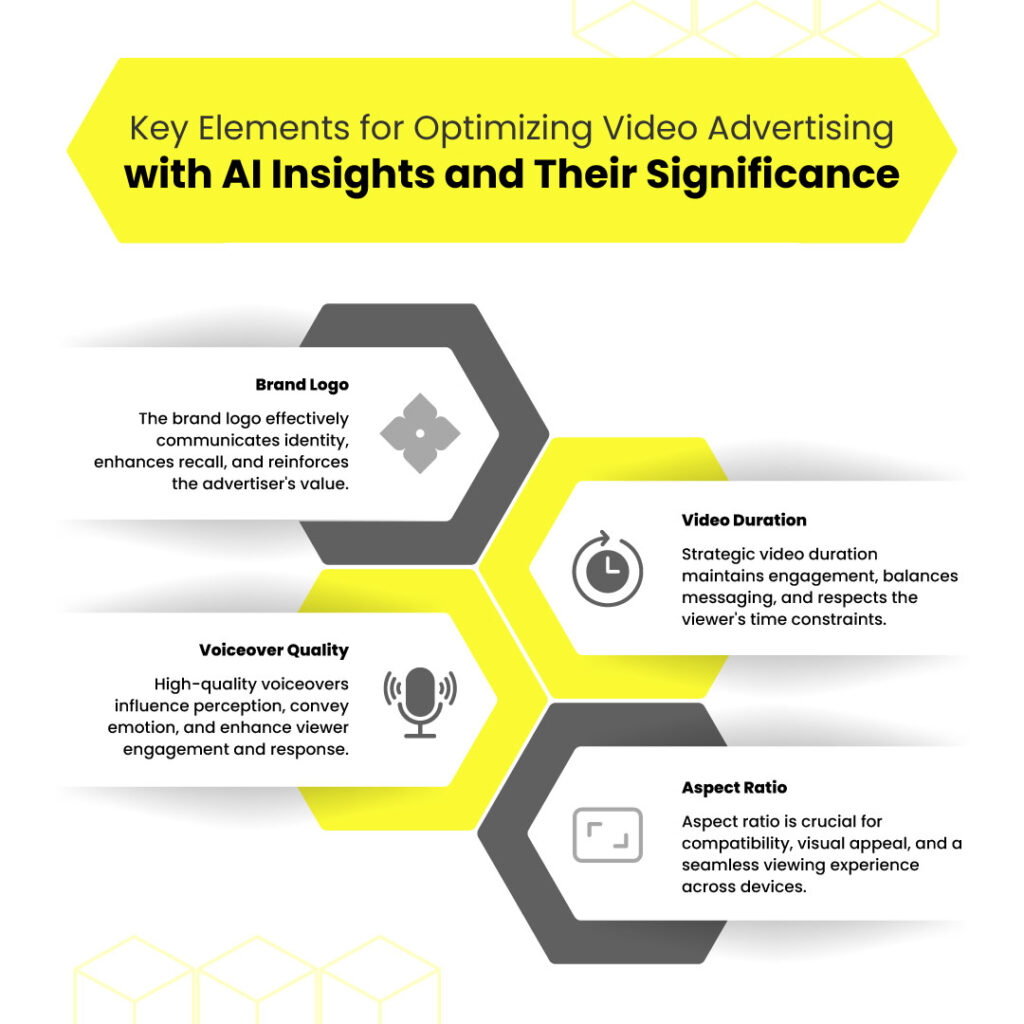
Google Ads’ recently introduced new feature evaluates video ads against Google’s best practices and assigns a score from 0 to 10. It also provides a breakdown of this score based on elements like brand logo, video duration, voiceover quality, and aspect ratio, with ratings of “Good,” “Needs improvement,” or “Missing,” along with explanations for each element.

Additionally, the feature offers specific suggestions to enhance video ads based on these ratings. For instance, it may recommend adding or enlarging a brand logo, adjusting video duration for campaign goals, or improving voiceover quality for clearer messaging.

To access this feature, advertisers should navigate to the “Video” section of their Google Ads account, select the video ad they wish to analyze, and click on the “Creative guidance” tab. Here, they can view their overall score, element ratings, and detailed suggestions.

This AI-powered creative guidance feature empowers advertisers to create more effective and engaging video ads, ultimately improving campaign outcomes.

Video Elements Analyzed by AI

Google’s AI-powered creative guidance evaluates key elements of video ads for improvement. They are as follows;

  • Brand logo

A brand logo is a powerful way to communicate the advertiser’s identity and value proposition to the viewers. It can create a lasting impression and increase brand recall. To optimize the logo display in the video ad, it is important to check its presence, visibility, and clarity. The optimal size, position, and duration for the logo can vary depending on the video content and format.

  • Video duration

A video duration is a strategic decision that affects how well the viewer pays attention, remembers, and engages with the video ad. It can balance the message delivery and the viewer’s time. To choose the right video length, it is important to consider the campaign goal, such as awareness, consideration, or action. The video content and structure should also be aligned with the goal and distribute the key messages and calls to action effectively.

  • Voiceover quality

A voiceover quality is a vital element that influences how the viewer perceives, understands, and responds to the video ad. It can convey the tone and emotion of the message and persuade the viewer to take action. To evaluate the voiceover quality, it is important to consider factors such as volume, pitch, speed, accent, and background noise. The voiceover quality can be improved by using professional voice actors or editing tools.

  • Aspect ratio

An aspect ratio is a key factor that affects the visual appeal, readability, and compatibility of the video ad across different devices and platforms. It can enhance the video quality and ensure that the video fits well on any screen. To assess if the aspect ratio is suitable for the audience and format, it is important to consider factors such as vertical, horizontal, or square. The aspect ratio can be adjusted by cropping, resizing, or reformatting the video.

AI-Powered Video Campaigns

Video advertising is a highly effective and engaging marketing method, but it can be challenging and resource-intensive to create and optimize video ads. AI-powered video campaigns leverage artificial intelligence and machine learning to automate and enhance various aspects of video production and optimization, including content generation, editing, analysis, targeting, and personalization. Here’s why advertisers should consider using AI-powered video campaigns:

  • Increased Efficiency and Productivity

AI streamlines video production by automating tasks such as video editing, adding special effects, generating subtitles, and even creating original content. This reduces the need for human intervention, saving both time and resources in the process.

  • Enhanced Creativity and Innovation

AI can generate diverse video content based on data, keywords, or images. It can suggest creative ideas and variations for video ads based on best practices and user preferences. This empowers advertisers to explore new possibilities and experiment with different styles and formats.

  • Improved Performance and Results

AI can analyze the effectiveness of video ads using various metrics like views, clicks, conversions, retention, and engagement. It optimizes video ads by adjusting content, duration, aspect ratio, voiceover quality, and other elements to align with campaign goals and target audiences. This leads to better outcomes and higher returns on investment.

AI-powered video campaigns leverage artificial intelligence to automate and enhance video production and optimization, increasing efficiency, creativity, and performance. For example, eBay’s “Fill Your Cart With Color” campaign utilized AI to create personalized video ads, resulting in a 12% increase in ad recall, a 40% increase in view-through rate, and a 9% increase in brand awareness. AI in video advertising promises greater relevance, engagement, and effectiveness, making it a valuable tool for marketers and a source of inspiration for the creative industry.

Google’s Commitment to AI in Advertising

Google has been pursuing AI integration in the advertising industry for several years, with the aim of enhancing the creativity, efficiency, and performance of its ad products and services. Some of the examples of Google’s pursuit of AI integration in the advertising industry are:

  • Google Ads

Google’s online advertising platform employs AI for creative guidance, smart bidding, responsive search ads, and dynamic display ads. These features empower advertisers to optimize campaigns using data-driven insights and industry best practices.

  • Google Marketing Platform

This unified platform combines AI-driven advanced analytics, attribution, optimization, and personalization tools. Marketers use these tools to measure and enhance marketing performance across channels and devices.

  • Google Cloud

Google’s cloud computing platform offers AI solutions tailored to various industries, including retail, gaming, media, healthcare, and education. These solutions enable businesses to leverage AI for operational transformation, product development, and improved customer experiences.

AI’s role will be instrumental in crafting more relevant and engaging ads that connect with audiences and drive action. Some of the trends and opportunities for the future of AI in advertising campaigns are:

  • Generative AI

Generative AI is a type of AI that can create original content from scratch or based on existing data, such as images, text, audio, or video. Generative AI can help advertisers produce diverse and novel ad creatives that capture attention and emotion.

  • Emotion Recognition

Emotion recognition is a type of AI that can detect and analyze human emotions from facial expressions, voice tones, body language, or text. Emotion recognition can help advertisers understand how their ads affect the viewers’ feelings and reactions.

  • Personalization

Personalization is a type of AI that can tailor ads to individual preferences, behaviors, contexts, and goals. Personalization can help advertisers deliver more relevant and customized ads that increase engagement and conversion.

Google is committed to advancing AI in advertising and media. Google believes that AI can help advertisers achieve their marketing objectives and provide better experiences for consumers. Google is also committed to developing AI responsibly and ethically, ensuring that its AI products and services are fair, safe, transparent, and accountable.

Conclusion

In the vast world of video advertising, we see a remarkable change. It’s the emergence of AI as the creative force that reshapes the advertising landscape. The main message is clear: AI, exemplified by Google Ads’ “Creative Guidance,” is the link between innovation and storytelling in the world of advertising.

The big picture shows that AI is not just about optimization; it’s a builder of narratives. It enables advertisers to create campaigns that are not only engaging but also effective and personalized. Google’s strong commitment to ethical AI highlights a future where advertising becomes a real and captivating experience, moving beyond mere interruption to genuine inspiration. Instead of repeating the same old messages, AI helps you craft unique and compelling stories that resonate with your audience. It’s a new way of expressing your vision and values, using the power of data and creativity.

Mastering App Install Campaign Optimisation: Strategies for Success

Consider your mobile app as a prime Initial Public Offering, set to captivate elite investors in a high-stakes boardroom. Just as a strategic IPO roadshow is crucial, consider app install campaigns your bespoke presentations, meticulously tailored to entice discerning stakeholders. 

App install campaigns aren’t just about increasing download numbers; they are a pivotal aspect of app marketing, aimed at forging meaningful connections between your app and potential users. They drive visibility, boost brand recognition, and most importantly, convert casual browsers into engaged users. In today’s mobile-dominated landscape, where apps reign supreme, mastering app install campaigns isn’t just a choice; it’s a crucial component of a successful app marketing strategy.

Yet, in this digital battleground, challenges abound. Adapting to ever-evolving algorithms, ensuring optimal user targeting, and standing out amidst a sea of competitors are just a few hurdles. However, within these challenges lie immense advantages. App Install Campaigns offer unparalleled opportunities for precise audience targeting, data-driven decision-making, and measurable results. 

The Elements You Can Control in App Install Campaigns

A. Operating System Device (iOS or Android):

Choosing the right platform is your first strategic move. Tailor your app install campaigns based on the predominant operating system of your target audience. Whether it’s the seamless aesthetics of iOS or the diverse ecosystem of Android, understanding user preferences guides your campaign’s direction.

B. Budgets and Bids:

Budgets and bids serve as your financial compass. Carefully allocate your budget across various platforms and adjust bids based on performance. Smart budgeting ensures your resources are utilised effectively, maximising the impact of your campaigns within your financial constraints.

C. Cost-Per-Install Caps:

Setting cost-per-install caps safeguards your budget. Establishing these limits prevents overspending while acquiring new users. By understanding the cost threshold for each installation, you maintain control over your expenses, ensuring efficient allocation of resources for optimal results.

D. Creative Assets and Copy:

Creative assets and compelling copy are your campaign’s voice and visual identity. Craft visually appealing graphics and write engaging, concise copy that resonates with your audience. Captivating creatives and persuasive language not only grab attention but also drive user interest, increasing the likelihood of installations.

E. Conversions to Track and Optimise Towards:

Identifying relevant conversion points is pivotal. Is it app installations, sign-ups, or in-app purchases? Define your key conversions and optimise your campaigns toward these goals. Tracking these metrics provides valuable insights, enabling you to refine your strategy and enhance your campaign’s overall effectiveness.

The Elements You Can’t Control in App Install Campaigns

A. Bid Adjustments:

Bid adjustments often lie beyond your control. Factors like competitor bids, market demand, and ad placements influence bidding dynamics. Adapting to these fluctuations requires strategic flexibility, allowing you to optimise your campaign within the confines of the bidding landscape.

B. Target Audience or Demographics:

The target audience and demographics are intrinsic to user behaviour and market segments. While you can refine your audience, fundamental characteristics like age, gender, and interests are beyond manipulation. Adapting your campaign strategies to align with these inherent traits ensures your message resonates authentically with your audience.

C. Network Where Ads Show:

The network where your ads appear is determined by algorithms and platform policies. While you can select specific networks, the exact placements within these networks are algorithmically decided. Adapting your creative assets and messages to fit diverse network environments ensures your message remains consistent despite varying placements.

D. Keywords or Websites Where Ads Appear:

The specific keywords or websites where your ads appear are subject to contextual relevance and user behaviour. While you can curate lists, the dynamic nature of online content means ads might appear in unexpected places. Crafting versatile ads that maintain relevance across a spectrum of contexts ensures your message remains impactful regardless of the specific keywords or websites.

Five Ways to Optimise App Install Campaigns

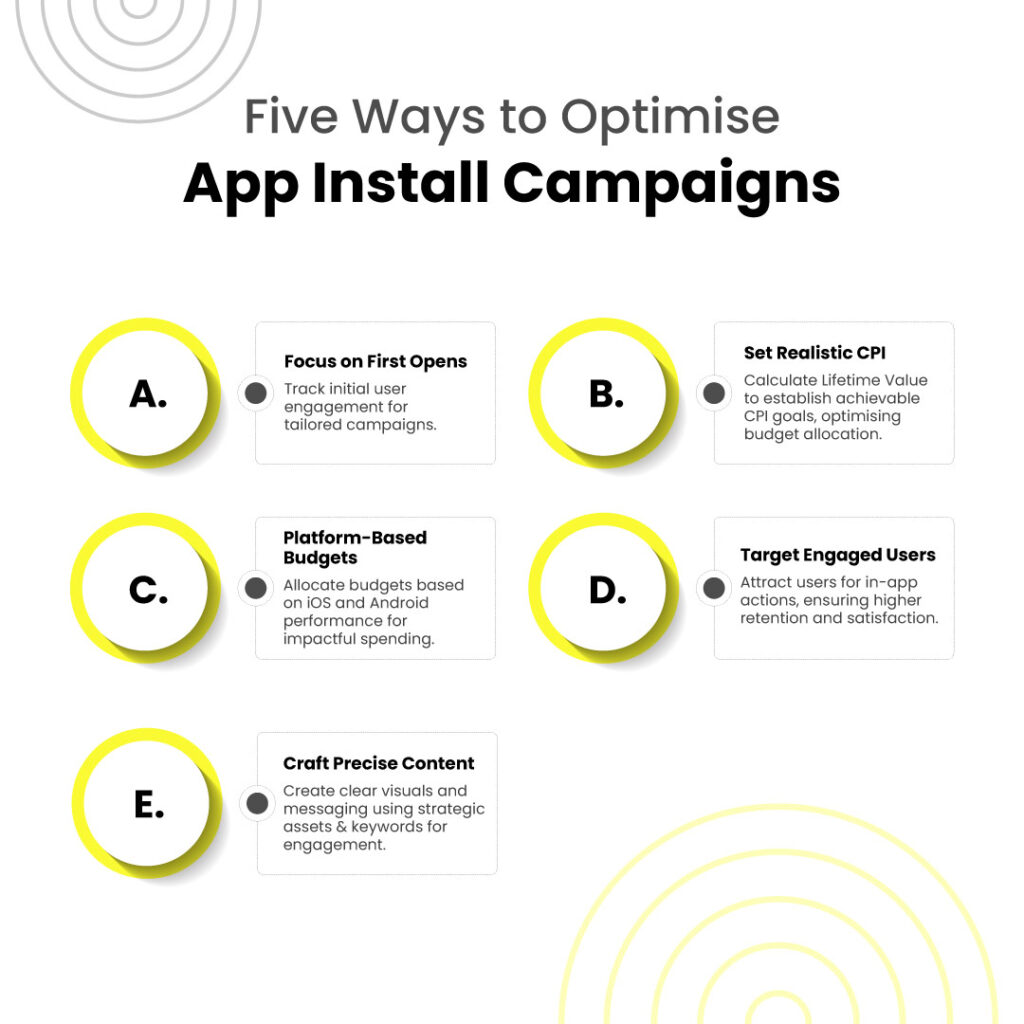
A. Optimise for First Installs, Not Downloads

Focusing on “first open” events post-installation offers deeper insights into user engagement. Importing these events into Google Ads allows for precise tracking, enabling you to tailor campaigns based on genuine user interaction rather than mere downloads. This approach ensures your app resonates with users, fostering meaningful engagement from the very beginning.

B. Understand Your “Cost Per Install” Goal

Calculate the Lifetime Value (LTV) of users to establish realistic Cost Per Install (CPI) goals. This data-driven approach aids in setting attainable CPI benchmarks, aligning your budget with the long-term value each user brings. Understanding the monetary worth of each install empowers you to invest strategically, maximising your ROI in the app ecosystem.

C. Segment iOS & Android Campaign Budgets by Performance

Allocate budgets based on individual platform performance, allowing you to optimise resources effectively. By observing campaign outcomes, adjust budgets between iOS and Android, ensuring resources are channelled where they yield the highest returns. This dynamic budget allocation approach optimises your spending, enhancing the impact of your app install campaigns.

D. Target Users More Willing To Perform In-App Actions

Identify user segments more likely to engage in meaningful in-app actions. Striking a balance between quality and volume, tailor your campaigns to attract users inclined to perform actions beyond mere installs. By understanding user behaviour patterns, your campaigns can be fine-tuned to attract users genuinely interested in your app’s offerings, ensuring higher retention and user satisfaction.

E. Create Clear, Compelling Assets & Content

The clarity and effectiveness of your ad content significantly impact user engagement. Create engaging visuals and messaging that deeply connect with your intended audience. Utilise assets effectively across various ad formats, ensuring consistency in your brand message. Strategic use of keywords and negative keywords enhances targeting precision, ensuring your ads reach the most relevant audience segments. By combining compelling content with precise targeting, your campaigns become more engaging and conversion-oriented.

In conclusion,

Analysing user behaviour, understanding engagement metrics, and deciphering the nuances of app interactions provide invaluable insights. These insights, derived from meticulous data analysis, guide precise campaign app store optimisation. By relying on concrete data rather than assumptions, businesses can make informed decisions, ensuring their app install campaigns are not just impactful but also cost-effective.

Tailoring strategies to align with company goals ensures that marketing efforts are not just generic but purposeful. Whether the focus is on increasing user engagement, maximising lifetime value, or expanding the user base, aligning strategies with these specific objectives amplifies the impact of app install campaigns. 

In essence, mastering app install campaign optimisation demands a holistic approach where data-driven decisions and strategic alignment converge as one.

Mastering Shopify SEO: A Comprehensive Guide to Boosting Your Online Store’s Visibility and Sales

Shopify stands as a powerful platform in the e-commerce domain, enabling entrepreneurs to set up and run online stores with remarkable ease. However, amidst the virtual shelves and digital transactions, there exists a vital element that can make or break the success of any Shopify store: Search Engine Optimisation (SEO). 

In an era where online visibility is synonymous with credibility and trust, SEO plays an essential role in ensuring that Shopify stores not only get noticed but also thrive. Effective SEO techniques can significantly enhance your store’s online visibility, making it more likely to appear in search engine results. This visibility isn’t just about being seen; it directly impacts the influx of organic traffic, drawing potential customers to your virtual storefront. By optimising your Shopify store, you attract relevant visitors and enhance user experience, making it more likely for visitors to stay, explore, and ultimately make a purchase. 

How Do You Improve SEO on Shopify?

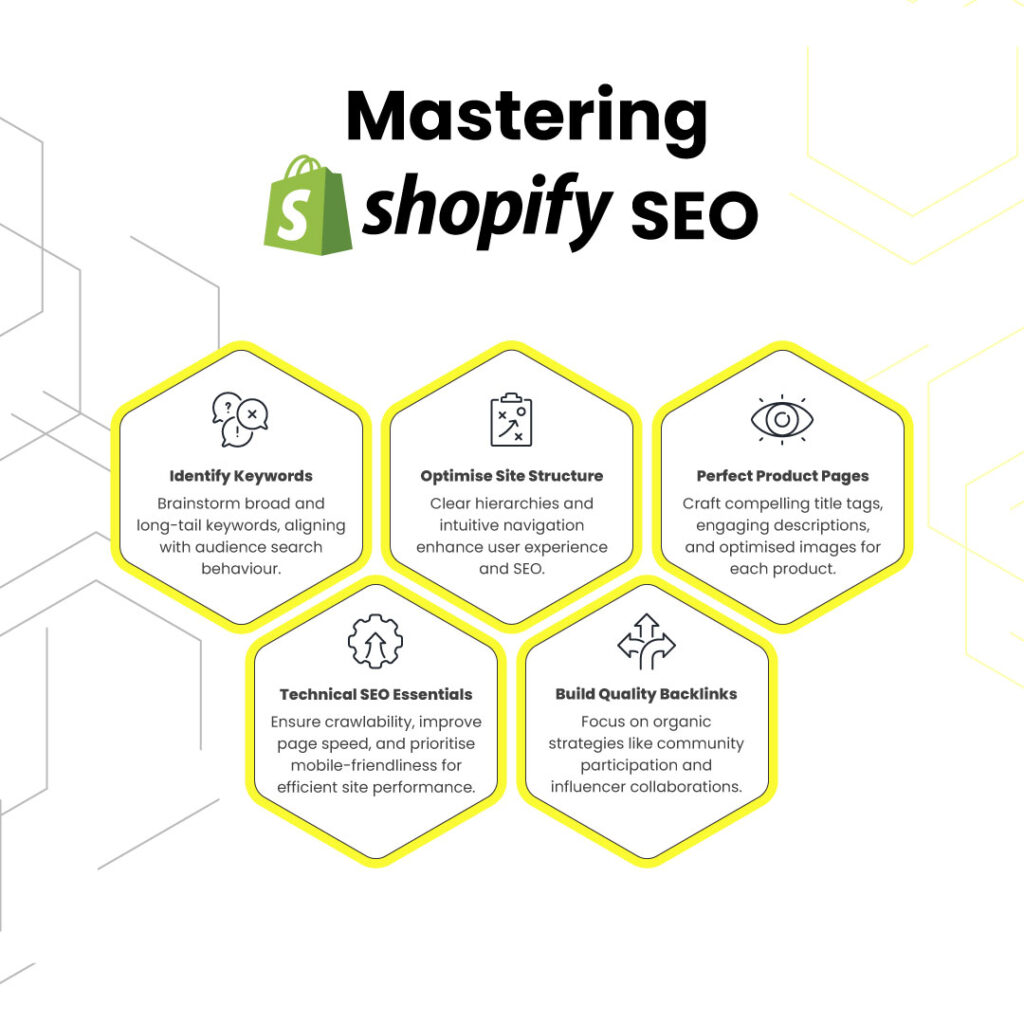
Step 1: Identify the Right Keywords for Your Shopify Store

In the competitive realm of online retail, the key to unlocking your Shopify store’s full potential lies in understanding the intricacies of keyword research. This essential process not only bridges the gap between your offerings and customer intent but also significantly enhances your store’s visibility in the vast digital marketplace.

  1. Keyword Research for Shopify

Effective research begins with understanding your audience. Brainstorm broad keywords related to your products, considering customer feedback and social media trends. Analyse competitors and trending topics to refine your list, aligning it with your audience’s search behaviour.

  1. Long-tail keywords

Long-tail phrases cater to niche audiences, offering focused relevance. Despite lower search volume, they attract highly interested customers, crucial for niche markets. Optimising for these specific keywords ensures your Shopify store appears in precise searches, boosting visibility, increasing conversions, and engaging customers effectively.

Step 2: Set up the Right Shopify Site Structure

Your Shopify site’s structure serves as the architectural blueprint that underpins your SEO success. A well-organised and intuitive site structure not only enhances user experience but also signals search engines, guiding them to index and rank your pages effectively.

  1.  Importance of Site Structure in SEO

A well-organised site structure is vital for SEO, enabling efficient crawlability and indexing. Clear hierarchies enhance search engine understanding, ensuring accurate categorisation of products and content. Proper structure is the foundation for search engines to navigate and rank your Shopify store effectively.

  1. Creating a User-Friendly Navigation

User-friendly menus and logical product categorisation enhance visitor experience. Clear labels and intuitive design help users understand content. Implementing internal links guides users to explore more products. A seamless navigation system ensures visitors can easily discover and engage with your Shopify store.

Step 3: Optimise Shopify Product and Collections Pages On-Page SEO

Mastering the optimisation of product and collections pages is akin to crafting a compelling narrative for your online store. Each element, from title tags and meta descriptions to product descriptions and image optimisation, weaves together to form a seamless user experience and bolster your search engine visibility.

  1.  Title Tags and Meta Descriptions

Craft descriptive, keyword-rich title tags and enticing meta descriptions. Incorporate relevant keywords naturally for your target audience’s search intent. Well-optimised tags and descriptions enhance click-through rates and visibility in search results.

  1.  Product Descriptions

Create detailed product descriptions outlining features, benefits, and unique selling points. Engage visitors with persuasive language, addressing common queries organically. Ensure descriptions feel natural, informative, and incorporate relevant keywords seamlessly.

  1.  Image Optimisation

Optimise images by compressing without loss of quality for faster loading. Use descriptive file names and relevant alt text with keywords. Properly optimised images enhance site speed and contribute to accessibility, ensuring search engines understand your visual content.

Step 4: Find and Fix Shopify Technical SEO Issues

Addressing technical issues is akin to fine-tuning the engine of a high-performance vehicle. Technical SEO ensures that your Shopify store operates at peak efficiency, not only pleasing your visitors but also impressing search engines.

  1. Crawlability and Indexability

Ensure search engines can crawl effectively using robots.txt and submit a comprehensive XML sitemap. Regularly check for crawl errors with tools like Google Search Console, addressing issues promptly to maintain site visibility.

  1. Page Speed Optimisation

Improve loading speed by compressing images, utilising browser caching, and reducing code complexity. Implement lazy loading for images and videos to enhance user experience. Fast-loading pages reduce bounce rates, boosting engagement and positively impacting SEO rankings.

  1. Mobile-Friendliness

Adopt a responsive design for seamless mobile experience. Test on various devices and browsers to ensure uniform functionality. Google prioritises mobile-friendly sites, making mobile optimisation crucial for technical SEO. Responsive design guarantees consistent user experience across devices, enhancing your site’s search engine rankings.

Step 5: Build Better Links in Shopify

Backlinks are the digital endorsements that elevate your Shopify store’s credibility and visibility. Building high-quality backlinks isn’t just a strategy; it’s an essential art that propels your online presence.

  1.  Importance of Backlinks in SEO

Backlinks signal your store’s credibility to search engines, influencing rankings. Links validate content authenticity, establishing trust and relevance. The more high-quality backlinks your Shopify site earns, the more credible it becomes, boosting visibility and attracting organic traffic effectively.

  1.  Strategies for Building Quality Backlinks

Build backlinks organically through guest posts on industry blogs, collaborations with influencers, and engaging content creation. Craft shareable infographics and in-depth articles to naturally attract links. Active participation in online communities and social media platforms can also lead to valuable backlink opportunities, enhancing your store’s authority.

Other Shopify SEO Tips

In the landscape of Shopify SEO, staying ahead requires a multifaceted approach. In this final step, we’ll explore these advanced techniques, unveiling how they synergise with your Shopify store to create a compelling online presence.

  1.  Content Marketing

Craft engaging content addressing common queries and showcasing products. Utilise blogs, videos, and podcasts to resonate with your audience. High-quality, regularly updated content positions your Shopify store as an authoritative source, attracting organic traffic and fostering credibility.

  1. Social Media Integration

Integrate your store seamlessly with platforms like Facebook and Instagram. Leverage social media for product showcases and promotions. Encourage sharing through social buttons, fostering engagement. Timely responses to comments and messages enhance your social media presence, creating an interactive online community.

  1.  User-Generated Content

Encourage customers to provide authentic reviews and product showcases. Highlight user-generated content on product pages, fostering trust. Engage with contributors, expressing gratitude and featuring their contributions. User-generated content not only provides social proof but also enhances your Shopify store’s credibility and customer engagement.

Shopify SEO Is the Secret Ingredient to a Successful Shopify Store

Shopify SEO isn’t just a feature; it’s the backbone of a thriving online store. Effective SEO strategies enhance visibility, attract organic traffic, and drive conversions. By optimising product pages, leveraging keywords, and building quality backlinks, Shopify stores can significantly improve their search engine rankings, leading to increased brand exposure and higher sales potential. Understanding the nuances of SEO is essential for any e-commerce venture aiming to succeed in the fiercely competitive digital landscape.

Numerous successful Shopify stores stand as testimonials to the power of SEO. Brands like Gymshark, Allbirds, and MVMT Watches have mastered the art of Shopify SEO, utilising techniques like content marketing, social media integration, and user-generated content to enhance their online presence. These examples showcase how strategic SEO implementation can transform a Shopify store from a digital storefront into a thriving online business, attracting customers from all corners of the internet.

Real-life case studies offer compelling evidence of the impact of SEO on Shopify stores. From modest beginnings to substantial revenue growth, these case studies demonstrate the transformative effect of SEO optimisation. By implementing tailored SEO strategies, businesses have witnessed significant improvements in their search rankings, organic traffic, and, ultimately, their bottom line. These success stories serve as inspiration, highlighting the tangible benefits of investing in Shopify SEO.

Common Shopify SEO FAQs

Q1: Is it necessary to hire an SEO expert for my Shopify store, or can I handle SEO on my own?

Whether you need an SEO expert depends on your familiarity with SEO practices and the complexity of your store. Shopify provides user-friendly tools and guides, allowing beginners to handle basic SEO tasks independently. However, for in-depth optimisation, technical issues, or competitive markets, consulting an SEO expert can provide valuable insights and ensure your strategies align with the latest search engine algorithms.

Q2: How long does it take to see results from Shopify SEO efforts?

The timeline for seeing SEO results varies based on multiple factors, including the competitiveness of your niche, the quality of your SEO efforts, and your website’s history. Generally, significant improvements might take a few months to become noticeable. Consistent efforts, such as creating high-quality content, building backlinks, and improving user experience, contribute to sustained, long-term SEO success. Patience and consistent optimisation are key when it comes to SEO.

Q3: Can Shopify apps improve my SEO?

Yes, Shopify apps can enhance your SEO efforts. There are various apps available that offer features like automated SEO optimisation, sitemap generation, and image compression, helping you streamline your SEO tasks. However, it’s essential to choose reputable apps that align with your specific SEO goals; a well-rounded SEO strategy involves diverse tactics.

In conclusion,

Mastering Shopify SEO is not just a valuable skill; it’s a necessity in the fiercely competitive realm of online retail. As the digital marketplace continues to expand, ensuring your online store’s visibility and sales requires a strategic approach to search engine optimisation specific to the Shopify platform and e-commerce SEO.

By delving into the intricacies of Shopify SEO, you unlock the potential to reach a broader audience. Higher visibility on search engine results pages translates to increased organic traffic, offering a consistent customer base. But it’s not merely about attracting visitors; it’s about attracting the right kind of visitors – individuals actively searching for products or services you offer. Shopify SEO allows you to align your store with these user intentions, ensuring that those who land on your site are more likely to convert into paying customers.

Uncovering Competitive SEO Insights: A Step-by-Step Guide to Success

Where visibility can make or break a business, mastering the intricacies of Search Engine Optimisation (SEO) is nothing short of essential. In a virtual marketplace saturated with countless businesses vying for attention, your position on search engine results pages (SERPs) can make all the difference. In this digital battleground, the key to ascending the ranks lies in deciphering the strategies of your competitors.

Enter the realm of SEO competitive analysis, a strategic endeavour that goes beyond the surface of rankings, delving into the heart of keywords and user preferences. By unravelling where your competition excels and where they falter, you gain a profound understanding of the very fabric that shapes online success. It’s not merely about identifying keywords; it’s about grasping the nuances of user engagement, decoding the content that resonates, and uncovering the SEO insights that propel your competitors to prominence.

In this blog, we will explore the backdrop of SEO competitor analysis, providing actionable insights to enhance your online presence and improve your SEO efforts.

The Power of Competitive SEO Insights

SEO competitor analysis is a strategic process of evaluating and understanding your competitors’ online presence, including their website performance, keyword rankings, content strategies, and backlink profiles. By analysing these factors, businesses can identify opportunities, uncover weaknesses, and develop effective SEO strategies to improve their own online visibility and outrank their competitors in search engine results pages (SERPs). Essentially, it helps businesses stay ahead in the digital landscape by learning from their competitors’ successes and failures through SEO insights.

How Do You Perform an SEO Competitor Analysis?

Performing a thorough SEO competitor analysis requires a combination of strategic thinking, analytical tools, and a keen understanding of your industry landscape. By delving deep into these steps, you gain the knowledge and insights needed to refine your own SEO strategies, outrank your competitors, and secure a prominent position in the digital arena.

  1.  Identifying Your SEO Competitors

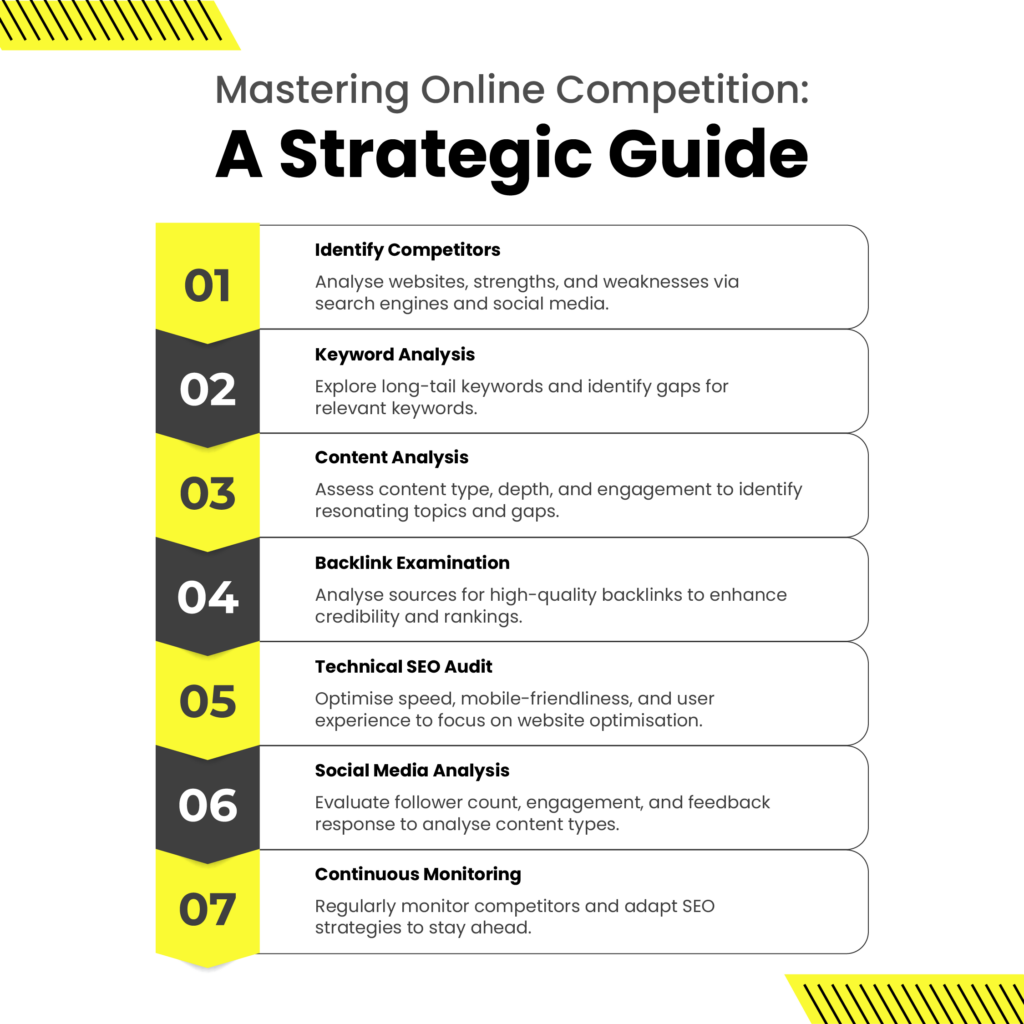
Begin by identifying your primary competitors in the online sphere. These are businesses targeting similar keywords or catering to the same audience. Use tools like Google search, industry directories, or social media platforms to pinpoint potential competitors. Once you have a list, analyse their websites, social media profiles, and content. Scrutinise their strengths, such as user-friendly interfaces or compelling content, and note their weaknesses, such as slow loading times or outdated designs. Understanding your competitors’ digital presence sets the stage for a comprehensive analysis.

  1.  Deciphering Competitor Keyword Strategies

Keywords are the foundation of SEO, making keyword analysis a crucial step. Identify the keywords your competitors are ranking for by using tools like SEMrush or Ahrefs. Pay attention to both organic and paid keywords. Evaluate the relevance and search volume of these keywords to determine their potential value for your business. Additionally, explore long-tail keywords that might be less competitive but highly relevant to your niche. Understanding the keywords your competitors target allows you to identify gaps and opportunities in your own keyword strategy, enabling you to target specific terms that might be overlooked by your competition, giving you an edge in search engine rankings.

  1.  Crafting a Winning Content Strategy

Content quality and relevance significantly impact SEO. Analyse your competitors’ content strategy by evaluating the type of content they produce, such as blog posts, videos, or infographics. Assess the depth of their content – are they providing in-depth guides or concise overviews? Evaluate the engagement metrics, such as social shares and comments, to gauge audience response. Identify the topics and themes resonating with their audience, and pinpoint gaps in their content that you can fill. Content analysis not only guides your own content creation but also helps you identify opportunities to offer unique, valuable content that can attract and retain your target audience.

  1. Building Backlinks Like a Pro

Backlinks are intrinsic to SEO authority. Analyse your competitors’ backlink profiles to understand the quality and quantity of their inbound links. Evaluate the types of websites linking to them – are they reputable industry sites, influential blogs, or social media platforms? Identify the specific pages on their site that receive the most backlinks. This analysis provides insights into their link-building strategies and allows you to identify potential link-building opportunities for your own website. By securing high-quality backlinks from authoritative sources, you enhance your website’s credibility and improve your search engine rankings.

  1. User Experience (UX)

A comprehensive technical SEO audit reveals the underlying health of your competitors’ websites. Assess factors such as website speed, mobile-friendliness, and overall user experience. Check their website structure, URL hierarchy, and internal linking strategy. Identify any technical errors, such as broken links or crawl issues, that might affect their SEO. By understanding their technical strengths and weaknesses, you can focus your efforts on optimising your own website for superior user experience and search engine performance.

  1. Social Media Presence Analysis

Social media is integral to online visibility and engagement. Evaluate your competitors’ social media profiles across platforms like Facebook, Twitter, Instagram, and LinkedIn. Assess their follower count, engagement metrics, and content frequency. Determine the type of content they share – is it informative articles, promotional offers, or interactive multimedia? Analyse audience interactions, such as likes, comments, and shares, to gauge the effectiveness of their social media strategy. Additionally, examine their response to customer feedback and concerns. 

  1.  Continuous Monitoring and Adaptation

Conducting a competitive analysis is not a single occurrence but a continuous and ongoing process. Keep a vigilant eye on your competitors’ digital activities, tracking changes in their strategies, keywords, and content. Adapt your own SEO strategies based on these insights, capitalising on emerging opportunities and adjusting your approach to counter their moves. Continuous monitoring ensures that your business remains agile and responsive in the ever-changing digital landscape, allowing you to maintain a competitive edge and sustain your online visibility over time.

Best Practices After Completing an SEO Competitor Analysis

After completing a comprehensive analysis of your competitors’ strategies, implementing credible steps is essential to refining your own approach and ensuring sustainable growth in the competitive world of digital marketing.

  1.  Leverage Insights for Content Optimisation

After completing an SEO competitor analysis, focus on optimising your content strategy. Identify the gaps and opportunities uncovered during the analysis. Develop high-quality, relevant, and engaging content targeting the keywords your competitors might have missed. Craft in-depth guides, multimedia resources, or interactive content that provide unique value to your audience.

  1. Strengthen Your Link-Building Strategy

Harness the backlink insights acquired from your competitors to fine-tune your link-building strategy. Identify reputable websites and influential figures linked to your competitors, then craft targeted outreach campaigns to secure backlinks from these authoritative sources. Develop compelling and shareable content that naturally draws in backlinks. Cultivate relationships with influencers and industry leaders, encouraging them to link to your valuable resources. By forging these connections, you not only enhance your website’s authority but also establish a network that fosters organic growth and credibility in the digital realm.

  1. Optimise Technical Aspects for Superior User Experience

Implement the findings from your competitor analysis to optimise your website’s technical aspects. Improve website speed by compressing images, leveraging browser caching, and minimising server requests. Ensure your website is mobile-friendly, providing seamless navigation on various devices. Enhance user experience by optimising website structure, improving internal linking, and fixing broken links. 

By regularly conducting website audits to identify and rectify technical issues, you prioritise technical optimisation based on competitor insights, enhancing user satisfaction, engagement, and boosting your website’s visibility in search engines.

In conclusion,

embracing the practice of competitive SEO insights is not just a digital marketing strategy; it’s the compass that guides businesses toward unparalleled online success. By meticulously dissecting the strategies of competitors, businesses unlock a wealth of insights that go beyond mere rankings and traffic numbers. It’s a journey of constant adaptation, where understanding consumer preferences is the key to staying ahead. 

In a world where online visibility is synonymous with brand influence, this strategic analysis becomes the catalyst for businesses to thrive, fostering innovation, customer engagement, and enduring market relevance. Embracing the power of competitive SEO analysis isn’t just a choice; it’s the pathway to digital eminence and sustained growth in the ever-evolving online sphere. To leverage your website on Google, contact HOP’s expert SEO team today!

Home of Performance & Performance One Car Rental Drive Up Success Together

We at Home of Performance are excited to announce a groundbreaking partnership with Performance One Car Rental, the esteemed luxury and supercar rental business based in Dubai. This strategic collaboration is set to elevate Performance One Car Rental’s brand awareness and boost customer acquisition through a holistic approach that combines PPC, SEO, and Social Media campaigns.

As part of this innovative partnership, we will leverage our vast experience and expertise in the digital marketing sphere to create and implement a comprehensive marketing strategy that aims to establish Performance One Car Rental as a prominent luxury and supercar rental destination in Dubai.

John Von Hofsten, Founder & MD, Home of Performance, expressed enthusiasm about the partnership, saying, “We are honored to have Performance One Car Rental as our esteemed client and look forward to taking their brand to new heights. Our agency is committed to delivering top-tier digital marketing solutions that will enhance brand visibility and drive conversions for Performance One Car Rental.”

Marc Gyoerf, Partner at Performance One Car Rental, shared his thoughts on the collaboration, stating, “At Performance One Car Rental, we’ve always been dedicated to providing an unmatched luxury and supercar rental experience in Dubai. Partnering with Home of Performance is an exciting step toward reaching a broader audience who share our passion for luxury vehicles. We believe this partnership will strengthen our position in the market and provide exceptional value to our clients.”

The integrated digital marketing approach will encompass pay-per-click (PPC) advertising to boost immediate traffic and lead generation, search engine optimization (SEO) to improve organic visibility and search rankings, and social media campaigns to engage with the audience and cultivate a loyal community of luxury and supercar enthusiasts.

This partnership between Home of Performance and Performance One Car Rental is set to redefine the luxury and supercar rental landscape in Dubai. By combining cutting-edge digital marketing strategies with Performance One Car Rental’s exceptional fleet of ultra-luxury vehicles and top-tier service, this collaboration aims to deliver an unparalleled experience for clients and a stronger brand presence in the region.

About Performance One Car Rental

Performance One Car Rental LLC is a luxury and supercar rental business based in Dubai. They carry an impressive fleet of ultra-luxury vehicles which can be booked online and delivered anywhere in Dubai. Performance One Car Rental also endorses Cryptocurrencies and includes Bitcoin and Tether as acceptable payment methods.

Got questions? Reach out to us

Google Autocomplete: Managing Reputational Risks and Negative Keywords

Online reputation is a valuable asset for business success. It can attract and retain potential customers, partners, and investors who trust the brand. This is why it is important to be aware of how Google autocomplete can affect online reputation in seconds.

Google autocomplete is a feature that helps users find what they are searching for by suggesting possible queries as they type. It can save time and effort by predicting the user’s intent and providing relevant results. However, Google autocomplete can also affect online reputation, especially when it shows negative keywords related to a brand or a person. 

In this blog post, we will explain how Google autocomplete works, the dangers of negative autocomplete keywords, and how to deal with them effectively.

How Google Autocomplete Predictions Work

Google autocomplete suggests queries based on real searches that match the user’s input. It also considers the user’s language, location, and history to make the predictions more relevant and personalised. It can predict words and phrases from the web to help users complete complex queries. Google autocomplete can also use AI to generate answers for questions that have no clear answer. 

This feature is called Google’s Search Generative Experience (SGE) and it provides quick and reliable answers. It is also known to change and improve new searches and information added to the web. However, Google has policies and measures to avoid inappropriate or misleading predictions.

Reputational Risks of Negative Autocomplete Keywords

Google autocomplete can be a useful feature for users, but it can also pose a serious threat to the reputation of brands and individuals. Negative autocomplete keywords can create a negative impression of the target before the user even clicks on any search result. This can affect the user’s perception, attitude, and behaviour towards the target, as well as influence the opinions of others who see the same predictions.

Negative autocomplete keywords can have various consequences for the target, depending on the type and severity of the negative term. Some of the possible outcomes are:

  • Loss of brand value and trust

Negative autocomplete keywords can harm a brand’s image and credibility. When users see suggestions like “product name + scam” or “product name + complaints,” it erodes confidence in the product and its manufacturer. This can lead to reduced sales, recommendations, and customer loyalty, impacting the brand negatively.

  • Decrease in web traffic and conversions

Negative autocomplete Google suggestions can deter users from visiting a website or engaging with an online presence. For instance, autocomplete suggestions like “celebrity name + scandal” can lead to a decline in visits, likes, shares, and comments, impacting the online visibility and attractiveness of the target.

  • Amplification of misinformation and discrimination

Negative autocomplete keywords can inadvertently spread false or biassed information and foster discrimination. When biassed or offensive google auto suggestions appear in searches about political or social issues, users might be influenced, leading to misguided or prejudiced opinions. This, in turn, affects the quality and diversity of information accessed online.

Amplification of Misinformation and Discrimination

Google search autocomplete can negatively impact the quality and diversity of online information. It can unintentionally spread false or misleading information based on popular but unverified searches, potentially leading users to form erroneous beliefs. Additionally, it can promote discrimination and hate by suggesting biassed, derogatory, or offensive terms associated with specific identities, such as race, gender, religion, or sexual orientation.

Google is aware of these issues and has taken steps to prevent harmful autocomplete predictions. However, these steps may not always effectively address the dynamic nature of online information and behaviour. Therefore, users should be cautious and exercise critical thinking when using this feature.

The Role of AI in Google Autocomplete

Google autocomplete uses AI to generate predictions, especially for questions that have no clear or definitive answer. These predictions are generated by artificial intelligence (AI). This prediction is not based on a pre-existing web page but rather on Google’s Search Generative Experience (SGE), which uses generative AI to summarise data from various sources and provide quick and reliable answers. SGE builds on Google’s AI advancements, including BERT and MUM.

SGE can help users find information faster, but it also raises ethical and social issues related to user trust in AI. User trust in AI depends on trustworthiness, user characteristics, and task context, affecting user perception, attitude, and behaviour towards AI systems and others.

It is essential to address challenges in building user trust in AI, such as avoiding anthropomorphization and ensuring reliability and accountability.

Google’s Approach to Harmful Autocomplete Predictions

Google has policies and guidelines to restrict predictions on autocomplete. These include prohibiting search predictions that violate the law, promote violence or hatred, contain explicit or abusive language, disclose personal or sensitive information, misinform or deceive users, or impersonate entities or individuals.

To enforce these rules, Google uses automated and manual methods. Machine learning and natural language processing are used to detect and filter out harmful predictions. Human reviewers assess prediction quality and accuracy, and user feedback is used to identify and remove inappropriate predictions.

Google acknowledges that its approach is not perfect, as some harmful predictions may slip through, and legitimate ones may be mistakenly filtered. They update policies to adapt to changing online standards, enhance systems for more accuracy, and engage with stakeholders to address ethical and social concerns related to autocomplete predictions.

How to Remove Negative Autocomplete Keywords

There are two main ways to remove negative autocomplete keywords: reporting them to Google or suppressing them with positive keywords.

  • Reporting to Google

You can report predictions that violate Google’s policies by clicking “Report inappropriate predictions” below the prediction. Google will analyse your feedback and may take time to review and update its predictions or reject your request if insufficient evidence is found for removal.

  • Suppression with positive keywords

Another method to remove negative autocomplete keywords is by suppressing them with positive ones. This involves creating and promoting content with positive keywords related to your brand or name, increasing their search volume and popularity to replace negative keywords in Google autocomplete. Some of the strategies for suppressing negative keywords with positive ones are:

  • Creating and optimising your website and social media profiles with positive keywords in various elements.
  • Publishing high-quality content that highlights your expertise, achievements, testimonials, and positive reviews.
  • Engaging with your audience and influencers on social media with positive keywords.
  • Generating positive word-of-mouth and referrals from customers, partners, employees, and friends.
  • Monitoring and managing your online reputation by responding to online mentions with positive keywords.

Suppressing negative keywords with positive ones can be a long-term and ongoing process that requires consistent effort and investment. It may also require professional help from reputation management experts who have the skills and tools to create and promote positive content for you.

Managing Reputational Risks

Reputational risks are the potential threats or challenges that can harm the reputation of a business or individual. These risks can arise from various sources, such as negative customer feedback, unfavourable media coverage, misinformation or disinformation, legal or ethical issues, or technical or operational issues.

To manage reputational risks effectively, it is essential to have a reputation management strategy.

By following these steps, you can protect and enhance your reputation in the digital age. You can also leverage your reputation as a competitive advantage that can help you achieve your goals and objectives.

Conclusion

In the broader context, this discussion prompts readers to contemplate the societal impact of reputation management and the considerable influence of tech platforms on public perception. It highlights the delicate equilibrium between information dissemination and potential reputational consequences in our interconnected world. Beyond tactical strategies, it encourages a reflection on the ethical, social, and technological dimensions of our digital lives. It emphasises the need for proactivity, adaptability, and informed engagement in a landscape where online reputation significantly affects personal and professional trajectories. This discussion serves as a call to acknowledge the evolving digital landscape and the responsibilities it entails, guiding us through the dynamic intersection of technology, reputation, and our shared digital future.