Disavowing Links: The Do’s and Dont’s.

There is no denying that Link building plays a big part in your SEO strategy. But the fact is that not every website that links back to your site is not worth it. It can affect your overall rankings, domain authority and performance when there are too many low-quality links associated with your website. The best practise is to reach out to the website publisher manually and try removing the low-quality links if that is not working the next best option is to disavow backlinks. 

What is Link Disavowing?

As I mentioned earlier, disavowing links should always be your last option. Disavowing link is telling Google the particular link is harming your site in terms of overall performance. It doesn’t remove the links, but signals google not to consider any link from that site when it comes to ranking factors. Don’t prioritize disavowing across the board as it might hurt your own SEO. 

5 Types of Links you need to consider disavowing

Bad backlinks come in different types. Although this doesn’t include every type of link that you should disavow, the most common types that you have to consider as a starting point. 

  1. Forum Spam Links 

Google doesn’t encourage users linking back to random materials in forums or comments. If you think that this will help your backlink profile, you got this wrong. Say for example; in a popular forum like Quora or Reddit, if you try to flood with links back to your website without any context, Google will consider it as spam and penalize your website. 

  1. Expired Domain Links

If you have links that are coming from expired domains, this is a clear violation of webmaster guidelines and google can penalize you for the same. So if you have some backlinks that are coming from expired domains this is one category that you should seriously consider removing.  

  1. Low Quality & Spammy Site Links

Like the expired domain links, another category which you should consider disavowing is a low quality and spammy site backlinks. If you don’t consider removing these links, there is a chance that your website is being targeted by a negative SEO attack. So it is always important to keep an eye on the search console on the actions required. 

  1. Directory Submissions

Submitting your link to low-quality is not a good practice to follow when it comes to SEO. But that doesn’t say that directory submission doesn’t play any part in the same. Always try to acquire links from relevant and targeted directories. Especially when it comes to Local SEO, if you can get relevant backlinks it definitely improves your overall SEO performance. Here is a list of relevant directories as per Hubspot. 

  1. Links From Cheap Link Building Services

This is another Link building tactic you should certainly avoid. Even though they are not part of google’s guidelines, we suggest that you avoid this link building method. Links from fiver and other cheap link building services more often can do harm rather than proving beneficial to your SEO efforts.

Should You Disavow Backlinks?

This is a question that definitely needs clarity. If you get a manual action notification from Google or suspect one in the future, you should consider disavowing backlinks. 

This manual action message could be a warning sign of bad links, spammy links and other unhealthy links to your website. To avoid this scenario always follow the healthy link building strategy, regularly check your backlink profile and check out for the suspicious links that may lead to negative SEO attack that will harm your website overall performance.  

As mentioned in the beginning always follow the option of reaching out to the website publisher via email to remove the link directly. If that doesn’t work out, consider disavowing the links if you come across the following: 

  • You get a manual action message
  • Suspect a lot of spammy, low-quality backlinks to your website
  • A sudden drop in your performance due to these low-quality links. 

How To Disavow Using Google Search Console?

As you know Google search console is an important tool when it comes to SEO. GSC helps you manually select the links which Google should ignore to avoid potential negative effects. But if you don’t use it wisely for disavowing, it might affect you negatively. 

Here are the steps for disavowing backlinks in Google Search Console:

  • Download the backlink profile
  • Conduct a full backlink audit
  • Create a disavow file and upload it to the google search console

1) Download the backlink profile

Before you start considering disavowing backlinks, find out the links that are harming your website. Use tools like Ahrefs, Semrush, Moz to download your backlink profile. By using these tools you can keep track of the backlinks.

  2 ) Conduct a full backlink audit

Now that you have a backlink profile, conduct a detailed audit of the backlink profile to identify the spammy links that can harm your website performance. The Disavow tool helps to get rid of spammy and irrelevant links. 

3)  Upload the file in Google Search Console

After you have a detailed list of your link profile, you can consider removing the links. This isn’t a too technical and complicated process.  It can be easily done using the disavow tool in Google Search Console. 
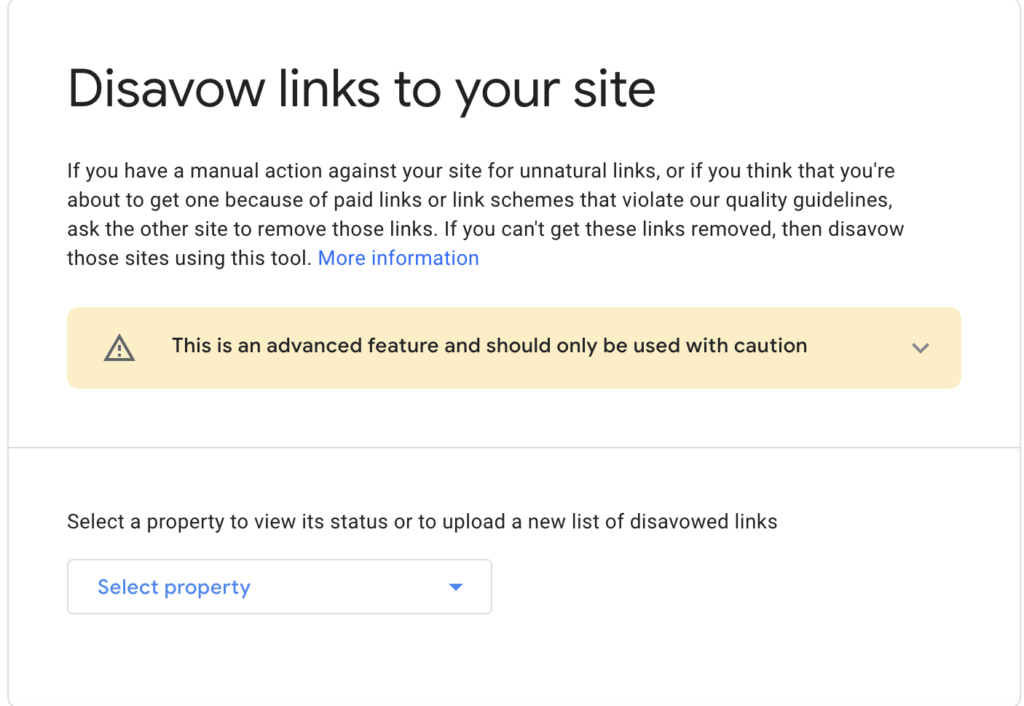
  • Go to Disavow tool in Google Search Console
  • Select your property
  • Upload your .txt file

To Conclude

As we say, when it comes to Link Building, Focus on quality rather than quantity of links. Be alert on the incoming links that can harm your site’s authority and reputation. You can use tools like Semrush, Ahrefs or Moz to do regular audits. Disavowing should be done based on your priorities, overdoing it might do more harm than good for your site.


Got questions? Reach out to us.


The 9 Most Important SEO Ranking factors

In this digital age, how do you think your prospects will find you: they go and search online. Say, for example, if they want to find an agency providing Local SEO services, they go online search for best “Arabic SEO services”. If you are spotted on the first page of Google, there is a higher chance that you will be converting that prospect into a client. How do you get yourself on the first page of google? 

Well paid ads are the best way to gain instant exposure, nothing can get better credibility than getting them in the top of the search engines organically. No matter what business you own, being there at the top of the search engine is important for the long run if you want to attract the prospects and drive revenue. 

What is SEO? 

Defined by Ahrefs,  SEO (Search Engine Optimization) is the practice of optimizing content to be discovered through a search engine’s organic search results. 

What are the ranking factors?

Ranking factors are certain aspects of your website that determines how well your page will perform in the organic search.  Well, there are more than 200+  factors that will have an impact on your search rankings. Not all are equally important, but some are very important enough to have an impact on your organic performance. In this blog, we are going to discuss those important factors.

How does google algorithm have an Impact on this? 

The reality is that no one could control the search engine algorithm. What you can focus on and what you should do is about optimising your website with various ranking factors. In this post, let’s look at some of the very important factors that you should take into account while optimising your website. 

Before we deep dive into details; these factors can change as google updates its algorithm very frequently to provide a better user experience. So it is important to stay up to date on the latest Google algorithm changes to ensure that you are up to date with the best SEO practises.

The Important 9 SEO Factors

  1. Security

In most of the updates, Google has stressed the importance of site security. Over the years now, it is one of the most important factors that can have an impact on your ranking. Always use HTTPS encryption, which gives an SSL certificate to your website, ensuring a secure connection between you and your end to end-users. Search engines always prefer to drive users to trusted websites.

  1. Crawlabity

Search engines cant rank your website if they can’t find it. Search engines must crawl your website to determine what the website is all about, review the content and determine how it should rank. There are certain steps you need to follow to allow search engines to crawl your website

  • Submit the sitemap
  • Use Google search console to find out the number of pages Google has crawled
  • Use robots.txt to tell search engines which pages they should consider and the pages they should ignore.
  1. Core Web Vitals

User experience is what matters most for google. Every factor that has a direct relation to user experience plays an important role in the ranking factor. In that case, page load speed is an important factor taken into account. Starting in May 2021, Google is rolling out the Core Web Vitals update which is said to have a significant impact on your SERP visibility. Read our blog to know more about what is core web vitals and their metrics.

Audience want answers and they want it quickly, search engines know that and they prefer to rank sites that load quickly to provide a better user experience. This is not only applicable to the desktop but the mobile version too since most of the searches are now happening in the mobile version.  Use Google page speed insights to determine the speed at which your website loads. 

  1. High-Quality Content

SEO is irrelevant without content. Quality content forms the crux of SEO as it is one of the most important factors which has an impact on ranking. To get the attention of the search engines you need to be consistent on posting content. Ensure that each page has a minimum of 300 words. Update all the existing thin content.

Google always prioritizes the users and they want to give the users the best search results. An in-depth, well-structured content always leads the race. Break down the content into shorter paragraphs, sub-headings, bullet points that make it easier for the users to consume the content and make it easy for Google to scan the content.  

  1. Content Optimization

Optimising the content is equally important as producing quality content. Optimising content doesn’t mean keyword stuffing. Optimize the page for one or two most important keywords that are relevant to the content on the page. Never optimise for the same keyword for more than one page. Avoid keyword cannibalization.  

Read our blog on the On-page SEO checklist to make sure you are aligned with the best on-page SEO practices. 

  1. Structured Data or Schema Mark-Up

Schema mark up is the data at the back end of your website. Implementing schema mark up tells search engines on how to classify and interpret pages and their intent. It can also contribute to the factor that your content can be featured in the rank zero or featured snippets which can improve the CTR. 

  1. Backlinks

Backlinks are one of the most important factors that will have an impact on your ranking. When you drive traffic back to your website from high authority websites it gradually increases your website DA. The higher the domain authority the more authoritative will be your website. So to improve your ranking it is important not to neglect this important off-page SEO tactic.

Plan your link building strategies through guest posting, directory submissions, digital PR and other link building techniques. But keep in mind when it comes to link building “Quality matters the most”.  

  1. User Engagement

What is the whole point of creating content if users are not engaging with the same? Google uses the advanced AI tool Rankbrain to determine user engagement. Click through rate and dwell time are two metrics that determine how engaging the content is. Use internal links throughout the content to keep the users engaged that will increase their time spent on the website. 

  1. Keywords

Create content around a cluster of keywords that can drive quality traffic to your website. Do proper keyword research and mapping before getting started with content creation. When doing keyword research and mapping keep three things in mind

  • Target long-tail keywords: With Alexa and Siri gaining popularity users are more likely to search for long phrases and questions. Structure the content with long-tail keywords in addition to the primary keyword to target the content. 
  • Focus on search intent: Matching the search intent boosts ranking for your page that matches the search intent.

To Conclude

SEO consists of several different acts but is not just a one-time thing or something you can buy off the shelf and expect it to work right away. Looking ahead, the Future Of Digital always remains bright. Who doesn’t want to invest in the bright future? SEO is always an investment for your business in the long term.


Got questions? Reach out to us.


An On-Page SEO Checklist – 15 Things You Should Know

According to Search Engine Journal, in this year of uncertainty SEO became the top priority as a marketing channel for brands and business. Studies and research shows that almost 70- 80% of the users  are focused on organic search results and they tend to convert into quality leads when compared to the paid ads.  So, is it all about organic traffic these days? Yes, with reduced marketing budgets, organic traffic is key to getting new sales and leads. Search Engine Optimization (SEO) plays a major role in your customer journey because it helps grow your organic traffic.  

For your website to gain visibility in the search results, you need to implement the on-page SEO elements making it easy for the search engines to understand, recognize and rank the content. To make this easy for you we are taking you through the important aspects of on-page SEO. Let’s dive in. If you are in a hurry, you can always bookmark this article for the future. 

What is ON-PAGE SEO?

On-page SEO is the process of optimizing your website for better visibility in search engines to rank higher by driving quality traffic. To get the best results for your website the on-page implementation should be supported by some technical SEO strategies. 

The ON-PAGE SEO Checklist

1.Keyword Research

The on-page SEO starts with the keyword research and finding the right primary keyword that needs to be mapped along with the relevant – content. Once you choose your primary keyword;

  • Assign that keyword to a specific page on your website  
  • Make sure you don’t assign that keyword to any other page of the content. Keyword cannibalization is something that can hurt your ranking in the SERP.

2. Optimize for the Titles & H1

Once you have assigned the primary keyword to a specific page, the next step is to optimize your title and H1 with the primary keyword that you have chosen. The title should be catchy enough to grab the attention of the search engine and the audiences. Add the primary keyword in the beginning and -get your audience  with a hook telling why you should not miss the content. 

3. Optimize the URLs

Every page of your website should have a unique URL that differentiates it from the other pages. The URL should be clean.  Clean? Okay let me simplify this:

  • The URL should include your primary keyword
  • Avoid using special characters
  • Keep your URL short this makes the users and search engines to remember your URL

4. Focus on your Meta Description 

Never ignore the Meta Description. What is a Meta Description? Defined by Moz, the meta description is an HTML attribute that provides a brief summary of a web page. Search engines such as Google often display the meta description in search results, which can influence the users to click through. – Include your primary keyword in the first few words of your meta description which helps create anticipation, and builds relevancy for the audience who is about to click through. 

5. Body Content 

Make sure that you have enough in your body content for Google and other search engines to understand what you are offering. The word count of the page depends on the purpose of the page and depth of the content. For example, if it is a blog, -you cannot have thin content. Based on the purpose of the content, if you are planning to write a long form,- it is recommended to have a word count more than 800 words. 

If it is the service page it is recommended to have a minimum of 300 words with the primary keyword positioned around the first 50 words and supported by strong semantic keywords. However, it is important to remember to not “stuff keywords.” You should avoid that at any cost. 

6. User Experience Matters

With all the updates Google has made, it is clear that only one thing matters –  the users. Are they finding the relevant information they need? It is important to provide a seamless experience to the users who visit your website. How can you make this possible? Here are a few things to consider:

  • Make sure your content is easy to understand
  • Ensure that there are no broken links
  • No one likes a slow loading website, improve your website speed both  for mobile and desktop
  • Make the website responsive

7. Provide High-Quality Content

Providing high-quality content means not to exhibit your flamboyant grammar skills. Make it as simple as possible.  A good yardstick is that even an eighth-grade level reader should be able to read and understand it. Avoid jargon. Create content that provides value for the users.  Evergreen content plays a major role in the SEO strategy.

8. Make the Content Scalable 

Content that is easy to scan and understand usually performs better in search engines. Once you are done creating the content; go through it and make sure the content is in a scannable format making it easy for the reader to understand. 

  • Break the content down into subheadings
  • Use short paragraphs 
  • Use bullet points to list the features and information as much as you can

9. Internal Linking

What is internal linking?  Internal linking is the process of linking your content to other pages or articles within your website. It is the best way to hook your audience to the website and encourage them to stay longer and explore. -This increases the over-all dwell time on your website. 

Use relevant and descriptive ‘anchor texts’ to make the reader understand what  the content and internal link is all about and how relevant it is.

10. Add External Links to High-Quality websites

External links leading to other quality sites helps the search engine to understand the content and also enables search engines to give  context. So, do not feel bad to include highly relevant and quality external links leading to high-quality websites where you mention the name of the resource within the content. In the process of doing this, you do not want your users to exit your website. Set each outbound link to open in another window with the goal that your site stays open regardless of whether the user visits another site.

11. Do Image Optimizations

Always make the content more visually appealing by adding images. But the job is not done yet. Make sure that you do proper image optimization. 

  • Add the primary keyword to the image file name
  • Add the primary keyword to the image title
  • Add the primary keyword to the image alt tag
  • Make sure to compress the image properly

12. Is it a Blog Post?

If yes, make sure to add relevant categories and tags to it to organize the content better. This helps search engines to understand the topic -You also need to be confident that the title tags and categories are relevant to the content. 

13. Implement Schema Markup

Schema markups help in organizing the data structure that enables search engines to read and rank in the Search Engine Results Pages (SERP). 

Referred to in MOZ, Schema.org is the result of the collaboration between Google, Bing, Yandex, and Yahoo! to help you provide the information their search engines need to understand your content and provide the best search results possible at this time. Adding a Schema markup to your HTML improves the way your page displays in SERPs by enhancing the rich snippets that are displayed beneath the page title.

14. Include Social Sharing 

Content distribution is as important as content creation. Your content must reach the right audience at the right time. There is no place better than social media channels for better visibility for your content. Add the social sharing buttons to make your content easily sharable.

15. Page Speed 

Research- shows that 50% of the users will exit the page if the page doesn’t load within 3 seconds. In this age of instant gratification,  users are searching for answers and they want it really quick. 

Page speed also contributes to one of the important ranking factors for Google.  Make sure that the website loads faster to get better visibility in the search engines. 

Find your page speed insights here.

To Conclude

These are some of the most important on-page SEO factors that you should start with your optimization. Always keep in mind that SEO has moved a long way from where it began. Always prioritize the target audience not Google and other search engines. The best way forward is to focus on trying to satisfy what you think your users need-By doing this you should definitely see quality traffic to your website. 

Do you think that any important elements were missed out? Let me know in the comments. 


Got questions? Reach out to us.


Local SEO: How to Optimize Your Website For Local SEO.

What is Local SEO?

Local SEO (Local Search Engine Optimization), also referred to as local search engine marketing, is an immensely successful way to advertise your company online, because it lets companies sell their goods and services to local consumers at the exact time they search for them online.

This is done by a number of approaches, some of which are significantly different from what is practised in traditional SEO.

What Exactly is Local Search?

There have been a lot of conversations going on the difference between standard informational search and local search. Which is more important than the other, which one should you give importance to. Well, it depends on the business but should go in hand to hand.

While anyone in the world with ample SEO and authority can rank for a search query such as ‘how to get fit by going to a gym’,  when the query has far more purchasing intent behind it, the search becomes more intended like “gyms near me” or “gyms in [location]. This is more towards user intent.

According to the latest stats by Google, 46% of the search has local intent behind it. 

For such types of intended queries, which usually require a location or ‘near me’ (which is not even appropriate if you search using Google Maps or if Google knows your position and assumes that the request is intended locally), search engines realize that what exactly the search needs is location-based business recommendations or lists, and so that’s exactly what they give in the local search engine results. This behavioural and result difference is precisely why local SEO is important and worth investing in alongside the standard SEO.

Optimize Local SEO For Multiple Locations

If you have several locations, optimizing local search results isn’t that different from the above, although there are a few distinct variations.

First, you’ll want to make sure that each of your locations has a unique landing page on your web. Most Popular SEO experts have a saying that “one website, one intention” works better than ever.  Optimization can be done on 2 phases 

  • Content
  • SEO

Factors To Consider While Optimizing for Content

1.Create Descriptive Content

It is important to fill your location pages with in-depth content that is exclusive, relevant to potential customers and easy to navigate. Make sure the content has to offer something unique.

2.Make Sure To Include Location Data

This is something that needs to be taken into consideration. It is important to include business-specific information like location address, Location phone number and other relevant business information. 

3.Add Specific Images and Videos

Adding location-specific pictures and videos can really boost up your local SEO efforts. Adding specific and location-based alt tags for the images helps the search engine to identify images that are relevant to. This also enhances user experience drawing them further down to the funnel.

4.Compel with An Unique Call To Action

Ideally, People who visit your website shouldn’t be confused about how to convert on your website. Include clear calls-to-action to motivate users to complete specific activities, such as calling your company, getting directions to your place, requesting a quote, etc. In addition to telling visitors how to convert, you should also make sure that the content is easy to search. All other elements being equivalent, pages that have logically and intuitively arranged key details are more likely to gain conversions.

Important Factors of  SEO Optimization

1.Header 1 or H1

Header tags are like secondary titles that help organize the content of a web page and allow the search engines and users to communicate the key topics of the website. H1 tags should be as near as possible to the top of the page and should include geo-modifiers and targeted keyword phrases. For example; If you want to target a location the Location should be included in the Header 1 or H1 of the page.

2.Optimize The Titles 

For your website, title tags serve as just that-a title. Using these tags to offer a succinct overview of your location pages to visitors and search engines including the company name, the store’s geolocation and the key service and/or product.

3.MetaDescriptions

Meta descriptions have for some time not had a significant effect on search rankings. Search engines, however, also display explanations for organic search results in the preview snippets, so it’s crucial that this copy entices users to click through to your site.

4.Optimize the URL

This is one of the most important factors that need to be considered on local SEO optimization. The structure of the website’s URL can have a significant impact on the local search engine rankings. For example consider you are using location pages, the best practice is to use the exact location along with the parent domain. 

5.Schema MarkUp

Schema Markup is a common semantic vocabulary of tags (or microdata) that can be applied to your location’s HTML pages to help search engines read and understand Web content. These tags allow search engine crawlers to classify text as important local business information, such as Local business style Address Areas served to review and aggregate reviews Product details for business hours 

6.Business Citations

A citation is any place where the name, address, telephone number, website URL, details of your company appears together online, usually in an online directory or database for company listings.

These are especially important to have in position for local SEO because if you don’t appear in the places people are searching for businesses like yours, the rivals that do will certainly overtake you.

Two types of quotation: unstructured and structured. Structured citations typically appear in business listings and come from fields of the form that are filled in when claiming the listing.

7.Reviews and Ratings

Genuine, truthful reviews are critical for both highlighting the efficiency of your service and sending signals to search engines that your website and service is trustworthy and helpful. All important criteria for local search rankings are the amount of feedback that you get, the overall consistency of the feedback and the credibility of the review sites themselves.

8.Get Quality Backlinks

Obtained naturally from well-regarded websites, backlinks help search engines identify your site as a reliable source of knowledge and improve the local search algorithm’s ‘prominence’ feature. Links from local newspapers, blogs and business groups, as well as quotes, can all help to boost awareness of your search. 

To Conclude 

By Implementing the above-mentioned optimization techniques the chances are high that you see an improvement in your Local SEO tactics. 

It is critical that your information about your company is consistent no matter where it appears.

Many of the tactics listed here are SEO tactics which you may already be doing. It all depends on your business priorities. Larger organizations may have a strong organic search presence but lack some of the simple local SEO strategies that could add to the broader picture.

Choose what’s best for you, set actions in order and go for it!


Got questions? Reach out to us.


Is Investing In SEO Still Worth In 2020.

How many occasions have you googled yourself or your company and found it incredibly difficult to locate the Google search results on your website? You might also be looking for a very specific product or service that you are selling only to find your site hidden pages deep inside the search results of Google. The prime reason why this is happening is pretty simple: You are not doing your SEO right.

What Is SEO or Search Engine Optimization? 

SEO or Search Engine Optimization is the process of using organic search engine results to maximize the amount and consistency of traffic to your website. Not only is SEO important for your company, but it’s also one of the biggest investments you can make that can affect your online presence instantly and in the long term.

Why is SEO important in your digital strategy?

A proper SEO strategy will bring exponential growth to any enterprise. The key emphasis may be on increasing the number of visitors that can result in increased sales or exchanges.

Search Engine Optimization and the practices are becoming more relevant in the future than ever before, but the success remains on how well we adapt to the latest updates and technologies like Artificial Intelligence and Machine Learning. Read more on the Top SEO trends in 2020 .

Moving forward Here are the 5 Important Benefits of having a perfect SEO strategy.

5 Important Benefits of having a perfect SEO strategy.

1.Improve Your Search Engine Ranking

SEO stands for the optimisation of search engines. It is your responsibility to help you rate your website higher in search engines, as you can tell by their titles. This is especially important for Google given that it’s the most popular search engine. 

For your website to be successful, you need to create SEO friendly designs and content. That means they have to generate clicks that turn into traffic. If you’re a new website, your best option may be to get help from an SEO firm. This will help you to build traction from the start and to create a loyal audience. This also happens if you are contemplating a redesign.

2.Helps In Building A Brand

This means that SEO allows you to build topics and content relevant to what your website stands for as SEO is based on optimization. Creating a piece of content involves focussing on keywords, creating linkable content and fulfilling demand. Why does it matter? Your web page must be one that can attract attention and be useful. 

Furthermore, a website that typically focuses on a particular market and is linked from other sites as a source would be listed higher in a search engine. But, it is hard to do because it takes time and needs technological skills. Nonetheless, the ways to get help are different.

3.Cost-Effective Strategy

Straight up On SEO is one of the most cost-effective marketing techniques since you can approach clients who are looking for your service or product with the right background work and analysis. For the off chance they may want to buy from you, you are not approaching them – you have everything they want!

If you’re looking for a cost-effective way to generate interest in your company, organic SEO is the way to go particularly if you’re looking for a long-term way to lower acquisition costs and improve your brand credibility.

4.An Investment For The Future

There is so much more to a long-term SEO strategy than to gain leads. When you use an SEO firm to take care of your website and strategy, they can continuously evaluate the website’s traffic, see how people move through the website, which pages are the most popular, and find new ways to maximize traffic.

This long-term website enhancement strategy is not a one-off expense-it is a long-term investment in a valuable asset. By populating your website with quality content and guiding visitors ever closer to contacting your company, you are constructing a reliable way to keep interested visitors coming back as well as drawing new traffic on.

5.It isn’t going anywhere soon

SEO’s aim is to attract organic visitors to your website which is what your company is essentially searching for. Many visits to your website come from search engines. Hence, dedicating a considerable amount of time to customize your website in a way that attracts visitors is important. The SEO will do wonders for the website if used correctly.

SEO-generated traffic is simply free traffic to your website – you haven’t charged for a click or anything like that, so organic traffic is also higher quality traffic. Organic SEO-driven traffic is much more likely to convert than an ad you’ve put out or a call you’ve made.

To Conclude

And, here the emphasis is on the long-term. SEO consists of several different acts but is not just a one-time thing or something you can buy off the shelf and expect it to work right away. Sure, you can make fixes on your website to make sure it’s ‘SEO friendly,’ but SEO is a challenging and evolving science in general. Looking ahead, the Future Of Digital always remains bright. Who doesn’t want to invest in the bright future? SEO is always an investment for your business in the long term strategy. 


Got questions? Reach out to us.


Keyword Cannibalization And Its Impact On SEO.

What Is Keyword Cannibalization?

Keyword Cannibalization happens when a website has more than one page based on the very same keyword. When this happens, Google will be forced to decide which page is actually the most important to a search query. It’ll pick one of them to show up in the tests, and maybe it’s not the one you want.

For a number of factors, keyword cannibalization isn’t an ideal scenario. We’re going to explore why in this post and then I’ll show you how to tackle the issue. SEO is an investment for the future. No one wants to fall behind. It is important to have a strong SEO strategy for long term investment. Read more about the latest SEO trends here. Now let’s shift our focus back to the Topic.

How Does Keyword Cannibalization have an Impact On Your SEO?

Keyword cannibalization really has an impact on SEO. There are plenty of cases that experienced a quite drastic change in the search engine rankings. It can have an impact on;

  • The conversion rate 

 There are multiple websites, apparently correct but diluting the impact instead of focusing just a single keyword-relevant subpage. It is possible that one or a few of those pages would convert better than others from multiple pages on the same topic. So when this happens it can impact on an overall conversion rate when tracking through analytics. Multiple Pages ranking for the same keywords can affect the overall conversion rate.

  • Quality of content

It is difficult on many pages to produce equally useful content on the same subject. This first victim is quality; the material can be straightforwardly duplicated over many pages in extreme cases.

  • External Linking

As you are aware of the fact Quality Backlinks forms the core of the SEO strategy when done right.  The links juice would be distilled into these when referring to multiple websites, instead of being focused on targeting and improving only one post. Read more on how Quality backlinks can boost your SEO.

5 Ways To Avoid Keyword Cannibalization

  1. Merging The Similar Content

When you have two web pages that do similar things, including a web page that recommends good dog food and a page that lists bad dog food, you may want to take all of that material and place it on a single page.

This approach does not automatically work with every case, but the mixing of the content does simplify and improve the search engine visibility of your website, quite often.

  1. Replacing Or Deleting Irrelevant Content

This is a serious case to consider if you want to avoid Keyword cannibalization. But you may want to consider fully removing web content from the problem – especially if it is no longer important to your website or irrelevant to the context. It is important that you repurpose and make changes in your content as your brand or business evolves which makes it more relevant to the current scenario. When the material no longer exists, so the question doesn’t exist anymore.

      2. Keep The Best For Your Best Content

Always Make sure to pair the most impressive content with the most beneficial keywords while working out the pages can help the company put the best foot forward for and target keywords. This could mean keywords that are the most popular in overall searches, those that are most common to your particular industry, or those that have the least (and therefore the least resistance) to rank well on your pages.

    3. Constant Updating Of Internal Links

Make sure the anchor text for internal links matches the target keyword for the page to which it is connected. At the same time, avoid linking a target keyword to any page which is not targeted.

With the keyword cannibalization issue now resolved, the next step is to take measures to prevent slipping into this issue again. To do so, it requires a constant content marketing strategy that aims to encourage and push new and relevant content and updating the existing one to exist in their own space in your asset. This helps to keep your content doesn’t compete with each other which has a negative impact on their ranking.

   4. Perform A Periodic Audit

Doing so will help you fully understand your situation as to which keywords are currently linked to your content, as well as the search rankings that the content yields. Start by creating a spreadsheet that includes your website URLs along with page information including the target keyword, title, meta summary, and internal links. This audit sets the stage for implementing changes to the plan which will boost the rankings and performance.

To Conclude 

Once it comes to determining search ranks, modern search algorithms are much more advanced and discerning. With the regular updates keep coming on it is important to keep your content updated relevant to the context. Those days are gone where keyword stuffing simply helps in ranking you or taking you to the top of the google. 

Good and relevant content that matches with the context is now what determines your ranking, so making sure you don’t cannibalize keywords can help you better highlight your intended content and get the exposure it deserves.


Got questions? Reach out to us.


Top 5 SEO Trends In 2023 To Implement.

As the online marketing trends go up and websites being an asset of the company, and google having core updates that prioritize companies and services on improving the relevance of the content that is put towards to consume. It is important that companies and businesses must have an SEO strategy on how they can create quality and relevant content for their target audience.

Although the world of SEO is often said to be constantly evolving, these figures reveal the magnitude of these changes. Because of this, it is crucial that every company has an up-to-date SEO strategy which recognizes the latest trends.

So in 2020 when technology is evolving here are the 5 top trends that might dominate SEO in 2020 and the coming future.

  1. Featured Snippets

The richer and more common snippets have been around, both resulting in significant changes to Google’s SERP (search engine results page).

Snippets are a search result sort for Google, which provides more information about a website. For On-SERP SEO, this means providing content to optimize the changes in the layouts of the results page of a search engine. 

Featured snippets appear above the organic search result number 1 at the top of the results page. As such, features are especially useful for mobile users who are often willing to scroll results and need fast answers. These are also the most common results for voice searches. With Alexa and Siri starting to dominate it is important that you purpose your content for user intended voice search queries.

  1. Optimizing for Mobile 

Mobile optimization has for years been an important trend in Google’s search, but now at 2020, it is inevitable that you cannot avoid mobile compatibility. Google earlier this year has made an important announcement that all pages will be indexed with the Mobile-First Index process, which ensures the rankings are calculated based on how the website is mobile compatible.

It is no longer the era that the mobile version is considered as a secondary option to the main desktop version. It is equally or more important than the desktop version. To put it simply, Google protects desktop sites and makes smartphone versions of the websites ‘ main pages.

It is therefore important to have the same or similar quality and relevant content for mobile sites as they correspond to the desktop versions.

For mobile optimization, there are a few basic steps to keep in mind. 

  • Limit paragraphs to 3 or 4 sentences.
  • Structure of the content with headings and subheadings.
  • Use bullet points and numbered lists where ever it is possible.
  • Make sure your web pages have simple navigation and have fast loading speeds.

Remember to restrict paragraphs to two or three sentences for mobile-ready content and to organize contents with headings or subheadings and to use bullet points or lists where possible. Simple navigation and fast loading speeds are essential to mobile-ready user experience.

  1. Voice Search

Research and studies suggest that by 2020 almost 50% of the searches will be voice-based. With the technology industry taking its shape with the introduction of Alexa, Siri voice search will be the most dominating trend that will happen in 2020. 

Moving forward, voice search will become more prominent by integrating the same into mobile search and featured snippets. We addressed the optimisation of content by addressing common issues for featured snippets. 

So as we discussed earlier it is important that you have your content well-optimized for featured snippets. Rank 0 in google plays a prominent role in voice search. Focus on user intent, conversational and personalized queries while focusing on voice search optimization.

  • Target on Long tail keywords
  • Use conversational phrases that are more personalized
  • Never ignore the importance of FAQ optimized for the long-tail keywords.

As the digital landscape continues to change rapidly, voice search will play a very crucial part in your SEO strategy.

  1. Video Marketing

Video marketing will form as the essential form of marketing strategy in any business model. Incorporating or repurposing your white paper content to a video is a proven strategy to increase the engagement.

The important advantage of video content is that as long as the user spends time on your page or the video; it will definitely have a massive improvement on the ranking of the page. Whatever the business or the target audience it is important to create evergreen content for them. 

Informative and educational content remains as one of the evergreen types of content that people would always like to consume irrespective of what your niche is. These are the types of content that provide value for the targeted users. 

They will keep coming at you regularly if they will find value in what you are providing. Repurposing the content you created is another great way to drive in quality traffic to your website.

  1. Visual Search 

Most of the time we come across interesting images across the search network, we feel the urge to figure it out, but struggle ourselves to describe and end up in a messy description for the seam. The result is we will end up with unwanted results. 

You can upload an image which you have come across to a search engine such as Google or Bing. The search engine will give you results that are closely related to your image search. The search engines then produce results that suit your item closely.

The results either produce information or provide the results where you can buy the product (such as locations, landmarks or monuments). Visual search also helps you to capture and upload information later on.

People are visual learners, so first they want to see photos of their items. Your pictures will decide whether a lead is converted or not. Visual Search will emerge as one of the prime factors of SEO in 2020. 

To Conclude

Search Engine Optimization and the practices are going nowhere, but the success remains on how well we adapt to the latest updates and technologies like Artificial Intelligence and Machine Learning. 

Keep it relevant to the Context, generate high-quality content, repurpose the content and stay patient. We assure you that the time invested by you in producing relevant, evergreen and quality content will be your priceless asset for years to come. 


Got questions? Reach out to us.


SEO: The Importance Of Voice Search Optimization In 2020.

Whether it is Google Assistant, Alexa, Bixby or Siri on your iPhone, voice search revolution is causing a ripple effect in finding information and has turned into everyone’s digital go-to apparatus today giving users the absolute freedom to look up the internet without having to type out long texts and scroll through suggested data. 

 What is Voice Search?

 When you’re allowed to orally speak the necessary keywords into a search query without holding onto a screen makes things a lot easier.

 Let’s say I’m on my way home and I want to know the ingredients for doughnuts but this is a risky thing to do if I’m driving. I’ll have to reach for my phone, unlock the screen, open Google search and type “doughnut recipe.” To trim out all the hassle, I can jump to voice search and say “find the recipe for doughnuts”.

 What happens next?

 Voice Search will generate recommendations having understood the user’s command through processing and transcribing human speech more quickly with less physical effort.

 Come to think of it, voice search optimization is the next radical approach for any brand or business wanting to further develop their visibility rate and elevate their site rankings for customers who depend on their phones to help them make the right choices in the most effortless way possible.

 Why Should You Optimize for Voice Search?

 Because numbers tell a lot.

  • 21% of users confirm that they don’t like typing on their mobile phones.
  • Almost 50% of people are making the shift to voice search when researching household products.

 This also justifies how SEO is taking over the conversational ecosystem as VSO (voice-search optimization) which can result in skyrocketing your business product with customer visits, which is a great way to network with potential buyers using a voice search strategy.

 Thus to say, make the best impression with the search engine to consider your product as the ideal response to a customer’s query. 

 Steps for Voice Search Optimization

 As of 2020, investing in VSO to localise your brand presence and search engine optimisation is considered as an important marketing strategy moving forward. 

  • Engage Locally

A whopping 67% of smart users prefer ads customized to their city/zip code. Therefore, businesses can reach out to a larger pool of consumers by taking on a location-based tactic. Phrases like “near me” can be included in your meta description, anchor text or title tags. Your location data present on Google maps, any landmarks in the area, office hours, images and can also help with immense brand visibility. 

  • Speak the Consumer’s Language

 What’s essential is easy human conversion even though it’s machine interaction. You’re asking a virtual assistant to the sound of, “Hey Google, which restaurants are open for brunch?” rather than “best brunch restaurants” typed out on screen.

 Case in point – voice search queries are marked by questions like ‘who’, ‘how’, ‘what’, ‘where’, ‘why’ and ‘when’ thereby allowing more context for the user successively passing awareness for the marketer to find out their position at the purchasing funnel. This way you can ensure your business website holds valid content and responds to voice search efficiently.

  • Get Featured Snippets

 Another way to get more clicks from organic search results is featured snippets. These short selections of text are automatically picked from web pages in Google’s index and placed at “Position #0” above the traditional #1 mark.

How Voice Search Will Impact the Future in Marketing and SEO?

Optimizing voice search to revolutionise your marketing platform gives you the power of a very interactive social presence and evolve with consumer behaviour that can diversify your brand for better profit margin in the future. At this point, when Machine learning and Artificial Intelligence get start to dominate the digital world; Step ahead for the future.


Got questions? Reach out to us.


BEST 7 STEPS FOR APPSTORE OPTIMIZATION

With the global increase in the billions of mobile users and the world is moving into fingertips, business and organizations are expanding their market into the era of smartphones targeting their users. With the huge popularity and increasing affinity towards the smartphone era, mobile apps have become one of the prime factors that contribute towards the success of the business.

With over 6 million apps competing against each other on the different niche on the google play store and ios, it is extremely important that your business needs to have an unreasonable and creative plan when it comes to marketing and optimising your app for propelling engagement and driving downloads.

What is ASO?

AppStore Optimization (ASO in short) in simple is the process of optimising your mobile app picking up perceivability in the app and play stores and expanding your natural downloads.

Along these lines, more individuals can discover your application and download it.

More downloads mean more clients and more clients mean more income. Appears to be clear, isn’t that so? All things considered, it isn’t too basic.

You are most likely considering how does App Store Optimization work? Is it extremely worth the exertion? Where would it be a good idea for me to begin? Try not to stress, we have the vital tips for you.

The 7 Key App Store Optimization Steps

1.Optimize the title and Description

What’s your app about? The first and primary thing you need to talk to your consumers. Obviously, the title and description are the most important metadata that conveys what all your app is about. So optimising the title and Description in a very creative and discoverable manner is the primary step.

Make sure the title is short and easily memorable. Don’t let it sink with thousands of other competitors. Be creative enough to stand out

Once you are done with the title then comes the description part. The description should have as much as important keywords in the first 250 characters because that is where your app is made discoverable depending on the user search.

2. Use Relevant keywords

It is important for you to focus on what keywords your customers are searching and the keywords your competitors are using for driving engagement and installs.

Make a deep research on the related keywords where you can drive the user engagement. Matching with the usage of user intent keywords make your app more discoverable for the users coming in.

Make sure you don’t use any irrelevant keywords relating to your app. It can hit you in a very hard way.

Make sure you don’t run into your competitor’s world. Don’t use their brand name in any of your keyword selection.

3. Use Engaging Icons and Screenshots

Nothing than matching the user’s attraction other than the compelling Visuals and Screenshots.

Pick an app icon that is appealing and become a signature of your brand. Try something that is really different from your competitors that makes your brand stand out that makes it easily recognizable for your potential clients.

Screenshots play a major role in decision making for your potential customers. Make sure to include a maximum screenshot that conveys the value they are going to gain downloading or using the app.

While using the screenshot make sure those visuals talks to the potential customers about the value your app provides other than your competitors.

4. Add Video

Video always provides value by a more significant percentage in marketing strategy. So make sure to upload an appealing video which talks about the features and benefits of the app. The video should not be fatigued. Try being creative but talk directly.

5.Competitor Research

“Competitor Research” forms a vital part of a marketing strategy. Understanding your competitors as well as their business strategy plays a pivotal role in App store optimization.

Make sure you choose the best and relevant category that your app belongs to in the app store.

Once Your app is well and placed in the marketplace, try implementing more creative keywords and images on a regular basis and monitor the performance of the app.

6.Backlinks

Backlinks” what better gives perfect backbone support, authority and relevance to your app. To get the best and high authority backlinks make sure your app is on highly relevant websites related to your app.

7. Reviews and Ratings

Elegantly composed, glad, and keen surveys can be an incredible factor that helps increment app engagement and downloads. Make sure that it does not feel scripted.

Yea, you may have an incredible application, yet 15 individuals guaranteeing “It’s the best application I’ve ever used!!!!!” and all with five stars is madly self-evident.

Pop up with a rating and review tab to the users while using their app and encourage them to rate and review your app.

The statement is simple “How highly your app is rated the engagement and downloads are directly related to it”


Got questions? Reach out to us.

 

BEST 4 TIPS TO GET FEATURED IN GOOGLE SNIPPETS 2019

Featured snippets can be an integral part of promoting your website. Better visibility for your website apart from the organic web traffic in the search engine. Your website needs to be very orderly organised with certain steps and parameters to make it into the featured snippet. Google itself has its certain guidelines for optimising your site for the featured snippet.

What is a Featured Snippet

Featured Snippets come up as a major aspect of the Google search results. A Google snippet appears in a case between the AdWords square and the start of the query items list. It completely depends on google’s algorithmic process depending on the user intent search from the user. The google snippet contains the information format as text, video or table depending on the search intended by the user. The outcome of your website for featuring in the google snippet is

  • Enhanced Visibility for your website
  • A very High Click-Through Rate
  • High Conversion Rate

Here are a Few tips to get easily featured in Google snippet

1.Research for the User Intended Queries from your Target Audience

User intended queries that get pointwise replies to have a higher chance of getting featured in the google snippet.

So on the off chance that you need to get Google highlighted snippets for your blog’s substance, make a point to discover a rundown of all the “fundamental inquiries” your audience may have in the niche.

Discover what they may type on Google to find solutions and optimization for the same will increase your chances of getting featured . The more you delve into the essentials of your field the better risks you need to get a piece box on list items.

2. Use a Marketing Power Word

Did you realize that you can build your odds of getting more engagement for your content is by utilizing the “marketing power words”? Yes, Undoubtedly Yes.

Marketing Power words (otherwise known as convincing words) help stands out as truly newsworthy all the more convincing and generates clicks). Here’s a rundown of probably the most marketing power words that you can use for your website to generate engagements and higher clicks. Words like “How”, “Best”,  always generate user interaction.

For Example: “How” to generate quality leads for your Real estate business

The “Best” Gyms in Dubai

3.Include Numbers in Your Headline

The Numbers are another strong component that gets your website featured in the google snippets. The use of numbers along with the marketing power words ensures that your website or the related content has a high chance of featuring in the google snippets.

For Example:  How to generate quality “2x” leads for your business

The best “5” gyms in Dubai

4.Optimize for the User intended Search

Regardless of what, header labels is a crucial part in improving your rankings. The primary factor here is to optimise your header with primary and secondary keywords in a way which is humanly appealing. Never do keyword stuffing. Use h1, h2, h3, and other heading labels in an intelligent manner (which is critical).

The primary keyword should be optimised in header 1 tag. The h2 tag is a subheading which ought to contain comparative keywords to your h1 tag. Your h3 is then a subheading for your h2, etc.

To conclude

Getting featured snippets for your website content is an achievable task. It doesn’t make a difference what your niche is, make sure you’re giving exceptionally useful and brief responses to the audience enquiries, the content is going to be featured in Google snippets.


Got questions? Reach out to us.