The Impact of AI in Digital Marketing: Redefining Customer Experiences

Take a moment to reflect on the last time you managed to resist the pull of your email inbox for an entire day. Or perhaps that rare instance when you consciously averted your gaze from the glow of a new notification on your smartphone. It’s a fascinating exercise, one that illustrates how the digital tide has engulfed our lives in a mere couple of decades, causing a profound transformation.

Artificial intelligence (AI), the technology that enables machines to perform tasks that normally require human intelligence, such as learning, reasoning, and decision making, has been transforming various industries and sectors, including digital marketing. 

At its core, digital marketing is the art of harnessing online channels and platforms to present products, services, and brands to a discerning audience of potential and returning patrons. This is where AI steps into the limelight, poised to elevate the entire field to unprecedented heights. AI can enhance digital marketing by providing data-driven insights, personalised experiences, automated processes, and innovative solutions. 

In this blog post, we will explore how AI is transforming and redefining customer experiences in digital marketing.

Enhancing Customer Experiences with AI-Powered Personalization

One of the ways that AI is transforming digital marketing is by enabling marketers to deliver more personalised content and offers to their customers. AI can analyse data from various sources, such as web browsing history, social media activity, purchase history, and customer feedback, to create a profile of each customer. This profile can then be used to tailor the content, design, and timing of marketing messages to suit each customer’s interests, needs, and preferences. Therefore, marketers will be able to go about revolutionising content strategy with AI recommendations.

By using AI to personalise customer experiences, marketers can increase customer satisfaction, loyalty, and retention. According to a report by Accenture (2022), personalization can boost revenue by up to 15%.

Streamlining Marketing Efforts with AI Automation

AI in digital marketing allows marketers to automate various tasks and processes that are repetitive, time-consuming, or complex. This can save time, money, and resources for marketers, as well as improve efficiency, accuracy, and consistency. 

For example, Google Ads uses AI to automate the bidding process for online advertising campaigns based on the advertiser’s goals and budget. Grammarly uses AI to automate the proofreading and editing process for written content by detecting and correcting grammar, spelling, punctuation, and style errors. Hootsuite uses AI to automate the scheduling and posting process for social media content by finding the optimal time and frequency for each platform.

AI in marketing automation can also help marketers with tasks such as content creation, lead generation, customer segmentation, campaign optimization, and performance measurement. It’s a transformative touch that streamlines processes, empowers strategies, and amplifies success.

Understanding Consumers through AI-Driven Insights

AI is transforming digital marketing by providing marketers with valuable insights into their customers. It can help marketers collect and analyse data from various sources, such as web analytics, social media analytics, customer relationship management systems, and surveys. AI can then use advanced techniques such as natural language processing, sentiment analysis, and machine learning to extract meaningful information from the data.

For example, AI can help marketers understand the customer journey by mapping out the touchpoints and interactions that lead to conversions. AI can also help marketers understand the customer sentiment by analysing the tone and emotion of their feedback and reviews. Marketers are able to understand the customer behaviour by identifying patterns, trends, and anomalies in their actions. One of the tools that can help marketers with these tasks is AI chatbots. By transforming customer support with AI chatbots, marketers can provide instant and personalised responses to customer queries, complaints, or suggestions. This allows AI chatbots to collect valuable data from customer conversations and use it to improve the marketing strategy and performance.

By using AI to understand consumers, marketers can improve their decision-making, strategy, and performance. According to a report by McKinsey, AI can help marketers improve their ROI by up to 30%.

Evaluating and Improving AI in Digital Marketing

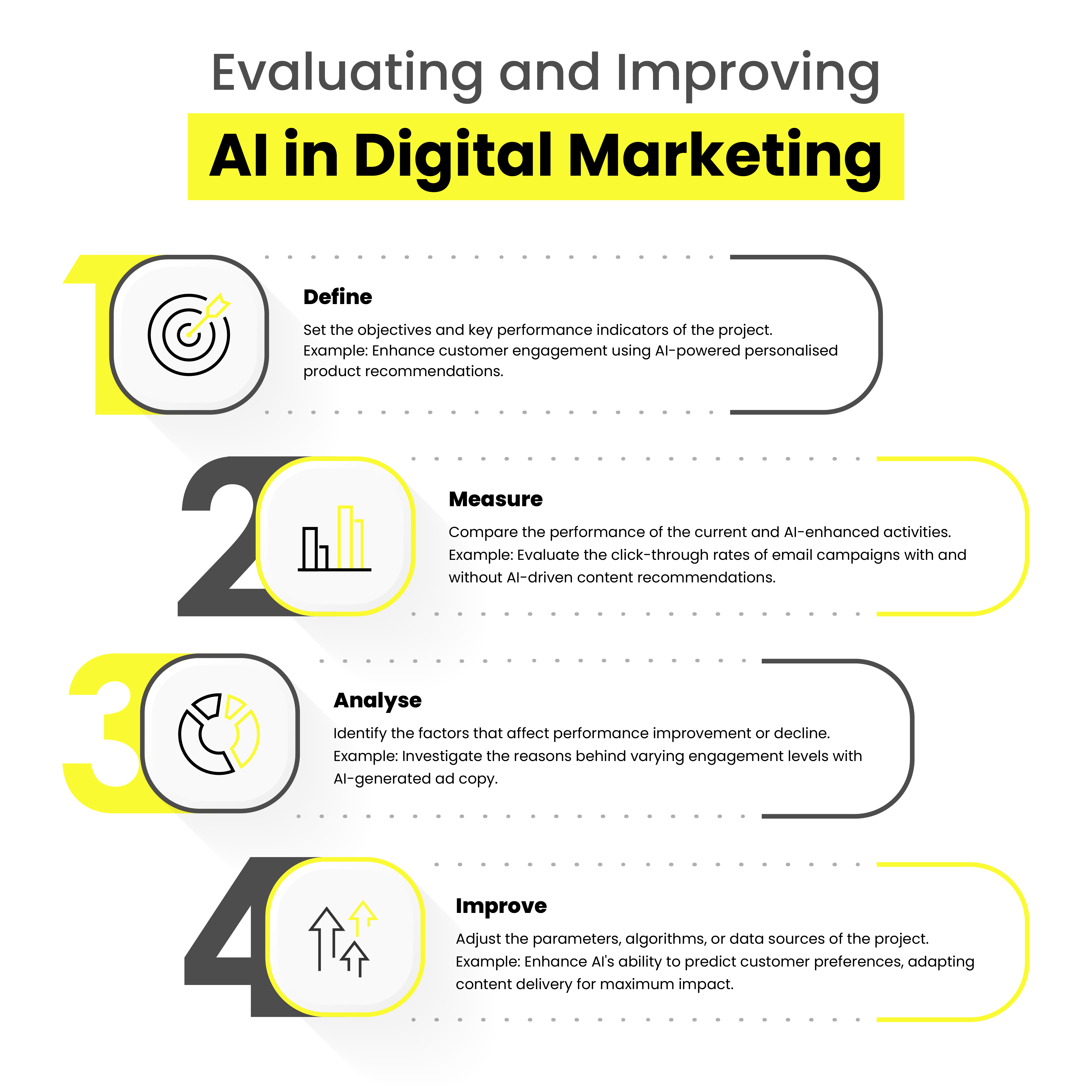
Evaluating and improving AI in digital marketing can be challenging due to the complexity and diversity of AI applications and outcomes. Therefore, marketers need to adopt an approach that can help with measuring AI’s impact on marketing performance in a systematic and holistic way. One possible way is to use a framework that consists of four steps: define, measure, analyse, and improve.

  1. Define: Defining the objectives and key performance indicators (KPIs) of the project, such as increasing conversions, revenue, or customer satisfaction. These will help to set the goals and expectations for the AI project and measure its success or failure.
  1. Measure: Measuring the baseline performance of the current marketing activities without AI, and comparing it with the performance of the AI-enhanced activities. This will help to assess the impact and value of using AI in digital marketing and identify the areas of improvement or decline.
  1. Analyse: Analysing the data and identifying the factors that contribute to the performance improvement or decline. This will help to understand the reasons and causes behind the results and find the optimal solutions or alternatives.
  1. Improve: Improving the project by adjusting the parameters, algorithms, or data sources based on the analysis. This will help to optimise the project and ensure its alignment with the objectives and KPIs.

Another possible approach is to use a framework that consists of three dimensions: efficiency, effectiveness, and experience. 

  1. The efficiency dimension: Measures how AI can reduce the time, cost, and resources required for marketing activities. 
  1. The effectiveness dimension: Measures how AI can increase the quality, accuracy, and relevance of marketing activities. 
  1. The experience dimension: Measures how AI can enhance the satisfaction, engagement, and loyalty of the customers and the marketers. 

The framework can use various metrics and methods to measure each dimension, such as surveys, interviews, experiments, etc. Marketers also need to be sensitive when navigating ethical and privacy considerations. This includes ensuring the transparency, accountability, and fairness of AI systems, respecting the data rights and preferences of customers, and complying with the relevant laws and regulations.

Real-World Examples of AI Success in Marketing

AI has been successfully applied in various aspects of marketing, such as content creation, personalisation, automation, optimization, and analytics. Here are some real-world examples of how businesses are using AI to improve their marketing efforts:

  • Netflix: AI helps Netflix tailor its content to the tastes and preferences of its users. By using AI to suggest movies and shows that users are likely to enjoy, Netflix increases customer satisfaction and loyalty, and saves a lot of money in retaining customers.
  • Starbucks: AI enables Starbucks to reward its customers with personalised offers and discounts based on their purchase history, preferences, and location. This makes customers feel valued and loyal to the brand. Starbucks also uses AI to manage its inventory and supply chain more efficiently based on customer demand and preferences.
  • Airbnb: AI allows Airbnb to create a better user experience for its hosts and guests. By using AI to provide personalised content, offers, and support, Airbnb enhances user engagement and trust. Airbnb also uses AI to protect its platform from fraud and abuse.

These are some examples of how businesses are using AI for marketing. By using AI, these businesses have improved customer engagement, driven sales, and stayed ahead of the competition.

The Future of AI in Digital Marketing: What to Expect

AI is not only changing digital marketing in the present, but also shaping its future. As AI technology advances and becomes more mainstream, it will also create new opportunities and challenges for marketers and businesses. Therefore, marketers need to prepare themselves for the future of AI in digital marketing by staying updated and informed about the latest trends and developments.

There are a number of future trends and developments of AI in digital marketing. For one, by becoming more accessible and affordable, AI will enable marketers and businesses of all sizes and sectors to leverage the power of data, analytics, automation, and personalization. Similarly, by becoming more human-like and empathetic, AI will provide customers with more relevant, engaging, and satisfying experiences across different channels and touchpoints. Next, by becoming more creative and innovative, AI will generate new and original solutions and outputs that will enhance the quality and effectiveness of marketing campaigns. 

At Home of Performance, we embrace the pulse of innovation. Our approach is rooted in staying attuned to the ever-evolving digital landscape, allowing us to strategically leverage cutting-edge advancements, including AI, when they align with our clients’ goals. This ensures our services remain on the forefront of industry trends, delivering results that reflect a keen awareness of the dynamic world we operate in.

Evolution of AI in Google Ads: Automation to Smart Campaigns

Imagine you are browsing the internet on your laptop or smartphone. You are sure to see various ads pop up on different websites and apps, and most times, those ads seem to be quite accurate to what you have been contemplating on buying. You might not realise it, but behind every ad you see, there is a complex process of targeting, creating, and optimising using artificial intelligence (AI).

Google has been at the forefront of artificial intelligence (AI) research and development for many years. One of the areas where Google has been using AI extensively is advertising. Google Ads is Google’s online advertising platform that allows advertisers to create and display ads on Google’s network of websites and apps. It operates on a pay-per-click (PPC) model, which means that advertisers only pay when someone clicks on their ads. To determine which ads to show to which users, Google uses a complex algorithm that takes into account various factors, such as keywords, bids, quality score, relevance, and more.

In this blog post, we will explore how AI has evolved in Google Ads and how it can help advertisers to create and manage their online advertising campaigns more easily and effectively. We will also look at some of the benefits and challenges of using AI in Google Ads, as well as some tips for a smooth transition to AI-driven advertising.

The Rise of Automated Bidding Strategies

Bidding is one of the most important aspects of online advertising, as it determines how much an advertiser pays for each click on their ads. Bidding also affects the visibility, relevance, and performance of the ads. To simplify and optimise the bidding process, Google Ads offers automated bidding strategies, which are a feature that allows advertisers to automatically adjust their bids based on their campaign goals and performance. Google Ads uses AI to create and optimise these bids based on various factors, such as user behaviour, context, intent, and more.

Automated bidding strategies have become more popular and prevalent in recent years, as they offer many benefits for advertisers, such as saving time and effort, improving their return on ad spend (ROAS), and reaching more potential customers. Google Ads offers different types of automated bid strategies for different goals and scenarios, such as maximise conversions, target CPA, target ROAS, enhanced CPC, and target impression share.

Understanding Smart Campaigns and Their Benefits

With the aim of rendering online advertising effortless and attainable for small businesses, Google Ads offers smart campaigns, which are a type of Google Ads campaign that are designed to simplify and optimise the advertising process. Smart campaigns use conversational AI to help advertisers create and manage their campaigns using natural language and voice commands.

Google Smart campaigns work by asking advertisers a few simple questions about their business, such as their name, location, products, services, and goals. Based on these inputs, Google uses conversational AI to generate a customised campaign plan that includes ad copy, keywords, budget, and targeting options. Advertisers can review and edit their campaign plan using voice or text commands, or by tapping on the screen.

AI-Driven Ad Extensions and Ad Formats

Ad extensions and ad formats are features of Google Ads that allow advertisers to enhance their ads with additional information, such as phone numbers, locations, ratings, reviews, images, videos, and more. They help advertisers to increase their click-through rates, conversions, and brand awareness. However, creating and optimising these features can be a difficult and tedious task, as it requires a lot of creativity, testing, and analysis.

To make ad extensions and ad formats easier and more effective, Google Ads uses AI to generate and optimise these features based on the advertiser’s goals and the user’s context. Google smart Ads uses chatbots powered by GPT-3, a state-of-the-art natural language generation model, to create catchy and creative ad copy and headlines for different ad formats and extensions. The chatbots can understand the advertiser’s input, such as their product name, description, target audience, and keywords, and generate relevant and personalised ad content based on them. The chatbots can also adapt their tone and style to match the advertiser’s brand voice and the user’s preferences.

Implementing AI for Efficient Budget Management

Incorporating AI into budget management, particularly within the context of platforms like Google Ads, holds significant promise for optimising advertising campaigns and maximising return on investment. By analysing historical data and user behaviour, AI optimises budget allocation across campaigns and keywords in real-time. This adaptability prevents overspending, maximises engagement, and refines strategies for more effective campaigns.

AI revolutionises Google Ads budget management through predictive insights. By analysing past performance and future trends, AI assists in proactive budget allocation. AI automation of tasks like bid adjustments and A/B testing further empowers marketers to focus on strategy, promising cost-effective campaigns, broader reach, and higher conversions.

AI-Powered Ad Scheduling and Targeting

AI-driven ad scheduling and targeting revolutionise digital advertising. Using AI, campaigns are optimised by analysing user behaviour, historical data, and context to display ads when they resonate most. This boosts engagement and potentially increases conversions, while AI-refined targeting ensures tailored messages for specific audiences, enhancing campaign efficiency and personalisation.

The synergy of AI-powered ad scheduling and targeting not only maximises the efficiency of ad expenditure but also fosters a more personalised and engaging advertising experience, ultimately leading to better results and a stronger return on investment.

Analysing Performance Metrics with AI Insights

As AI continues to shape the landscape of digital advertising, its role in deciphering performance metrics takes centre stage. Gone are the days of manual analysis – AI now dives into the vast pool of data, extracting meaningful patterns and correlations that may have eluded human observation.

Through sophisticated algorithms, AI scrutinises campaign performance metrics with unparalleled precision. It identifies trends, spotlights key indicators of success, and pinpoints areas of improvement. By discerning which keywords, ad copies, and targeting strategies yield the best outcomes, AI empowers advertisers to make data-driven decisions that elevate campaign efficacy. This progression from mere automation to strategic insights marks a transformative shift, as AI not only streamlines operational tasks but also equips advertisers with the intelligence to optimise strategies and achieve a higher return on ad spend.

Real-Life Success Stories with Smart Campaigns

Google Ads smart campaigns use AI to create and optimise ads for small businesses. They are designed to be simple, fast, and effective, as they automatically adjust the ads based on the performance and the goals of the advertisers. Smart campaigns can help businesses reach more customers, drive more actions, and save more time and money. Here are some real-life success stories that speak for themselves. 

  • Airbnb: Airbnb uses Smart Campaigns to create and target ads that show its diverse and safe rentals in India. This doubled its brand awareness and increased its bookings by 25%.
  • Spotify: Spotify uses Smart Campaigns to create and target ads that offer free trials and personalised playlists in Latin America. This boosted its user acquisition by 50% and its subscriptions by 30%.
  • L’Oréal: L’Oréal uses Smart Campaigns to create and target ads that promote its online store, delivery options, and customer reviews during the pandemic. This increased its sales by 40% and its repeat purchases by 20%.

Tips for a Smooth Transition to AI-Driven Advertising

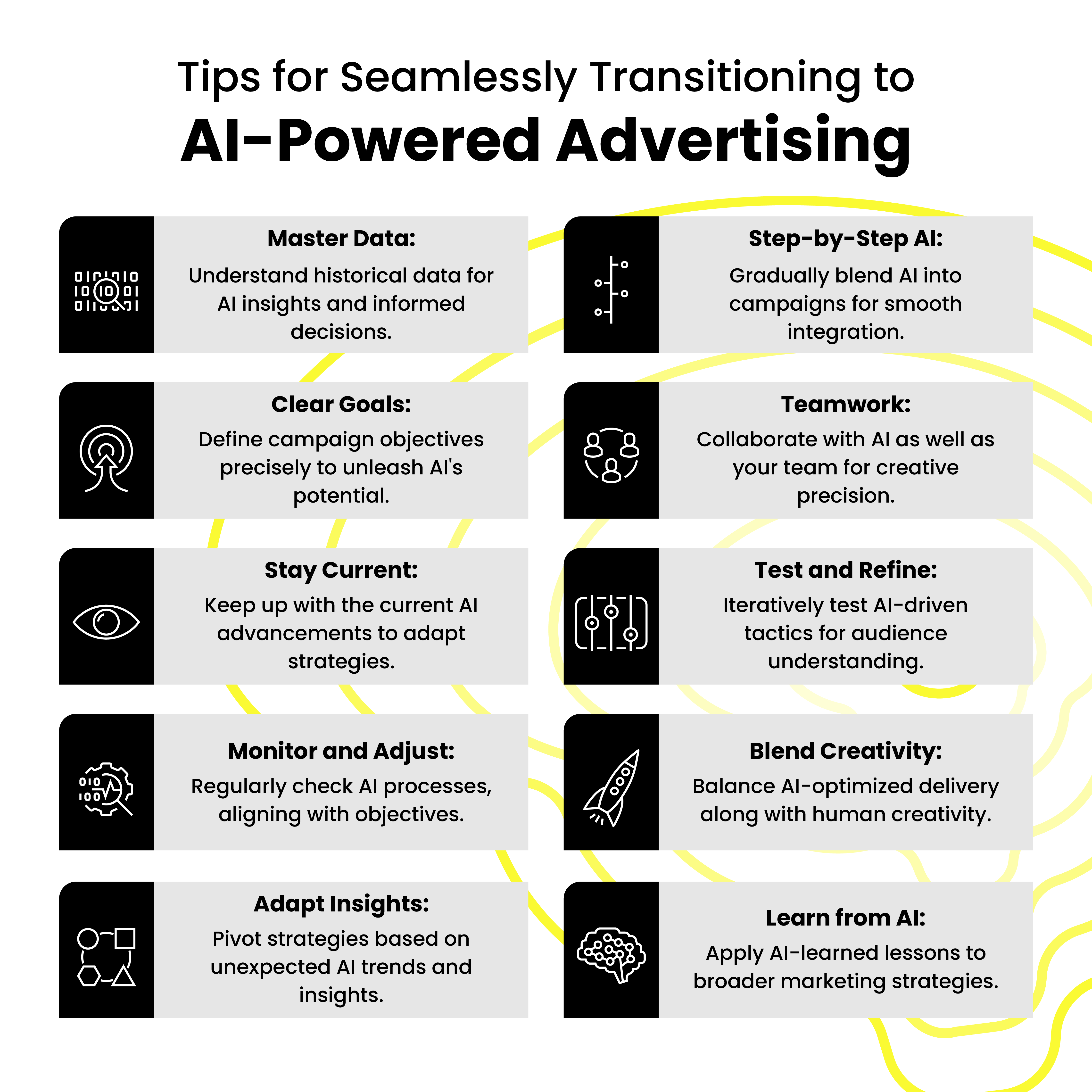
Transitioning to AI-driven advertising involves trusting and relying on AI to make decisions and suggestions for your ad campaigns, which can be difficult for some advertisers who are used to manual control and intervention. Here are some tips for a smooth transition to AI-driven advertising.

  • Data Mastery: Cultivate a deep understanding of your historical campaign data. AI thrives on insights, and by comprehending your past performance, you empower AI to make informed decisions.
  • Incremental Adoption: Embrace AI gradually. Start by integrating AI features into existing campaigns, allowing for a smoother learning curve and minimising disruption.
  • Refined Objectives: Clearly define your campaign goals. AI’s potential is maximised when it knows precisely what outcomes you’re aiming for.
  • Collaboration: Establish a collaborative environment between your marketing team and AI. This synergy leverages human creativity and AI precision for optimal results.
  • Continuous Learning: AI evolves, and so should your understanding. Stay updated with AI advancements in Google Ads to adapt and capitalise on new features.
  • Testing and Optimization: Consistently test different AI-driven strategies and analyse their performance. This iterative approach refines AI’s understanding of your target audience.
  • Monitoring and Adjustments: While AI automates many processes, regular monitoring is vital. Be ready to make adjustments to maintain alignment with your campaign objectives.
  • Creativity in Ad Design: AI can optimise delivery, but compelling ad content requires human creativity. Balance data-driven insights with captivating visuals and copy.
  • Adapting to Insights: AI insights might uncover unexpected trends. Be open to pivoting strategies based on these discoveries for maximum effectiveness.
  • Learning from AI: As AI refines its understanding of your audience, reciprocate by learning from AI’s decisions and applying those lessons to broader marketing strategies.

In conclusion, AI is a game-changer and a disruptor that can transform the online advertising industry and the digital economy. It can help advertisers create, optimise, and manage their online ads more effectively and efficiently. Advertisers who embrace AI-driven advertising can gain a competitive edge and a strategic advantage. On the other hand, those who ignore or resist AI-driven advertising can lose their relevance and market share. Therefore, advertisers need to follow best practices for using AI in Google Ads, such as setting clear goals, testing different options, monitoring results, etc.

By using AI in Google Ads, advertisers can create more engaging and effective ads that can help them to reach and attract more customers, increase their conversions and sales, and achieve their goals.

Home of Performance Welcomes EATX Onboard As New #SuccessPartner

Home of Performance is absolutely delighted to welcome its newest #SuccessPartner EATX, the pioneering culinary innovation brand. As a leading digital agency, we are passionate about driving results and helping brands flourish in the digital landscape.

EATX stands as a hospitality conglomerate committed to crafting visionary concepts that prioritize climate, culture, and community. With an unwavering resolve to emerge as the forefront restaurateurs in the UAE and establish a global presence as a homegrown hospitality pioneer, EATX is dedicated to fostering emerging talent and igniting the evolution of culinary entrepreneurship.

Under this exciting collaboration, Home of Performance will bring its expertise in digital marketing and brand enhancement to EATX’s portfolio, aiming to drive growth, engagement, and brand visibility across various digital platforms.

“We are thrilled to partner with EATX and have the opportunity to contribute to the success of their portfolio brands,” said John von Hofsten, Founder and MD of Home of Performance. “Our agency is dedicated to creating impactful digital experiences, and we believe our partnership with EATX will allow us to leverage our capabilities and insights to elevate their brands to new heights. To the amazing team at EatX, thank you for entrusting us with your brand’s growth and innovation. We’re committed to delivering high-performing campaigns that ignite engagement, drive conversions, and leave a lasting impact.”

EATX is renowned for its commitment to excellence, sustainability, and innovation, traits that align perfectly with our core values. This partnership signifies a powerful synergy between the two companies, combining Home of Performance’s digital prowess with EATX’s dynamic brand power. Together, they are poised to set new benchmarks for F&B brands in the digital marketing landscape. 

About EATX

Founded in 2013, EATX is a Dubai-based hospitality group that is driven to create concepts of the future with climate, culture, and community at the core. Determined to become the UAE’s leading restaurateurs and one of the few homegrown hospitality companies to launch internationally, EATX’s mission is to empower young talent and inspire the future of culinary entrepreneurship.

Got questions? Reach out to us

AI’s Role in SEO and Its Future Trends

AI for SEO has reached a crucial juncture, where the advanced technology employed by major corporations is becoming increasingly accessible to smaller businesses. This growing utilization of this innovative technology is permanently transforming the field of SEO as we know it today.

SEO stands for Search Engine Optimization and involves optimizing a website to improve its visibility and rankings on search engine results pages (SERPs). The goal is to increase organic traffic by making the site more relevant and valuable to search engine algorithms and users.

Furthermore, AI’s capacity to process, interpret, and retain vast amounts of data empowers you to develop a successful SEO strategy. AI for SEO aids marketers in discovering popular keywords and topics, gaining deeper insights into customer purchasing patterns and behaviors, effectively targeting markets in significantly less time and ultimately driving conversions and business growth.


Benefits of AI in SEO

By incorporating AI into your SEO strategy, you can unlock a multitude of benefits that will propel your brand to higher rankings and maintain a competitive edge. Let’s delve deeper into the top three remarkable advantages you can attain through this integration.

01. Enhanced Effectiveness, Efficiency, and Speed.

Integrating AI into your SEO strategy yields notable advantages, making your digital marketing endeavors faster, more efficient, and highly productive.

Consider the automation capabilities of AI, which eliminate time-consuming tasks and streamline your operations. By reducing the need for developer hires, you gain the flexibility to focus on strategic planning and the effective delivery of digital content. This shift translates to substantial time and cost savings for your brand.

Furthermore, AI-driven SEO provides you with accurate and up-to-date information, empowering you to enhance productivity and make well-informed business decisions. The insights unearthed through SEO in AI enable you to optimize your strategies and stay ahead of the competition.

02. Enhanced User Experience and Customer Satisfaction.

The ultimate goal of AI SEO is to deliver a user experience that is highly tailored, valuable, and personalized. AI algorithms can analyze user preferences, behavior, and intent, allowing you to personalize content, recommend relevant products or services, and improve overall user satisfaction. By tailoring your website’s experience to individual users, you can increase engagement, drive conversions, and build long-lasting customer relationships. In essence, AI aims to improve the lives of both you and your clients.

When you successfully enhance your clients’ lives by offering hyper-personalized services and products, the result is increased customer loyalty and positive word-of-mouth. By utilizing AI to create exceptional user experiences, you can cultivate a strong customer base that not only returns for more but also becomes advocates for your brand.

03. Improved Ranking and Competitive Edge

By incorporating an AI-powered SEO strategy, you can set your sights on achieving outstanding results. AI’s ability to delve into vast amounts of data enables precise keyword targeting, helping you optimize your content to rank higher in search engine results. Additionally, AI assists in identifying trending topics, enabling you to create relevant and engaging content that resonates with your target audience. Furthermore, AI can uncover insights about your competitors, allowing you to stay one step ahead. By analyzing competitor strategies, AI helps you identify gaps and opportunities in the market, enabling you to refine your SEO approach and outperform your rivals.

This targeted approach of AI in SEO further boosts your rankings by aligning your online presence with the specific search queries and preferences of your audience.


Successful Applications of AI in SEO

By harnessing the capabilities of AI, you can gain valuable insights, optimize your content, and enhance your overall SEO strategy. Read on to explore three exceptional use cases where AI-powered solutions have driven remarkable results and elevated the brand’s online presence.

01. Rocky Brand

Rocky Brand, a retailer specializing in footwear, placed a significant emphasis on developing SEO-friendly content to boost their organic search revenue. To accomplish this goal, they employed BrightEdge’s suite of tools to strategize and prioritize their SEO initiatives. These SEO AI tools encompassed:

  • Data Cube: This tool enabled Rocky Brand to identify and target specific keywords that would drive organic traffic to their website.
  • BrightEdge Recommendations: By leveraging this tool, they optimized essential content elements such as page titles and meta tags, enhancing their search engine visibility and performance.
  • Storybuilder: Rocky Brand utilized Storybuilder to track the effects of their website optimization endeavors on their brand equity and revenue, gaining valuable insights into their SEO progress.
  • Keyword and Page Reporting: This feature allowed them to monitor the performance of keywords and content on individual pages, enabling them to refine their SEO strategies based on data-driven analysis.

Implementing these SEO software solutions resulted in remarkable outcomes for Rocky Brand, including a substantial 30% increase in search revenue, a notable 74% year-over-year revenue growth, and an impressive 13% rise in new users.

02. STACK Media

STACK Media, a content delivery website catering to professional and amateur athletes, recognized the significance of web traffic for their business success. Upon integrating BrightEdge’s platform into their operations, the STACK team achieved notable outcomes:

  • Keyword Identification: Through the platform, they successfully pinpointed high search volume keywords that were relevant to the fitness category, enabling them to align their content with popular search queries.
  • SERP Visibility Analysis: Utilizing BrightEdge, STACK Media conducted an in-depth analysis of their keyword rankings on search engine results pages (SERPs), gaining valuable insights into their visibility and performance.
  • Competitive Research: The platform facilitated competitive research, allowing STACK Media to identify content themes and page URL structures that ranked prominently on SERPs. This knowledge helped them refine their own content strategies and optimize their website for improved visibility.


As a result of their partnership with BrightEdge, STACK Media witnessed a significant 61% increase in website visits, indicating a substantial growth in web traffic. Moreover, their average bounce rate per page decreased by an impressive 73%, indicating enhanced user engagement and satisfaction.

03. Fugue

Fugue, a vendor specializing in cloud infrastructure security and compliance, operates in a highly competitive landscape with numerous high-quality competitors. To enhance their visibility and rankings in cloud security searches, Fugue leveraged the SEO capabilities of the Frase.io tool.

By utilizing Frase.io, Fugue successfully identified the crucial topics that needed to be incorporated into their Cloud Security Posture Management (CSPM) page. Additionally, the tool allowed them to compare their content to the best-performing content within the same segment, ensuring they were meeting industry standards.

As a result of their efforts, Fugue experienced a significant improvement in their CSPM page ranking, rising from the 10th position to claim the coveted 1st place. This achievement reflects the effectiveness of their SEO optimization strategy implemented with the assistance of Frase.io.


Future Trends in AI and SEO

With AI’s rapid progress, the future of SEO is undergoing a revolutionary shift, reshaping the operations of search engines and the optimization practices of businesses worldwide. Read on to take a look at the potential trends in AI and SEO.

  • AI-Enhanced Search Algorithms

AI-powered algorithms in search engines like Google, such as RankBrain, improve understanding of user intent for more relevant search results. As AI advances, we can expect similar technologies to enhance search engines, leading to improved user queries and overall search experience.

  • Revolutionized Keyword Research and Content Optimization

AI automates and enhances keyword research and content optimization by understanding semantic relationships, identifying search trends, and predicting user behavior. AI-powered tools optimize content for relevance and engagement, analyze user behavior to identify top-performing content, and generate crucial on-page elements for SEO success.

  • Elevated User Experience

AI enhances user experience in SEO by analyzing user behavior, suggesting personalized content, and using chatbots for instant assistance. It improves search result accuracy, keyword research, and content optimization. Embracing AI’s capabilities helps businesses optimize their SEO strategies for enhanced online visibility and success.

  • Predictive SEO

Predictive SEO utilizes AI and machine learning to forecast trends, user behavior, and search engine algorithm updates. This allows businesses to adapt their SEO strategies proactively and stay competitive. It helps identify trending topics, create targeted content, and minimize the impact of algorithm changes on search rankings.

  • Voice Search Optimization

Voice assistants like Alexa, Siri, and Google Assistant have popularized voice search, making it crucial for SEO. To optimize for voice search, businesses must prioritize natural language processing and incorporate long-tail keywords. AI helps analyze voice queries, understand user intent, and provide insights for optimizing content and websites.

  • Visual Search Optimization

Visual search is growing rapidly with the help of AI. Platforms like Google Lens and Pinterest Lens enable users to search using images instead of text. AI-powered image recognition improves search engine understanding and indexing of visual content. To optimize visual search, businesses should optimize images with metadata and ensure easy accessibility on their website. AI aids in analyzing and optimizing images for better visibility and higher rankings in visual search results.

The future of SEO is set to be revolutionized by AI, offering businesses a more accurate, personalized, and efficient landscape. AI-powered search algorithms, improved keyword research, and content optimization are just a few of the benefits that await businesses in this evolving field. Moreover, AI advancements promise enhancements in user experience, predictive SEO, voice search optimization, and visual search optimization, transforming the way businesses optimize their online presence.

To remain competitive, businesses must embrace these changes and adapt their SEO strategies to harness the power of AI. By doing so, they can navigate the ever-evolving digital landscape and provide seamless, engaging experiences for their users. The integration of AI into SEO is becoming increasingly vital, shaping the future of search and online visibility as we forge ahead.


Got questions? Reach out to us

Affordable AI Video Generator Tools for Content Creators

Artificial Intelligence (AI) has made significant progress in generating content based on internet research. As content shifts towards infographics and video posts, there is a growing demand for AI-powered video mockups that engage audiences and convey a transformative appeal.

Content creators often struggle to cater to their audience’s visual preferences while working within tight budgets. However, the introduction of AI video editing programs has provided an affordable solution for content creators to keep up with the demands of producing engaging content. This blog will highlight 5 affordable Al video generator tools that can help content creators efficiently handle their daily video editing tasks.

What are Al video generator tools?

AI video generator tools are software applications that use artificial intelligence algorithms to transform textual content, such as blogs, into visually engaging videos by considering a wide range of variables. These tools take into account various factors to create videos that align with a specific persona or editorial calendar. With minimal human interaction, AI generator tools can construct videos, and they can also incorporate AI voices for text-to-speech functionality.

Albeit being in the introductory phase, Al video generator tools show great potential to create audience-specific content by leveraging recorded audience data. This means that the experimental phase is supported to create highly personalised video pieces because Al is, after all, the new technology which surpasses menial content-creating manpower. However, an important aspect to keep in mind is that AI has never been solely independent. It requires a thorough understanding of logistics and analytical research, which allows for the verification of video content that aligns with the pillar page or the main theme of your video campaign objectives.

AI Video Generator tools combine advanced AI algorithms with user-friendly interfaces, offering a diverse range of features to create compelling videos. Read on to dive into the five affordable AI video generator tools.

01. InVideo

As tech-savvy individuals, we often consider InVideo to be the perfect video editing tool to create videos which are economical, personalised and creative. With several aspects of professionalism in creating unique content from thousands of users’ input, InVideo provides about 50+ Al-based templates which support voice overs, text-to-speech data or plain text programmed into its web-based software. 

InVideo is not only mobile and tablet responsive but also offers data packages with reasonable pricing and even a trial run for beginners on a budget. InVideo is also highly accessible over the net.

02. Synthesia

Synthesia is one of the leading video creation tools available, as it enables collaboration by transforming 2-dimensional images into a diverse range of faces. This video generation tool not only supports voice overs but also offers a film-like experience for training and production purposes. This is often useful for on boarding new foreign employees who make use of the language voice over feature, or if you lack the lustre to allow the real cast being filmed in your video editing piece. 

Synthesia comes with fewer fallback except that you might need to learn the logistics of using the tool and could require a more flexible payment plan

03. Pictory

Pictory allows you to envision transforming long-form video content into bite-sized portions that can be easily stored, re-captioned, and repurposed for future use with minimal modifications and expenses. Pictory offers the opportunity to upsell raw advertising materials or components, such as a pillar page with sub-domains, or a video that effectively summarises the primary purpose for audience engagement. Instead of repurposing the end result from current video material, you can add a unique selling point (USP) flair that Pictory achieves in many sales briefings.

And much like Al functions, Pictory has a very intuitive algorithm and improves its functioning over time such as retrieving key snippets which speak directly to an advertising conflict. Pictory is known to be user-friendly as well and is inclusive of the whole asset package in terms of cost.

04.Veed.io

For small enterprises and businesses looking to create a cohesive brand theme within a limited digital scope, Veed.io offers the best editing experience with a cost-effective monthly plan. While dissecting videos is a common phase for many video editors, the in-house Veed.io experts provide a step-by-step personalised experience which delivers high-quality video rendering in a matter of minutes. 

The one-off clicking mechanisms within the video editing dashboard also upgrade the video editing experience and are easily readable for novice users who have not dabbled with videography and prefer a simplified editing process without extensive collaboration

05.Lumen5

From text to video, Lumen5 covers it all. The drag-and-drop interface is easy to use and is just a snippet adjoined to a template scheme which has one of the closest resemblances to virtual reality and 3-dimensional characteristics. What makes Lumen5 stand out is its ability to concoct a miniature video frame that truly has facets to the overall social architecture of the brand you are trying to sell, and can relate to your market audience with the videography.

In conclusion, AI video generator tools offer substantial returns on investment, considering that AI has become indispensable in the digital landscape. While Al progresses it’s identifiers and performance in presenting video data, with time Al video editing tools will be a major agenda in content calendars concurrently. 

With the global milestones quickly shifting with new cosmopolitan avenues, people will vouch for freedom of expression in the way they reside, shop and work. AI video generators are capturing the holistic wavelength of brand voice which is modified by human interaction, unmistakably meaning that Al will be present for content creators in days to come. 

Furthermore, AI video editing has gained relevance by addressing data touch points that may have been misinterpreted or overlooked during the conversion to visual searches. This unlocks a new paradigm for the brand voice that AI video editing taps into.


Got questions? Reach out to us

5 Best FREE AI Marketing Tools to Help you with Digital Marketing

The advent of AI software has brought a profound transformation to the field of marketing. Numerous businesses, regardless of their size, are increasingly dependent on AI based marketing tools to promote their brands and enhance their marketing strategies. These tools have become essential components of business plans for both individuals and organizations, offering the potential to elevate marketing efforts to new heights.

AI marketing tools encompass software and platforms that leverage data collection and analysis to generate automated decisions. They excel in predicting consumer behavior, often without requiring human intervention. By efficiently processing vast amounts of information from diverse sources like social media and email, AI augments the pivotal role of data in marketing. Moreover, these digital marketing AI tools enable organizations to allocate resources wisely by reducing the need for dedicated staff in such tasks, freeing up valuable time and capital to be utilized in other critical areas of the business.

AI marketing tools have the capability to personalize sales and marketing strategies, enhancing their effectiveness and relevance. Leveraging predictive analytics, these tools delve into profound insights regarding consumer purchasing patterns. Similar to how Google and Netflix excel at providing personalized recommendations, AI marketing tools enable businesses to tailor their approaches to individual customers, enhancing engagement and conversion rates.

Considering the abundance of impressive options available, it is worth exploring the five most notable AI marketing tools in the market that you can leverage for your Digital Marketing.

01.ChatGPT

ChatGPT, developed by OpenAI, is a versatile language model designed for various language-related tasks such as text generation, answering frequently asked questions (FAQs), and facilitating conversations. With its advanced natural language processing capabilities, ChatGPT has gained significant attention in the industry.

Features & Benefits of ChatGPT:

  • Natural Language Processing: ChatGPT exhibits highly advanced natural language processing skills, outperforming many other similar tools in the market.
  • Versatility: It can be used for content creation as well as customer service, offering flexibility in its applications.
  • Time-Saving: By automating language-related tasks, ChatGPT can help save time and streamline workflows.

Example of Uses:

  • ChatGPT excels in content creation by generating initial drafts for articles, blog posts, and social media content. It can also assist in customer service by providing real-time, accurate responses to common inquiries.


02. Beacons

Beacons is a platform specifically designed for content creators, offering a centralized solution to streamline their business operations. While known for its impressive link-in-bio functionality, Beacons goes beyond being just a link-in-bio app. It also includes an AI Brand Outreach app that leverages artificial intelligence for email marketing purposes.

Features & Benefits of Beacons:

  • Link-in-Bio Functionality: Beacons provides content creators with a single platform to showcase their offerings and relevant links, making it easy for their audience to access desired content or products.
  • AI Brand Outreach: The AI Brand Outreach app within Beacons enables creators to leverage AI for email marketing. It automates the creation of personalized emails by combining recipient information and user-specific details, resulting in professional emails tailored to the right tone and pitch.
  • Personalized Emails: With Beacons’ AI-driven email marketing, content creators can send personalized emails that have a higher likelihood of converting, enhancing their engagement and conversion rates.
  • Custom Domain and Digital Storefront: Beacons offers features such as custom domains and digital storefronts, allowing creators to have their own branded online presence and sell products or accept donations.
  • Analytics and Integration: The tool provides advanced analytics to track performance and integrates with marketing tools, email/SMS platforms via Zapier, and other marketing integrations to streamline workflows.

Beacons’ Example of Uses:

  • Beacons consolidate important links in one place for easy audience navigation. With AI-powered email marketing, creators can automate personalized campaigns.


03.Google Bard

Google Bard is an AI-powered conversational bot developed by Google. It is based on the Large language model (LLM) called LaMDA (Language Model for Dialogue Applications) and aims to provide natural language queries and comprehensive search results. Bard can generate human-like text and images, respond to prompts and queries, and create stories and summaries on various topics. It can be integrated into third-party platforms such as websites, applications, and messaging platforms.

Features & Benefits of Google Bard:

  • Cutting-Edge Model: Google Bard is built on the PaLM2 model, which offers advanced multilingual abilities (over 100 languages) and reasoning skills.
  • Conversational Responses: Bard provides human-like responses to prompts and queries, enhancing the conversational experience.
  • Generative Potentials: Bard can generate text in different formats and styles, including news articles, letters, blog posts, and code in various programming languages.
  • Real-time Information and Internet Access: Bard extracts information from the web using Google search, providing up-to-date and relevant responses to prompts.
  • Extensions Through Plugins: Users can extend Bard’s functionality through plugins, enabling integration with various apps and sites.
  • Voice Command Compatibility: Bard supports voice commands, allowing users to interact with the tool using voice input.

Example of Uses:

  • Google Bard helps content creators generate articles and blog posts, aids in real-time information retrieval, enables multilingual communication, and offers integration with third-party platforms for conversational interactions, recommendations, and image generation.


04.Chatsonic

Chatsonic is an advanced AI-powered conversational chatbot that offers superpowers beyond ChatGPT. It is built on the latest GPT-4 model and utilizes Natural Language Processing (NLP) and Machine Learning (ML) technology to automate text and image generation. With its wide range of capabilities, Chatsonic is designed to provide quick and accurate results, making it an exceptional tool for content creation and customer service operations.

Features & Benefits of Chatsonic:

  • Quick and Accurate Results: With integrated Google search, Chatsonic delivers relevant and up-to-date information promptly, saving time and effort.
  • Customizable and Easy-to-Use: Users can easily customize their requests and preferences, such as personality types and memory settings, without requiring technical expertise.
  • High-Quality Content: Chatsonic produces original and detailed content, free of plagiarism, with the ability to detect and correct grammar or spelling errors.
  • Automation Capabilities: Chatsonic streamlines workflows by automating text and image generation tasks, saving time and energy.

Example of Uses:

  • Chatsonic is well-suited for customer service operations. It also assists in content creation, research efficiency by retrieving accurate information from multiple sources and streamlining workflows.

05. Jasper AI

Jasper AI is an advanced and versatile artificial intelligence tool designed to assist individuals and businesses across various domains. Developed using machine learning and natural language processing technologies, Jasper AI is geared towards enhancing productivity, decision-making processes, and overall efficiency. The tool is designed to analyze and process complex data sets, generate insights, provide recommendations, and automate tasks, all while offering a user-friendly interface for seamless interaction.

Features & Benefits of Jasper AI:

  • Advanced Data Analysis: Jasper AI excels in analyzing large and intricate datasets, uncovering patterns, trends, and correlations that might be challenging for human analysts to identify.
  • Real-time Insights: The tool can provide real-time insights into ongoing processes, allowing users to make informed decisions promptly.
  • Personalized Recommendations: Jasper AI can offer tailored recommendations based on historical data, user preferences, and current trends, assisting businesses in optimizing their strategies.
  • Automation of Repetitive Tasks: The tool can automate routine and repetitive tasks, freeing up human resources for more creative and strategic endeavors.
  • Natural Language Interaction: Jasper AI employs natural language processing, enabling users to communicate with the tool through natural language queries and commands, making it accessible to non-technical users.
  • Scalability: The tool’s architecture is designed to handle scalability, making it suitable for both small businesses and large enterprises.
  • Risk Management: Jasper AI can assist in identifying potential risks by analyzing historical data and recognizing patterns that might indicate impending issues.


Tips & Choosing the Best AI Tool

Choosing the best free AI marketing tool can bring numerous benefits to your business. Here are a few tips to go about this:

  • Define Your Needs: Determine your specific requirements and goals before selecting an AI tool. Identify tasks for automation or improvement, like content creation, data analysis, customer support, or marketing.
  • Research and Compare: Conduct thorough research on available AI tools in the market. Compare features and customer reviews to find reputable AI tools for digital marketing that align with your needs.
  • Ease of Use and User Interface: Evaluate the user interface and ease of use of the AI tool. Look for a user-friendly interface with intuitive navigation to enhance productivity.
  • Training and Support: Assess the training and support provided by the AI tool vendor. Check for tutorials, documentation, and reliable customer support to maximize the tool’s potential.
  • Reviews and Recommendations: Seek feedback from trusted sources like industry experts or colleagues who have used similar AI tools. Consider their experiences and recommendations to make an informed decision.


Conclusion

The availability of free AI marketing tools has opened up incredible opportunities for digital marketers. These tools offer a wide range of benefits, from automating tasks to improving decision-making and enhancing customer experiences. The power of AI is no longer limited to large companies with substantial budgets. Even the smallest startups can now leverage these free AI tools to compete on a global stage and achieve remarkable success.

As we continue to embrace the AI technology revolution, let us appreciate the immense value these free AI marketing tools bring to the world of digital marketing. They empower marketers to reach new heights, unlock untapped potential, and transform the way we connect with our audiences. Embrace the power of AI in digital marketing, explore the capabilities of these tools, and embark on a journey of innovation and growth.  

The future is bright, and with these free AI marketing tools at our disposal, we have the power to reshape the marketing landscape and achieve remarkable results.


Got questions? Reach out to us

Meta’s New Twitter Rival Threads: Everything You Need To Know


Mark Zuckerberg’s company Meta, formerly known as Facebook, recently unveiled the first iteration of Threads, a text-sharing application developed by Instagram’s team. Threads provides a distinct platform for instantaneous updates and public discussions, catering to both content creators and occasional users. Efforts are underway to ensure that Threads is compatible with the open and interoperable social networks that have the potential to define the internet’s future. 

Threads bears some resemblance to Twitter, but with a few twists. The launch of Threads comes at a time when Twitter is undergoing major changes, as it was recently acquired by Elon Musk, the billionaire entrepreneur and founder of Tesla and SpaceX. It aims to differentiate itself from Twitter by focusing on close friends and integrating with Instagram, Meta’s popular photo-sharing app. In this blog post, we will explore the features, audience, and impact of Threads, and what it means for the future of social media.

What Is Threads Exactly?

Instagram serves as a platform for billions of individuals worldwide to share and connect through visual media. With Threads, Meta aims to extend Instagram’s strengths to encompass text-based communication, fostering an encouraging and imaginative environment for the expression of thoughts.

As a microblogging app, Threads allows users to share short posts, photos, videos, and stories with their close friends. Users can create a list of close friends from their Instagram contacts, and only those people will see their Threads content. Users can also reply to their friends’ posts with emojis, stickers, or text messages. Threads also has a camera feature that lets users capture and share moments from their day with their close friends. Users can customize their camera with different lenses, filters, and effects.

Threads also have some unique features that distinguish it from other social media apps, such as the ability for users to set a status or mood that will change automatically depending on their location, movement, or battery level. Some early reviews of the app have praised its user interface, design, and functionality, as well as its potential to foster more meaningful interactions among users.

Who Is The Target Audience?

Threads is designed for people who want to have more intimate and authentic conversations with their close friends, without the pressure of public scrutiny or the noise of irrelevant content. It is also meant to appeal to younger users who are more comfortable with visual communication and ephemeral content.

Threads could attract users who are looking for a more private and personal alternative to Twitter, or who want to complement their Instagram experience with a more focused and curated feed. However, some users may find it hard to switch from Twitter to Threads, especially if they have a large following or enjoy engaging with a wider audience such as on Twitter. Some users may also prefer Twitter’s features such as hashtags, search, and trending topics, which Threads does not offer yet. Threads faces stiff competition from Twitter, which has a loyal fan base and a strong brand identity.

A Gateway to The Metaverse

Threads is a strategic move by Meta to counter the influence of Elon Musk, who has become a powerful figure in the tech industry and a vocal critic of Meta. By launching Threads, Meta is signaling its ambition to remain relevant and dominant in the social media space, while also exploring new possibilities for the future of online communication. Threads could be seen as a gateway to the metaverse, as it allows users to create and share their own digital worlds and experiences with their close friends, using Meta’s technologies such as virtual reality, augmented reality, and artificial intelligence.

Threads could also enable users to access and interact with other metaverse platforms and services, such as gaming, education, entertainment, and commerce, through Meta’s integration and interoperability efforts. The launch of Threads could spark a new wave of innovation and experimentation in the social media space, as other players try to keep up with Meta’s vision and ambition. The launch of Threads could also raise new questions and challenges about the role and responsibility of social media platforms in shaping public discourse and opinion.

Threads And the Social Media Landscape

Threads could have a significant impact on the social media landscape, as it challenges Twitter’s dominance in the microblogging space and expands Meta’s reach in the social networking market. Threads could be seen as a direct competitor or a potential partner for Twitter, depending on how the two platforms evolve and interact. Threads could offer Twitter users a more intimate and integrated experience, or it could lure them away from Twitter altogether. Alternatively, Threads and Twitter could collaborate or coexist peacefully, as they cater to different needs and preferences of users. The launch of Threads could also prompt Twitter to innovate and improve its own features and services, in order to retain its user base and market share.

However, Threads could also face some challenges, such as competing with other Meta-owned apps like WhatsApp and Messenger or dealing with privacy and security issues that have plagued Meta in the past. Threads will have to prove its value and uniqueness to users who are already using multiple social media apps and convince them to switch or add Threads to their daily routine. Threads will also have to address any concerns or criticisms that users may have about Meta’s policies or practices, especially regarding data collection and user safety.

One notable concern for users is that Threads, being powered by Instagram, currently requires users to delete their entire Instagram account in order to remove their Threads profile and data. However, Meta is actively exploring options to allow users to delete their Threads profile separately, addressing the need for more granular control over account deletion.

In conclusion

Threads is a new social media app that aims to provide a more intimate and personal microblogging experience for users who want to share their thoughts with their close friends. Threads has some similarities with Twitter, but also some differences that make it unique and appealing. Threads could have a big impact on the social media scene, as it challenges Twitter’s position and offers a new way of online communication. However, Threads also faces some challenges and risks, as it deals with Meta’s reputation and privacy issues. Threads is an interesting and ambitious app that shows Meta’s vision for the future of social media and the metaverse. Threads has a lot of potential to grow and succeed, but it will also have to overcome some obstacles and prove its worth to users. Like most, we are curious to see how Threads will evolve and interact with other platforms, and how users will respond to it.

Got questions? Reach out to us

How To Setup Google Analytics 4 (GA 4) – A Detailed Guide

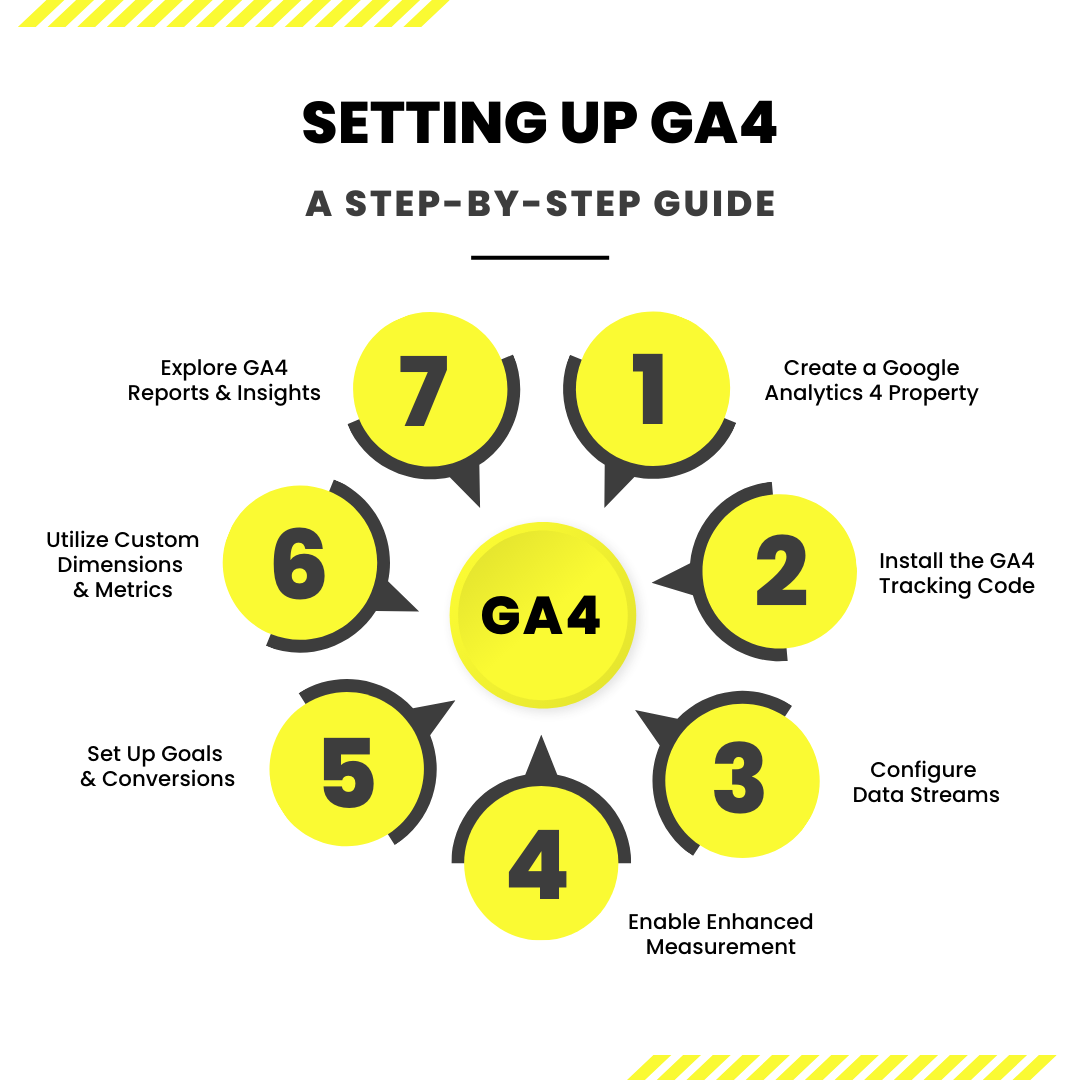
Easy Step-by-Step Guide on Setting up GA4: A Detailed Guide 

In the realm of digital marketing, understanding user behavior and tracking website performance is crucial for success. Google Analytics 4 (GA4) has emerged as a powerful tool for gathering insightful data and unlocking valuable information about your website visitors. In this step-by-step guide, we will walk you through the process of setting up GA4, empowering you to harness the full potential of this advanced analytics solution.

Step 1: Create a Google Analytics 4 Property

To begin, navigate to the Google Analytics website and log in with your Google account. Next, create a new property by clicking on the “Admin” tab and selecting “Create Property” under the “Property” column. Follow the prompts, providing relevant information such as property name, URL, and time zone.

Step 2: Install the GA4 Tracking Code

After creating the property, you will be provided with a Measurement ID. Copy this ID and paste it into the header section of your website’s HTML code. This allows GA4 to start collecting data from your website.

Step 3: Configure Data Streams

In GA4, data streams represent the various sources of data you want to track. To configure data streams, click on the “Data Streams” option under the “Property” column in the Admin tab. Add a new data stream for your website by providing the appropriate information, such as the data stream name and URL.

Step 4: Enable Enhanced Measurement

GA4 offers enhanced measurement capabilities, allowing you to automatically track events without manual implementation. To enable enhanced measurement, go to the “Data Streams” section, click on your website’s data stream, and toggle on the desired events you wish to track, such as page views, scrolls, outbound clicks, and more.

Step 5: Set Up Goals and Conversions

Define your goals and conversions to measure specific actions taken by your website visitors. In the “Property” column, click on “Conversions” and then “Goals.” Follow the prompts to create a new goal, specifying the desired action, such as form submissions, purchases, or newsletter sign-ups. GA4 provides various goal types and templates to choose from, making the process intuitive and flexible.

Step 6: Utilize Custom Dimensions and Metrics

Custom dimensions and metrics allow you to gather additional data tailored to your specific business needs. By defining custom parameters, you can capture valuable insights beyond the default tracking capabilities. In the “Property” column, click on “Custom Definitions” and explore the options to create custom dimensions and metrics that align with your unique requirements.

Step 7: Explore GA4 Reports and Insights

Once your GA4 setup is complete and data starts flowing in, you can access the Reports section to gain valuable insights into user behavior, audience demographics, acquisition channels, and more. GA4 offers a wide range of reports and visualization tools to help you understand the performance of your website and make data-driven decisions.

Setting up GA4 for your website is an essential step in unlocking the power of advanced analytics and gaining deeper insights into your audience. By following this easy step-by-step guide, you have equipped yourself with the knowledge to configure GA4, track relevant data, and utilize its powerful features to drive growth and make informed marketing decisions. Embrace the possibilities of GA4 and leverage its capabilities to propel your digital marketing efforts to new heights.

Got questions? Reach out to us

6 REASONS WHY YOU NEED TO UPGRADE TO GA4

In today’s digital age, data is the key to unlocking insights and making strategic business decisions. Google Analytics (GA) has long been a powerful tool for understanding website and app performance, however in 2020 Google launched its latest analytics tool, Google Analytics 4 (GA4), which was arguably the biggest update of the platform. Now after 3 years of GA 4 being around as an option alongside the default tool, Universal Analytics or GA3, Google is solidifying the status of the latest release by completely taking off Universal Analytics from its platform.

What is GA4?

Google Analytics is a free service that allows you to track any traffic and engagement that happens across your website and apps. GA4, or Google Analytics 4, is the latest version of the Google Analytics platform. It represents a significant upgrade and a shift from the previous version known as Universal Analytics. GA4 introduces several new features and capabilities designed to provide businesses with more comprehensive and insightful data analysis.

GA4 being a very advanced tool, introduces several new features and capabilities designed to provide businesses with more comprehensive and insightful data analysis.

When is it happening?

On 1st July 2023, all standard Universal Analytics properties will stop processing new data. This means that from July 2023, no website activity will be recorded through Universal Analytics. 

Furthermore, Google announced that existing Universal Analytics properties would only be able to be accessed for around 6 months after this date. This means that all historical data could be gone forever.

Why your business needs GA4?

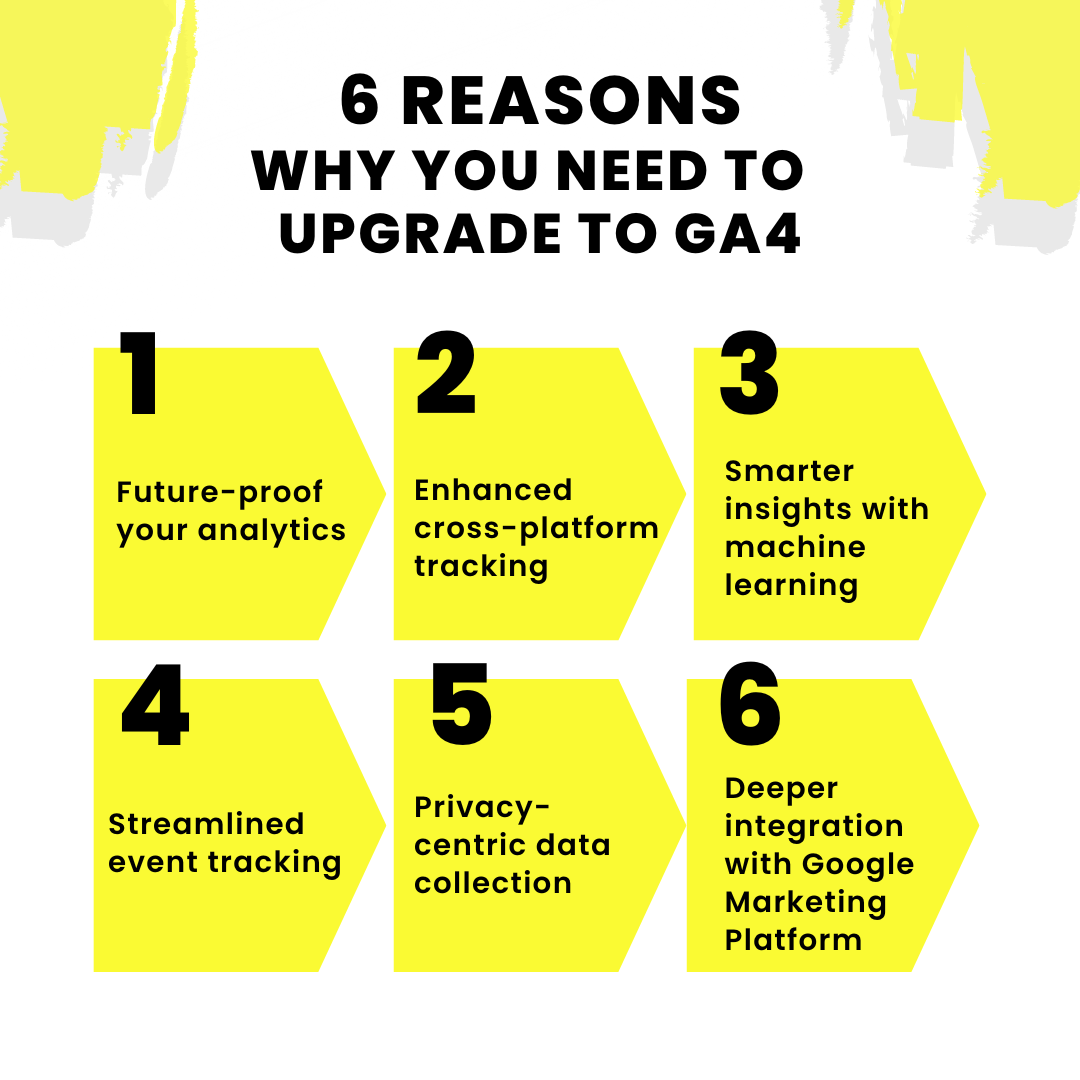
  1. Future-proof your analytics

GA 4 Analytics represents the future of Google Analytics. It is designed to adapt to the evolving digital landscape, including emerging technologies and privacy changes. By upgrading now, you ensure that your business remains at the forefront of analytics, ready to leverage new features and capabilities as they are introduced.

  1. Enhanced cross-platform tracking

One of the major advantages of GA 4 Analytics is its ability to track user interactions across multiple platforms, including websites, mobile apps, and offline touchpoints. This holistic view provides valuable insights into user behavior and engagement, allowing you to optimize your marketing efforts and improve the overall customer experience.

  1. Smarter insights with machine learning

GA 4 Analytics incorporates advanced machine learning capabilities that can automatically uncover meaningful trends and insights from your data. With the power of machine learning, you can identify hidden patterns, predict user behavior, and discover growth opportunities. These smart insights enable you to make data-driven decisions that drive results and improve your bottom line.

  1. Streamlined event tracking

Event tracking is a crucial aspect of understanding user interactions on your digital properties. GA 4 Analytics simplifies event tracking by introducing a more flexible and streamlined approach. The model uses an event-driven data model, allowing you to define and track events based on your specific business needs. This flexibility gives you granular control over the events you want to measure, ensuring you capture the most relevant data for analysis.

  1. Privacy-centric data collection

Privacy concerns are becoming increasingly important for businesses and users alike. GA 4 Analytics addresses these concerns by providing privacy-centric data collection methods. It aligns with emerging privacy regulations, such as the General Data Protection Regulation (GDPR), by providing more options for data control and consent management. By upgrading to GA 4 Analytics, you can ensure that your data collection practices are compliant with privacy regulations, enhancing trust with your customers.

  1. Deeper integration with Google Marketing Platform

For businesses already leveraging Google Marketing Platform (GMP), upgrading to GA 4 Analytics brings additional benefits. GA 4 Analytics seamlessly integrates with GMP, allowing you to combine data from various sources for a unified view of your marketing efforts. This integration empowers you to gain deeper insights into campaign performance, optimize your marketing spend, and deliver more personalized experiences to your target audience.

The transition to GA 4 Analytics is a proactive step for businesses looking to stay ahead in the world of data analytics. The key thing to remember is that you have time to get everything configured and familiarize yourself with the platform. But there is a defined deadline, so the sooner you act the better.
Don’t wait; make the move to GA 4 Analytics and unlock the full potential of your data-driven decision-making process.

Got questions? Reach out to us

Home of Performance Shines at Seamless Middle East 2023-The Future of Digital Commerce

The digital landscape is evolving at an unprecedented pace, and businesses across industries are compelled to adapt and embrace innovative solutions to stay competitive. Seamless Middle East 2023 which took place on the 23rd-24th May at the Dubai World Trade Centre, was a seminal event that brought together industry leaders, experts, and technology enthusiasts. In its 24th year, Seamless has been a meeting place for the brightest and most innovative minds across the payments, fintech, identity, banking, retail, e-commerce, home delivery, and digital marketing industries. It is renowned as one of the largest marketing events in the region and rightly so. This year it garnered over 30,000 attendees, 800+ exhibitors, and over 800 speakers over the course of two days.

We at Home of Performance proudly registered a remarkable presence at the event through our participation as an exhibitor and conference speakers.  Our experience of meeting so many enthusiastic visitors who came to meet us at our stand and presenting our range of innovative digital marketing solutions to them has been very rewarding. 

Let’s delve into our experience and the remarkable insights gained during this innovative dynamic gathering.

Embracing the Future of Digital Commerce

At Seamless Middle East 2023, the theme of “The Future of Digital Commerce” resonated with the Home of Performance team. We understand that the digital landscape is not just transforming businesses; it is also redefining customer experiences and expectations. By participating in this event, we aimed to showcase our expertise in leveraging digital marketing strategies and technologies to empower businesses in this evolving environment.

A Thriving Exhibition Stand

Our exhibition stand at the event served as a vibrant hub for engaging discussions and knowledge sharing. With eye-catching visuals and interactive displays, we captivated the attention of the visitors, enticing them to explore the services and solutions we provide. From search engine optimization, performance, and app marketing to social media management and creative content production, we highlighted our comprehensive suite of digital marketing offerings that are tailored to meet the diverse needs of businesses in the digital era.

Moderating a discussion panel on ‘Empowering Marketers with AI: Making Content Curation Smarter and More Efficient With Machines’

Our Strategy Director, Warren LaRey was a speaker and moderator for the Seamless Middle East Conference, where he moderated a discussion panel on the topic – Making Content Curation Smarter and More Efficient With Machines. He was joined by Antonio Ricciardi, SVP Consumer Intelligence & Engagement, Etisalat UAE By E&, Marwa Hassan, Head Of Marketing, Global Food Industries/ International Beverage and Filling Industries, and Ahmed El Gamal, Senior Director Of Marketing, Jumeirah Hotels & Resorts. It was a very insightful session attended by a packed hall and followed by a highly interactive audience interaction.

Engaging with Visitors

Seamless Middle East 2023 provided an excellent platform for us to connect with professionals from various industries and exchange insights on the future of digital commerce. We engaged in thought-provoking conversations with entrepreneurs, marketers, and technology enthusiasts, learning from their experiences and sharing our expertise. These interactions fostered valuable connections, opening doors to potential partnerships and collaborations.

Unveiling Innovative Solutions

Our participation in the event allowed us to showcase our latest innovative services that align with the future of digital commerce. We talked about our focus on employing data science to craft ROI-driven business marketing strategies for our clients. Additionally, we demonstrated the power of personalized marketing campaigns, leveraging data-driven insights and dynamic tracking and reporting to create tailored experiences for customers. By presenting these solutions, we aimed to inspire businesses to embrace the digital revolution and harness its potential for growth.

Key Insights and Takeaways

Seamless Middle East 2023 provided a rich environment for learning and gaining valuable insights into how the region is adapting to the advents of business automation and digital marketing. We observed a significant shift towards mobile commerce, with an increasing emphasis on frictionless, secure payment solutions. This directly ties in with our agile App marketing projects. Artificial intelligence and machine learning emerged as transformative technologies, enabling businesses to automate processes, analyze vast amounts of data, and deliver personalized customer experiences at scale. Furthermore, the importance of data privacy and security was highlighted, with businesses urged to prioritize the protection of customer information.

Looking Ahead

Participating in Seamless Middle East 2023 was an invigorating experience for us. It was an incredible platform for Home of Performance to showcase our digital marketing prowess and engage with industry leaders in exploring the future of digital commerce. We return from the event with valuable knowledge, new connections, and a reinforced commitment to empowering businesses in the digital era. Digital Marketing holds immense potential, now more than ever, and we are excited to continue partnering with organizations, leveraging our expertise to drive growth, innovation, and exceptional customer experiences. As we look ahead, we remain committed to empowering businesses, leveraging the transformative power of digital marketing to navigate the evolving landscape and embrace the opportunities that lie ahead.

We look forward to participating in the upcoming Seamless Saudi Arabia that is happening in Riyadh from the 4th-5th September 2023.

Got questions? Reach out to us